
Blog
18k Gold vs. 14k Gold: Choosing the Perfect Metal for Your Ring
Choosing the perfect gold ring is a deeply personal journey, a celebration of a moment or a milestone. Yet, when faced with terms like ‘karat’ and ‘alloy,’ the beautiful decision can suddenly feel technical and confusing. You might find yourself wondering: Will it scratch easily? Is the richer color of 18k gold worth the higher price in shekels? And what’s the real difference in the debate of 18k gold vs 14k gold for rings when it comes to everyday wear or sensitive skin?
At KaMila, we believe this choice should be empowering, not intimidating. Your jewelry is an extension of you-a personal talisman designed to make every day feel special. This guide is designed to demystify the world of gold, exploring the key differences in durability, color, and value. We’re here to help you confidently select the perfect metal that not only captures your heart but also complements your story and lifestyle for years to come.
Key Takeaways
- Understand that the ‘karat’ number on your ring directly influences its color, durability, and how it feels to wear every day.
- Discover why 18k gold is prized for its rich, vibrant yellow hue, offering a touch of pure luxury for those who adore a classic, warm glow.
- In the debate of 18k gold vs 14k gold for rings, learn why 14k gold’s superior durability makes it an ideal choice for an active lifestyle.
- Move beyond the technical details to choose the gold that best reflects your personal story, whether you value enduring strength or luminous purity.
The Language of Gold: What Does ‘Karat’ Truly Mean for Your Ring?
Every piece of fine jewelry begins with a story, and its first chapter is written in the metal itself. While we often think of gold in its purest form, the radiant 24-karat (24k) gold is surprisingly soft-too delicate to withstand the beautiful journey of daily life. To create a ring that is both a timeless treasure and a durable companion, pure gold is blended with other metals in a process of modern artistry.
This blend is where the term ‘karat’ comes into play. The karat system is a simple and elegant way to measure gold purity, based on a total of 24 parts. To understand what ‘karat’ means for gold, you can imagine any gold piece as a whole divided into 24 equal units. The karat number tells you how many of those units are pure gold. This precise measurement is the foundation of the 18k gold vs 14k gold for rings discussion, as it defines the very character of your chosen piece.
Understanding Purity: 24k, 18k, and 14k
The purity of gold directly influences its color, feel, and resilience. Each karat level offers a unique balance of these qualities, allowing you to choose a ring that perfectly reflects your story and lifestyle.
- 24k Gold (100% Pure Gold): The benchmark of purity, 24k gold is 24 out of 24 parts pure gold. It has a rich, deep yellow hue but is too malleable for crafting durable jewelry meant for everyday wear.
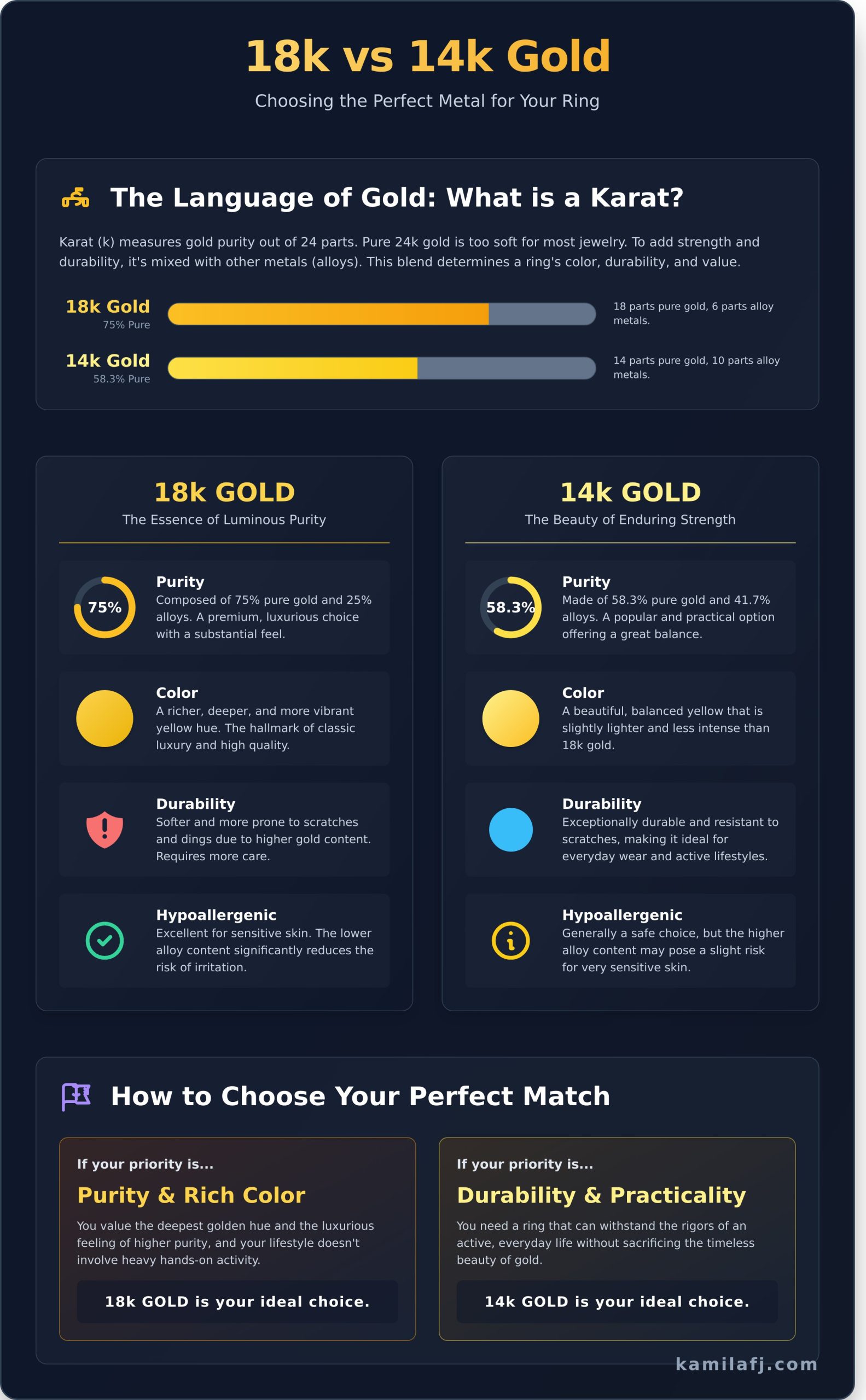
- 18k Gold (75% Pure Gold): A premium and luxurious choice, 18k gold consists of 18 parts pure gold and 6 parts alloy metals. This blend offers a beautiful, rich color that is very close to pure gold, with the added strength needed for a lifetime of memories.
- 14k Gold (58.3% Pure Gold): A highly popular and practical option, 14k gold is made of 14 parts pure gold and 10 parts alloys. It provides exceptional durability, making it an ideal choice for engagement rings and everyday pieces.
The Role of Metal Alloys
The metals mixed with pure gold are called alloys, and they are the unsung heroes of fine jewelry. Common alloys include metals like copper, silver, zinc, and palladium. Their primary role is to lend strength and hardness to the naturally soft gold, transforming it into a resilient material ready to be handcrafted into a meaningful talisman.
Beyond durability, these alloys are also the artist’s palette. By carefully adjusting the type and proportion of alloys, jewelers can create the warm, romantic blush of rose gold (by adding more copper) or the cool, modern elegance of white gold (by adding white metals like palladium or zinc). They are essential to the craft, ensuring your ring is not just beautiful, but a lasting symbol of celebration.
18k Gold: The Essence of Luminous Purity
Step into the world of 18k gold, and you’ll discover a metal that radiates a unique warmth and luxury. Composed of 75% pure gold and 25% strengthening alloys, 18k gold is the standard for fine jewelry across much of the world, celebrated for its substantial feel and luminous glow. It’s a choice that speaks to timeless elegance, making it the perfect canvas for a meaningful engagement ring or a future family heirloom. At KaMila Fine Jewellery, we are often drawn to its rich character, believing it best captures the artistry and emotion of our most cherished designs.
Visual Appeal: A Deeper, Warmer Glow
The most immediate difference you’ll notice is its color. The higher gold content in 18k pieces imparts a distinctly richer, deeper, and more vibrant yellow hue. This warm glow beautifully enhances the fire of a diamond and creates a stunning harmony with other warm-toned gemstones. It’s this unmistakable color that has long been the hallmark of luxury, a visual promise of exceptional quality and purity.
Hypoallergenic Qualities: A Gentle Choice
For those with sensitive skin, 18k gold is a gentle and reassuring choice. With only 25% alloy metals, the risk of skin irritation is significantly lower. Many skin reactions are triggered by nickel, an alloy sometimes used more prominently in lower-karat gold. By choosing 18k gold for a ring you’ll wear every day, you are investing in comfort and peace of mind, ensuring your symbol of love remains a source of joy, not irritation.
Considerations for Wear
The luxurious purity of 18k gold also means it is softer than its 14k counterpart. This softness is a direct result of its high gold content, a core characteristic detailed in the scientific Properties of Gold. In the debate of 18k gold vs 14k gold for rings, this is a key consideration. An 18k gold ring is more prone to scratches and dings, making it best suited for those with less active, hands-on lifestyles. However, these signs of a life well-lived can be easily polished away by a professional jeweller, restoring its original, breathtaking luster.
14k Gold: The Beauty of Enduring Strength
While 18k gold offers a rich, deep colour, 14k gold presents a compelling story of balance. It is a modern, thoughtful choice that blends timeless beauty with the demands of everyday life. This popular alloy is crafted from 58.3% pure gold and 41.7% strengthening metals like copper, silver, and zinc, creating a piece that is designed not just to be admired, but to be truly lived in.
The result is a warm, beautiful gold with a slightly softer, more subtle yellow hue than its 18k counterpart. It offers a gentle glow that is incredibly versatile, complementing every skin tone with effortless grace. For many, 14k gold is the perfect harmony of luxury, durability, and value, making it a beloved choice for jewelry that celebrates your story, day in and day out.
Superior Durability for Everyday Life
The higher percentage of strong alloys gives 14k gold a significant advantage in resilience. It is more resistant to scratches, dents, and the general wear-and-tear of a busy life. This makes it an exceptionally practical choice for those with active lifestyles or professions that are demanding on the hands, from artists and chefs to parents and healthcare workers. In the discussion of 18k gold vs 14k gold for rings, this enduring strength is often the deciding factor.
Aesthetic and Price Point
The gentle, buttery hue of 14k gold has a modern elegance that many find appealing. Its colour is rich without being overpowering, allowing the design of the ring and the sparkle of any gemstones to truly shine. This accessibility extends to its price. Because it contains less pure gold, a 14k gold ring offers significant value, often priced 25-30% less than an identical 18k piece. A beautiful handcrafted 14k gold band might start around ₪1,200, making it a more attainable piece of everyday luxury.
Potential Allergen Considerations
It’s important to be mindful that the higher alloy content in 14k gold can sometimes include nickel, a common metal allergen. If you have sensitive skin or a known nickel allergy, this is a crucial consideration. We believe in making informed, personal choices for your jewelry. Always feel empowered to ask about the specific alloys used in your piece to ensure it’s a perfect, comfortable fit for your life.
Choosing Your Gold: A Side-by-Side Comparison
To simplify the choice in the 18k gold vs 14k gold for rings debate, it helps to see their qualities laid out directly. While specifications are important, remember that the perfect ring is the one that becomes a part of your personal story. This quick-glance table and the detailed points below are designed to empower you to choose the gold that truly reflects your life and style.
| Feature | 14k Gold (58.3% Pure Gold) | 18k Gold (75% Pure Gold) |
|---|---|---|
| Durability | Higher resilience, more scratch-resistant. | Softer, more prone to scratches and dents. |
| Color | A subtle, lighter shade of yellow. | A rich, deep, and vibrant yellow. |
| Hypoallergenic | Generally safe, but can contain nickel. | The safer choice for sensitive skin. |
| Price | More accessible and budget-friendly. | Higher price point due to more pure gold. |
| Best For | Everyday wear, active lifestyles, engagement rings. | Special occasion pieces, mindful wearers, luxury feel. |
Durability & Lifestyle
Your daily life is the ultimate test for a ring. 14k gold, with its higher percentage of strengthening alloys, is the clear winner for resilience. It’s a trusted companion for the woman who is always on the move, working with her hands, or simply wants a worry-free piece for everyday wear. 18k gold, being softer, asks for more mindful wear. It’s perfect for those who cherish its purity and don’t mind removing their rings during strenuous activities.
Color & Appearance
The visual difference between the two is a matter of warmth and intensity. 18k gold possesses a rich, buttery, and deeply saturated yellow that is unmistakably luxurious. This is the classic gold hue many people envision. 14k gold offers a softer, lighter yellow with a subtle brightness that complements every skin tone beautifully. While the difference is noticeable side-by-side, both carats offer a timeless elegance.
Hypoallergenic Properties & Skin Sensitivity
For those with sensitive skin, this is a crucial factor. Because 18k gold contains 75% pure gold, there is less room for other metals that can cause irritation, like nickel. It is generally considered the more hypoallergenic and safer option. While most modern 14k gold is made with quality, nickel-free alloys, it’s essential to choose a reputable artisan jeweler who prioritizes skin-safe materials in their craft.
Price & Perceived Value
Gold is priced by weight, so the higher gold content in 18k naturally makes it more expensive. A beautifully handcrafted 18k ring might cost ₪3,500, while its 14k counterpart could be closer to ₪2,800. 14k gold offers exceptional value-a durable, beautiful precious metal at a more accessible price. 18k gold is an investment in purity and that signature, radiant color. For those who desire this unparalleled richness, we invite you to explore our handcrafted 18k gold rings.
How to Choose: Matching the Metal to Your Personal Story
Beyond the technical details of purity and durability lies the true heart of the matter: your story. A ring is more than an accessory; it’s a personal talisman, a quiet celebration of a moment or a milestone that becomes part of you. The choice between 18k and 14k gold is an opportunity to select a metal that doesn’t just look beautiful, but feels like an authentic extension of who you are.
Consider Your Daily Routine
Think about the life your hands lead. Are they typing, gardening, creating art, or caring for little ones? A life filled with constant motion and hands-on work may find a perfect companion in the resilient nature of a 14k gold ring. It offers a beautiful glow with an added touch of strength for everyday demands. If your days are gentler, the sumptuous softness of 18k gold could be the ideal choice, a luxurious touchstone for a life of mindful elegance.
Define Your Aesthetic Style
Your jewelry is a curated collection of your personal taste. Do you gravitate towards the deep, buttery warmth of classic heirlooms? The rich, vibrant color of 18k gold makes a statement of timeless sophistication. Or is your style more aligned with modern minimalism and a subtle, contemporary gleam? The slightly softer hue of 14k gold offers an understated lustre that pairs beautifully with a wide range of styles and other metals, from sterling silver to platinum.
The KaMila Philosophy: Jewelry for Everyday Celebration
At KaMila, we believe fine jewelry is crafted to be worn, loved, and woven into the fabric of your daily life-not saved in a box for a special occasion. We have a deep appreciation for 18k gold because its luxurious color and substantial feel are a true celebration of the metal’s natural beauty and the artistry of the design. It’s a conscious choice for a piece that feels both significant and deeply personal. The decision of 18k gold vs 14k gold for rings is about choosing the material that will best tell your story, day after day.
Ultimately, whether you choose the durable grace of 14k or the rich elegance of 18k, the right ring is the one that resonates with your spirit. It should feel like it was always meant for you. We invite you to explore our collection of handcrafted gold rings and find the piece that feels like you, in gold.
Your Story, Cast in Gold
The choice between the luminous purity of 18k gold and the enduring strength of 14k gold is a beautifully personal one. While 18k offers a richer, deeper glow that speaks of pure luxury, 14k provides enhanced durability for a more demanding lifestyle. Ultimately, the debate of 18k gold vs 14k gold for rings isn’t about finding a superior metal, but the one that best reflects your unique narrative.
At KaMila Fine Jewellery, we are captivated by the unmatched warmth of 18k gold. We believe it is the perfect canvas for our handcrafted artistry, creating timeless pieces designed to make every day feel special. Each ring, paired with the sustainable brilliance of lab-grown diamonds, is a testament to modern elegance and personal meaning.
Are you ready to find your perfect expression? Discover your story in gold with our 18k handcrafted rings and choose the piece that will carry your story forward, beautifully and authentically.
Frequently Asked Questions
Is 18k gold too soft for an engagement ring?
While 18k gold is softer than 14k gold due to its higher pure gold content, it is a beautiful and classic choice for an engagement ring. It is perfectly suitable for daily wear, especially for those who are mindful of their jewellery or have a less active lifestyle. It simply requires a touch more care to maintain its pristine condition. The choice is a personal one, balancing the luxurious feel of 18k gold with the enhanced durability of 14k.
Can you visually tell the difference between 14k and 18k gold?
The difference is subtle, yet discernible to a keen eye, particularly in yellow gold. 18k yellow gold has a richer, more saturated and vibrant yellow hue because it contains 75% pure gold. In contrast, 14k yellow gold has a slightly softer, paler colour. For white and rose gold, the visual difference is much less noticeable, as the colour is primarily influenced by the alloy metals and, for white gold, the rhodium plating.
Which is better for white gold or rose gold, 14k or 18k?
For rose and white gold, 14k is often the preferred and more practical choice. 14k rose gold contains more copper, which gives it a deeper, more pronounced rosy hue that many find appealing. For white gold, 14k is slightly more durable and, once given its final rhodium plating for a bright white finish, it looks identical to its 18k counterpart. This makes 14k a wonderful option for both beauty and everyday resilience.
Does 18k gold scratch more easily than 14k gold?
Yes, 18k gold is more prone to scratching than 14k gold. This is because pure gold is a very soft metal, and 18k gold is composed of 75% pure gold. The higher concentration of stronger alloy metals in 14k gold (which is 58.3% pure gold) provides greater resistance to the scuffs and dings of daily life. This is a key factor to consider in the 18k gold vs 14k gold for rings decision, especially for a piece you’ll wear every day.
Is 14k gold still considered ‘real’ gold?
Absolutely. 14k gold is a beautiful and popular standard for fine jewellery and is certainly considered real gold. Pure 24k gold is too soft for crafting durable pieces, so it is alloyed with other metals for strength. 14k gold consists of 58.3% pure gold, blended with other metals to create a strong, lasting, and valuable piece of jewellery perfect for telling your story for years to come.
How does the choice of metal affect the ring’s price?
The primary factor affecting the price is the pure gold content. Because 18k gold contains more pure gold (75%) than 14k gold (58.3%), it is the more expensive option. Depending on the specific design and weight of the ring, this price difference can range from several hundred to over a thousand shekels (₪). This allows you to select a meaningful piece that aligns perfectly with both your aesthetic desires and your budget.
Related Posts
What Does 18K Gold Mean? A Guide to Purity, Color, and Lasting Value
-
Posted by
מילה קלר
Have you ever admired a beautifully handcrafted piece of jewelry, noticed the small “18K” stamp, and felt a mix of wonder and confusion? Navigating…
Jewelry Trends 2026 Israel: The Ultimate Forecast for What’s Next
-
Posted by
Choosing a new piece of fine jewelry is a deeply personal decision-an investment in your story that should feel timeless, not temporary. But how do…

Affordable Fine Jewelry Israel: Your Guide to Timeless Pieces Without the Markup
-
Posted by
Does the thought of fine jewelry conjure images of velvet ropes, intimidating price tags, and pieces saved only for the most formal occasions? The…
How to Care for Precious Gemstones: A Guide to Lasting Brilliance
-
Posted by
Your jewelry is more than an accessory; it’s a chapter of your story, a personal talisman holding moments of joy and celebration. With so much…
The Ultimate Guide: Finding the Best Place to Buy Gold Rings in Tel Aviv
-
Posted by
The vibrant pulse of Tel Aviv is captivating, a city where modern energy meets timeless stories. Finding a gold ring that reflects this unique…

Jewelry to Celebrate a Milestone: A Guide to Modern Heirlooms
-
Posted by
Your life is a collection of meaningful chapters-a promotion earned, a degree completed, a personal goal achieved. These moments deserve to be…
What to Look for When Buying a Gold Chain: A Timeless Guide
-
Posted by
A gold chain is more than just an accessory; it’s a whisper of elegance, a daily talisman that rests close to your heart. But the journey to finding…
Sustainable Fine Jewelry Brands: The Ultimate Guide to Conscious Luxury
-
Posted by
Fine jewelry should be a source of pure joy, a celebration of a moment or a milestone. Yet, for the conscious modern woman, a shadow of doubt can…
Bezel Set Engagement Rings: The Guide to Modern Elegance & Security
-
Posted by
Choosing the perfect engagement ring is a deeply personal journey, a search for a piece that not only shines with brilliance but also moves…
Personalized Jewelry Gifts in Israel: A Guide to Creating Wearable Stories
-
Posted by
Finding a gift that truly speaks from the heart can feel like a search for something that doesn’t exist. You want more than just another accessory;…
The Art of the Dainty Gold Ring with Gemstone: A Complete Guide
-
Posted by
In a world of endless sparkle, finding that one small piece of jewelry that truly feels like you can seem like a monumental task. The search for the…
Lab-Grown vs. Natural Diamonds: The Pros, Cons & How to Choose
-
Posted by
Choosing a diamond is a deeply personal moment. It’s not just a purchase; it’s the beginning of a story, a symbol of a milestone meant to be…