
Blog
Lab Diamond Clarity and Color Guide: Finding Your Perfect Sparkle
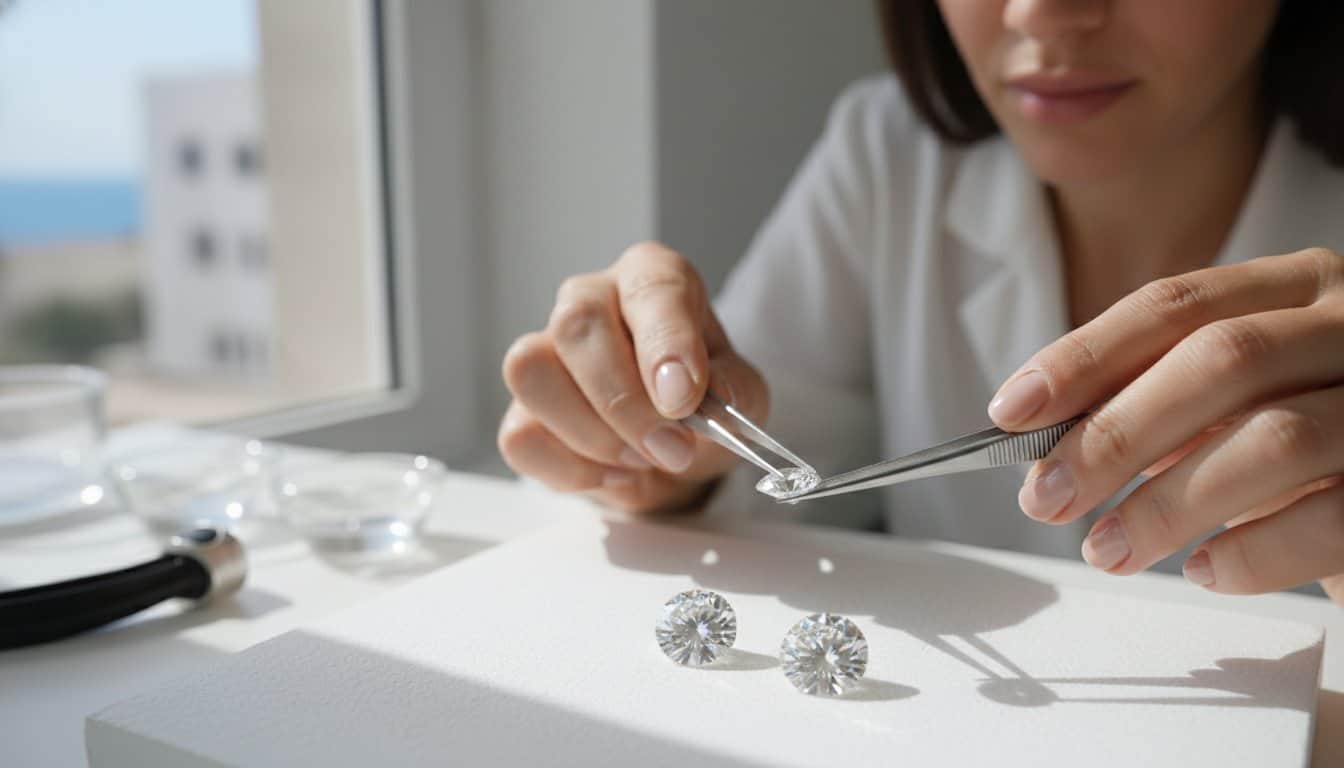
A flawless grade on a diamond certificate might actually be the least important detail when you’re choosing a stone for your next meaningful piece. While a D-Flawless rating sounds perfect, approximately 90% of people can’t distinguish it from a stone two grades lower once it’s set in a handcrafted gold band. This lab diamond clarity and color guide helps you move past the technical jargon to find the true artistry in every facet. We understand the fear of investing ₪7,500 in a stone only to notice a faint tint or a tiny inclusion that you can’t unsee. It’s confusing when two diamonds with the same technical specs look entirely different under the lights of a Tel Aviv studio.
We agree that jewelry should be a celebration of your personal journey, not an overwhelming chemistry exam. Your jewelry should feel like you. You’ll learn how to master the nuances of lab-grown stones to find the “sweet spot” where breathtaking brilliance meets ethical value. This guide provides the tools to confidently choose a diamond that looks colorless and clear to the naked eye. We’re going to break down the grading scales and show you how to select a stone that aligns with your story and your budget.
Key Takeaways
- Understand how the D-to-Z color scale and clarity grades shape your stone’s visual personality, allowing you to choose a diamond that reflects your individual grace.
- Use our lab diamond clarity and color guide to find the “sweet spot” where microscopic inclusions remain invisible to the naked eye, maximizing both sparkle and value.
- Learn to strategically pair grades to save thousands of ₪ without sacrificing brilliance, ensuring your investment focuses on visual impact and ethical integrity.
- Discover the KaMila approach to selecting stones that celebrate your unique story, perfectly complemented by handcrafted 18k gold settings for a modern, timeless finish.
Understanding Lab Diamond Clarity and Color: The Modern Standard
Choosing a diamond is a deeply personal journey, a way to select a talisman that reflects your unique story. In the Israeli jewelry market, which has long been a hub for diamond excellence, a significant shift occurred by 2024. Local designers and couples now prioritize beauty and ethics over traditional “investment” narratives. This lab diamond clarity and color guide helps you navigate the two most influential factors of a stone’s visual personality. These attributes define how a diamond interacts with light, especially when set in the minimalist, 18k gold designs that define modern Israeli artistry.
Lab-grown diamonds aren’t imitations. They’re real diamonds. Chemically, physically, and optically, they’re identical to those mined from the earth. Because they’re grown in controlled environments, they often reach the market with fewer structural interruptions. This allows you to secure a stone with breathtaking presence for a fraction of the cost. For instance, a high-quality 1-carat lab diamond in Tel Aviv might cost between ₪3,500 and ₪6,500, whereas a mined equivalent could exceed ₪25,000. This price difference empowers you to focus on the grades that actually impact the sparkle you see every day.
This shift in value has been embraced by both local designers and premier online destinations. For instance, marketplaces like LUXEMARKET have made a wide range of sustainable fine jewelry more accessible, reflecting the growing consumer demand for both ethical sourcing and breathtaking design.
The Science of Lab-Grown Brilliance
The journey of a lab diamond begins with two primary methods: Chemical Vapor Deposition (CVD) and High Pressure High Temperature (HPHT). A Synthetic diamond created via HPHT often mimics the natural volcanic growth process, frequently resulting in stones with exceptional color grades. CVD processes, while slightly different, allow for incredible precision in clarity. Because these processes are refined, lab stones frequently achieve “Very Very Slightly Included” (VVS) or “Internally Flawless” (IF) grades more consistently than mined stones. To ensure these technical attributes are authentic, look for certification from the International Gemological Institute (IGI) or the Gemological Institute of America (GIA). These reports provide a transparent roadmap of your stone’s DNA.
Why Color and Clarity are the “Visual Duo”
Color and clarity work as a partnership to produce fire and scintillation. Fire refers to the flashes of rainbow light, while scintillation is the sparkle you see when the stone moves. If a diamond has a high clarity grade but a poor, yellowish color grade, it can look “flat” or “heavy” in a white gold or platinum setting. Conversely, a perfectly colorless stone might lose its life if large “clouds” or inclusions block the light path. In the context of this lab diamond clarity and color guide, the goal is to find the “sweet spot.” This means choosing a stone where the clarity is “eye-clean” and the color appears crisp against your chosen metal, ensuring your jewelry makes every day feel special without overpaying for microscopic perfection.
The Lab Diamond Color Scale: Navigating D to Z
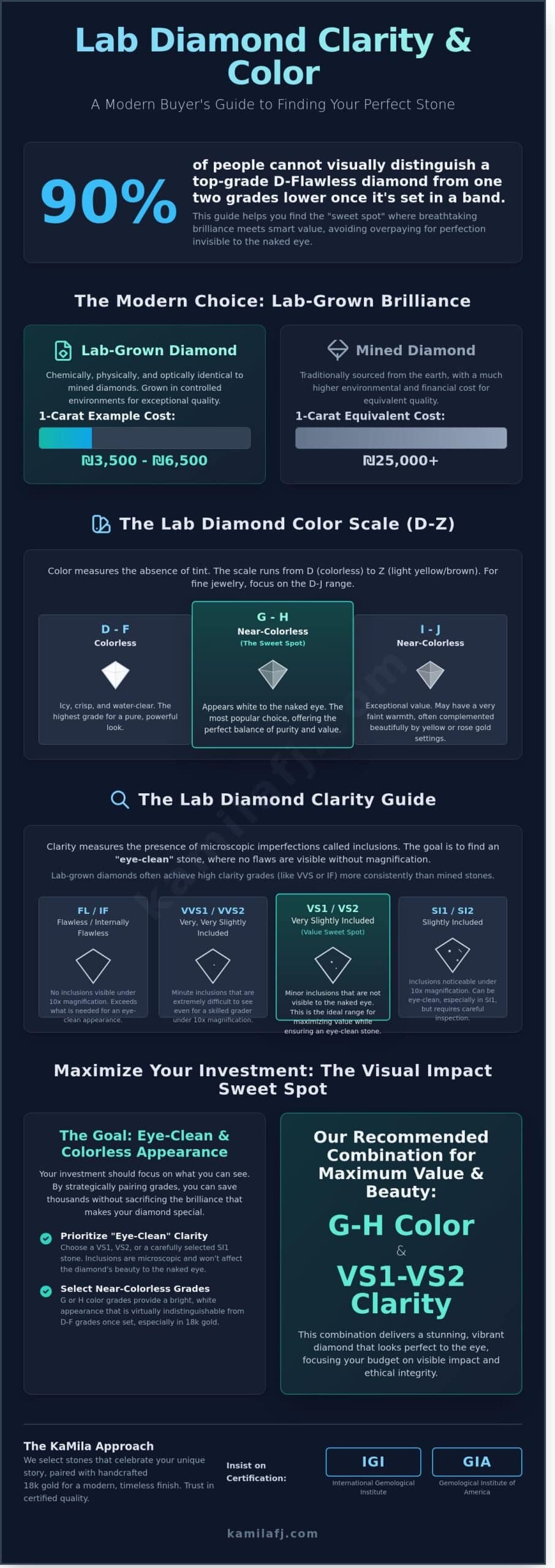
Choosing a stone is an intimate process that balances technical precision with personal artistry. The industry relies on a standardized scale to measure the presence of color within a stone, a system that ensures transparency for every wearer. This scale begins at D, representing a completely colorless diamond, and continues through Z, which indicates a visible light yellow or brown tint. In the world of fine jewelry and modern design, you’ll find that most selections fall within the D to J range.
To understand the nuances of these grades, many experts refer to the International Gemological Institute’s 4Cs, which provides the essential framework for global grading standards. A colorless diamond is defined as the absence of any trace tint under 10x magnification. While the technical grade matters for valuation, your choice is often a reflection of the story you want to tell. Your lab diamond clarity and color guide should prioritize how the stone makes you feel when it catches the light in your daily life.
Colorless (D-F) vs. Near-Colorless (G-J)
D, E, and F grades offer an icy brilliance that perfectly suits a look of edgy sophistication. These stones are rare and possess a crisp, water-clear appearance that feels both powerful and pure. If you’re seeking incredible value, G through J grades are exceptional choices. These near-colorless diamonds appear white to the naked eye but come at a more accessible price point. In the current market, G and H color diamonds are the most popular choices for modern engagement rings. They offer a perfect balance of purity and value, often allowing you to invest more in the carat weight or a more intricate setting. For example, selecting an H color over a D color can frequently save a collector upwards of ₪1,800 on a 1-carat stone without compromising the visual impact.
How Metal Choice Affects Your Color Selection
The metal of your setting acts as a frame for your stone’s personality, and it can significantly influence how the diamond’s color is perceived. Choosing 18k yellow gold allows you to drop to an I or J color grade without a visible tint. The warm metal masks the slight warmth in the diamond, making the stone appear whiter by comparison. This is a clever way to maximize your budget while maintaining a high-end aesthetic.
Conversely, white gold or platinum creates a mirror effect. These metals reflect the stone’s internal color and can emphasize any yellow or brown hints in the diamond. For these settings, a D through G grade is usually the most harmonious choice. For those who love a romantic, personal look, rose gold pairs beautifully with stones across the spectrum. It adds a soft, warm glow to the overall design that feels both timeless and fresh. You can explore how these colors interact in our latest collection of handcrafted lab-grown diamond rings, where we celebrate the unique character of every stone.
The Lab Diamond Clarity Guide: Beyond the Naked Eye
Every diamond tells a story of its unique creation. When we grow lab diamonds using advanced technological processes, we replicate the intense heat and pressure of the earth. This journey, which typically takes 3 to 12 weeks for a high-quality stone, can leave behind microscopic “birthmarks.” These internal characteristics are known as inclusions, while surface marks are called blemishes. This lab diamond clarity and color guide helps you understand that these features aren’t “defects” but rather evidence of a genuine growth process. In minimalist, geometric jewelry, the way light travels through these structures determines the stone’s ultimate soul and sparkle.
The Clarity Scale Breakdown
The industry uses a precise scale to categorize how clear a diamond is under 10x magnification. Understanding these tiers allows you to balance technical perfection with your personal budget. Here is how the grades typically perform in fine jewelry settings:
- VVS1-VVS2 (Very, Very Slightly Included): These stones are the pinnacle of clarity. The inclusions are so tiny that even professional gemologists struggle to find them under a microscope. They offer a sense of pure, untouched elegance.
- VS1-VS2 (Very Slightly Included): We often call this the “sweet spot” for modern jewelry. These diamonds appear perfectly clean to the naked eye. You aren’t paying for a “Flawless” grade you can’t see, yet the stone remains bright and clear.
- SI1-SI2 (Slightly Included): These diamonds offer incredible value. In many cases, an SI1 stone is “eye-clean,” meaning the inclusions don’t interfere with the diamond’s beauty unless you use a jeweler’s loupe.
Defining the “Eye-Clean” Standard
You don’t need to pay the premium for a “Flawless” (FL) grade to have a breathtaking piece of jewelry. In the Israeli market, where we often enjoy bright, natural sunlight, the “eye-clean” standard is what truly matters. A diamond is considered eye-clean if no inclusions are visible to the unaided eye from a distance of 20 to 25 centimeters. When you inspect a stone, do so under natural light rather than the specialized spotlights of a showroom. This gives you a realistic view of how the diamond will look as you go about your daily life.
Your choice of diamond shape also dictates your clarity needs. Brilliant cuts, like the classic Round or Princess, have 57 or 58 facets that reflect light in many directions. This “scintillation” helps hide tiny inclusions. Conversely, step-cuts like Emerald or Asscher have large, open facets that act like clear windows. For these minimalist shapes, we recommend a higher clarity grade, typically VS1 or above. Choosing a VS2 instead of a VVS1 in a 1-carat round diamond might save you between ₪1,200 and ₪2,800 without changing the visible beauty of your ring. It’s about being a thoughtful curator of your own luxury.
Maximizing Your Investment: The Best Color and Clarity Combinations
Balancing technical specs with visual beauty is where the magic happens. This lab diamond clarity and color guide isn’t just about aiming for the highest possible grades; it’s about finding the intersection where value meets brilliance. By choosing a stone that looks identical to the naked eye but sits two tiers lower on the scale, you can redirect ₪4,000 to ₪11,500 toward a more intricate setting or a larger carat weight. This process is less of a technical checklist and more of a personal curation. You’re selecting a stone that resonates with your story. Understanding the 4Cs of diamonds: a simple guide to sparkle helps you master this balance with confidence.
The “Sweet Spot” for Engagement Rings
For a center stone that captures every ray of light, aim for the F-G color range paired with VS1-VS2 clarity. This combination is the industry’s best-kept secret for daily wear. These stones appear colorless and “eye-clean,” meaning no inclusions are visible without professional 10x magnification. Opting for a G color over a D color often lowers the price by 20% to 30%. On a 1.5-carat lab diamond in Israel, this choice can save you approximately ₪7,200. This ensures your ring feels special every day while maintaining a sophisticated, timeless look. You can explore more about these aesthetics in our engagement rings: the complete guide.
Choices for Minimalist Earrings and Necklaces
Earrings and pendants offer more flexibility than rings. Since these pieces aren’t viewed as closely as a stone on your hand, you can safely drop to SI1 or SI2 clarity without losing visual impact. This shift allows you to prioritize color consistency, which is vital when layering multiple gold necklaces or wearing a matching set. If your jewelry is 14k or 18k yellow gold, an H or I color diamond will still look remarkably bright and white. We view these pieces as personal talismans. They should feel right for your energy, not just satisfy a lab report. About 70% of our clients choosing daily-wear pendants find that color harmony matters more than a flawless clarity grade. Choosing stones based on how they make you feel creates a more meaningful connection to your jewelry.
Strategic Budget Tips:
- Prioritize Cut: Never compromise here, as it dictates the sparkle.
- Metal Matters: Yellow gold hides lower color grades better than platinum or white gold.
- Size vs. Quality: In Israel’s market, shifting from VVS1 to VS2 can often let you increase your stone size by 0.25 carats for the same price.
Ready to find your signature piece? Discover our handcrafted lab-grown diamond collection.
Artistry and Ethics: The KaMila Approach to Lab-Grown Stones
At KaMila, we select lab-grown diamonds because they represent brilliance with a conscience. We don’t believe you should ever have to choose between high-end luxury and your personal values. Our collection is built on the belief that fine jewelry should be an intimate expression of your story, crafted with respect for the planet. This approach allows us to offer stones that are physically, chemically, and optically identical to mined diamonds but without the heavy environmental toll. It’s a fusion of timeless craftsmanship and modern sustainability that defines every piece we create.
For those who want to understand the full journey of these remarkable stones, we invite you to explore Lab Diamonds: The Complete Guide. We prioritize transparency in everything we do, from the way we source our materials to the way we price our finished pieces in Israeli Shekels. By choosing lab-grown, you’re investing in a future where beauty and integrity coexist perfectly.
Designing Your Story in 18k Gold
We don’t just set stones; we curate them to match our minimalist, edgy, and sophisticated designs. Every piece of KaMila jewelry is handcrafted in 18k gold, a metal chosen for its rich color and lasting durability. Our 18k gold contains 75% pure gold, providing a level of prestige and strength that 14k options can’t match. This is particularly important in the Israeli climate, where jewelry needs to withstand daily wear while maintaining its luster.
The human touch is essential in our workshop. Our artisans carefully evaluate how light interacts with each stone within its setting. We use this lab diamond clarity and color guide to ensure that the setting enhances the diamond’s best features. “You, in Gold” is our guiding philosophy. It means finding the specific diamond that reflects your unique balance of softness and power. Whether it’s a bold geometric ring or a delicate pendant, the setting is designed to maximize light performance, making every facet sing.
Customizing Your Perfect Piece
If you’re looking for something truly unique, our custom design service allows you to be part of the creative process. We work closely with you to source a stone that fits your ideal color and clarity specifications. Because we operate with a commitment to ethical artistry, we provide full transparency regarding the grading of your diamond. We help you navigate the lab diamond clarity and color guide to find the “sweet spot” where quality meets value.
- Personalized Sourcing: We find stones that match your specific budget, with custom engagement pieces often starting around ₪6,500.
- Direct Collaboration: You’ll work with our designers to ensure the 18k gold setting perfectly complements your chosen stone.
- Local Craftsmanship: All our custom work is handled by skilled artisans, ensuring your piece is a one-of-a-kind talisman.
We invite you to explore our custom design services and start a conversation about your next meaningful piece. Your jewelry should be as unique as your own story, and we’re here to help you tell it with brilliance and grace.
Your Path to Conscious Brilliance
Choosing the perfect stone is a blend of technical knowledge and personal intuition. This lab diamond clarity and color guide highlights how selecting a G or H color grade paired with VS1 clarity offers the best value for your investment. Industry data from 2024 suggests that choosing an eye-clean VS2 stone can reduce costs by 20% to 30% compared to VVS grades without any visible difference to the naked eye. By focusing on what you actually see, you prioritize visual beauty over invisible paper specifications.
Every piece at KaMila is handcrafted in 18k gold to provide a lasting foundation for your most meaningful moments. We design with a modern minimalist aesthetic, creating jewelry that’s meant for everyday elegance. Our sustainably sourced lab-grown diamonds represent a 100% conflict-free alternative for the conscious consumer in Israel. It’s time to find a piece that resonates with your personal narrative and values.
Discover Your Story in Gold: Explore our Lab-Grown Diamond Collection
Your journey toward a more mindful and radiant lifestyle starts with a single, brilliant choice.
Frequently Asked Questions
Is color or clarity more important in a lab diamond?
Color is generally more important than clarity because it’s the first thing your eye notices when looking at a stone. In the bright, natural light common in Israel, a slight yellow tint is far more visible than a microscopic inclusion. You should aim for an eye-clean clarity grade like VS2 and prioritize a higher color grade between D and G to ensure your jewelry looks crisp and bright.
Do lab diamonds get cloudy over time?
No, lab diamonds will never get cloudy or lose their brilliance because they’re chemically and physically identical to mined diamonds. They rank a 10 on the Mohs scale of hardness, meaning they’re incredibly durable. If your ring looks dull, it’s usually just a buildup of lotions or oils. A quick soak in warm water with mild soap will restore that original artistry and sparkle immediately.
Can you tell the difference between a D and F color lab diamond?
You cannot tell the difference between a D and F color grade with the naked eye under normal lighting conditions. Both grades sit in the “Colorless” category on the GIA scale. Choosing an F color stone can save you between ₪1,500 and ₪3,800 on a one-carat diamond in the Israeli market. This allows you to invest more in a superior cut or a more intricate setting.
What is the best clarity grade for a lab diamond engagement ring?
The best clarity grade for value and beauty is VS1 or VS2, as these stones are eye-clean to 99% of observers. While VVS grades are technically purer, the inclusions in a VS stone are invisible without 10x magnification. This lab diamond clarity and color guide recommends focusing on how the stone looks to you rather than paying a premium for perfection that requires a microscope to see.
Does a lab diamond have the same sparkle as a natural diamond?
Yes, lab diamonds exhibit the exact same fire and scintillation as natural diamonds because they share an identical refractive index of 2.417. When a stone is cut to “Excellent” proportions, it dances with light in the same way regardless of its origin. This makes them a beautiful, modern choice for anyone seeking that timeless radiance. The sparkle is a result of the cut quality, not the growing process.
Why are lab diamonds graded by IGI and GIA?
Lab diamonds are graded by the IGI and GIA to provide an objective, third-party assessment of their quality and 4Cs. In Israel, IGI certificates are very common for lab-grown stones and offer precise details on the stone’s growth method. These reports act as a passport for your diamond. They ensure you’re getting exactly what you pay for and protect the value of your personal talisman over time.
Which metal color is best for a diamond with a lower color grade?
Yellow gold or rose gold is the best choice for diamonds with lower color grades like H, I, or J. The warm tones of 14k or 18k gold mask slight yellow tints in the stone, making it appear whiter by comparison. If you prefer the icy look of white gold or platinum, it’s better to stick to a D, E, or F grade. This ensures the metal doesn’t highlight any warmth in the diamond.
Are lab-grown diamonds a sustainable choice for fine jewelry?
Lab-grown diamonds are a more sustainable choice as they require zero mining and have a significantly lower environmental impact on the earth’s surface. Producing a one-carat lab diamond uses approximately 250 million joules of energy compared to over 500 million for mined stones. At KaMila, we believe these stones are a thoughtful way to celebrate your story while making a conscious choice for the future of our planet.
Related Posts
Custom Initial Necklace Gold: The Ultimate Guide to Modern Personalized Jewelry
-
Posted by
מילה קלר
Why settle for a generic accessory when you can wear a piece that speaks your name before you even say a word? Most jewelry lovers in Israel have…
Best Minimalist Bracelets: The Ultimate Guide for 2026
-
Posted by
What if the most impactful piece in your jewelry box was also the most subtle? It’s a question many modern women across Israel are asking in 2026 as…
How to Build a Capsule Jewelry Collection: A Guide to Timeless Curation
-
Posted by
What if your jewelry box wasn’t a cluttered drawer of forgotten trends, but a curated gallery of your life’s most meaningful moments? Most women own…
The Ultimate Guide to Custom Wedding Rings in Jerusalem (2026)
-
Posted by
What if your wedding ring didn’t have to carry the heavy weight of centuries-old tradition, but could instead whisper the secret of your own modern…
Jewelry Care Kit Essentials: The Definitive Checklist for Fine Jewellery
-
Posted by
Last Tuesday, Maya sat at a sun-drenched café in Neve Tzedek and realized her 18k gold band had lost the radiant glow it possessed on her wedding…

Unique Men’s Wedding Bands in Israel: The 2026 Modern Groom’s Guide
-
Posted by
Your wedding band shouldn’t be the last item on a wedding checklist; it’s the only piece of jewelry you’ll likely wear every single day for the next…

10 Common Mistakes to Avoid When Buying Jewelry in 2026
-
Posted by
Last Tuesday, Maya sat at her vanity in Tel Aviv and realized the ₪1,500 “forever” necklace she purchased online just four months ago had already…
Jewelry Consultation Service Tel Aviv: Create Your Story in Gold
-
Posted by
The most expensive piece of jewelry in a glass mall display is often the least valuable item you will ever own. You have likely felt that wave of…
Anniversary Jewelry Gift by Year: The Complete Modern Reference Guide
-
Posted by
Last Tuesday, a client named Elena shared that she had visited 14 different websites just to find one consistent recommendation for her tenth…
Birthstone Jewelry Gift Guide 2026: Meaningful Modern Talismans in 18k Gold
-
Posted by
What if the most personal gift you give in 2026 isn’t just a piece of jewelry, but a 2,000-year-old story reimagined in 18k gold? Many people follow…
Timeless Jewelry Pieces Every Woman Should Own: The 2026 Essential Guide
-
Posted by
What if the most expensive mistake in your jewelry box isn’t the piece you splurged on, but the ₪550 “gold-plated” necklaces that tarnish before the…
Israeli Jewelry Online Shop: A Guide to Modern Handcrafted Luxury
-
Posted by
What if the most authentic way to wear a piece of Israel is not found in a crowded souvenir market, but through a curated Israeli jewelry online shop…