

Blog
Do Lab Diamonds Pass a Diamond Tester? The Science of Lab-Grown Brilliance
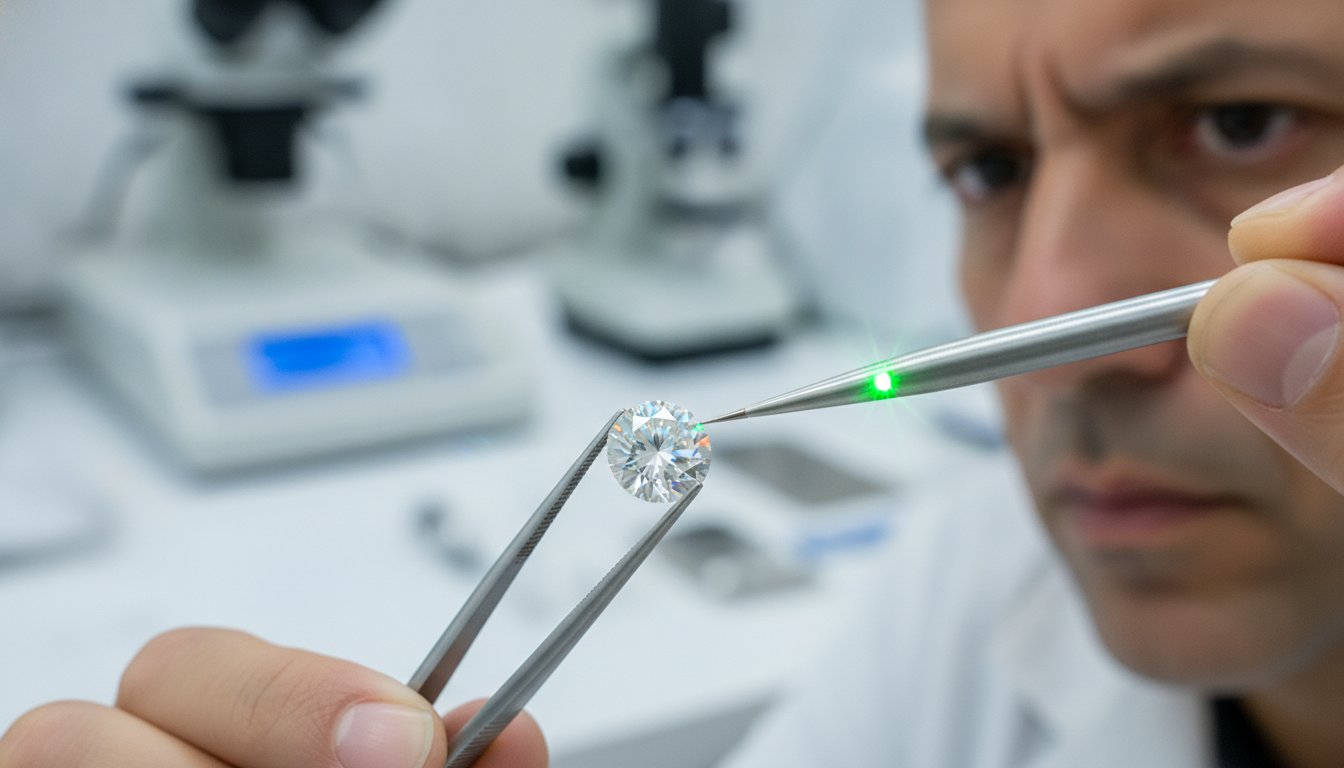
What if the device meant to spot a fake actually confirms that your lab-grown stone is the real thing? It’s a common concern for anyone choosing a modern heirloom: do lab diamonds pass a diamond tester? You might feel a lingering worry that a jeweler’s tool will suggest your jewelry is an imitation, or perhaps you’re confused about how these stones differ from options like cubic zirconia. It’s natural to want your most meaningful pieces to stand up to every test, especially when they represent such a significant chapter of your life.
You’ll discover exactly why lab-grown diamonds pass standard tests and how they compare to mined stones in both chemistry and brilliance. We’ll also explain the advanced technology professionals use to tell their unique stories, from thermal conductivity to laboratory spectroscopy. This guide provides the clarity you need to understand professional verification, giving you the confidence to select a lab-grown diamond for your engagement ring or a piece of daily luxury that truly reflects your identity.
Key Takeaways
- Learn why do lab diamonds pass a diamond tester by exploring their identical physical and chemical composition to stones found in nature.
- Understand the science of thermal conductivity and why standard handheld tools register lab-grown brilliance as genuine carbon.
- Differentiate between basic testers and the advanced gemological equipment used by professionals to identify a diamond’s unique origin story.
- Troubleshoot potential false readings by understanding the rare Type IIa classification that is common in premium lab-grown stones.
- Gain the confidence to choose a modern heirloom that balances traditional artistry with sustainable, forward-thinking innovation.
Defining the Diamond: Why Lab-Grown Stones Test as Genuine
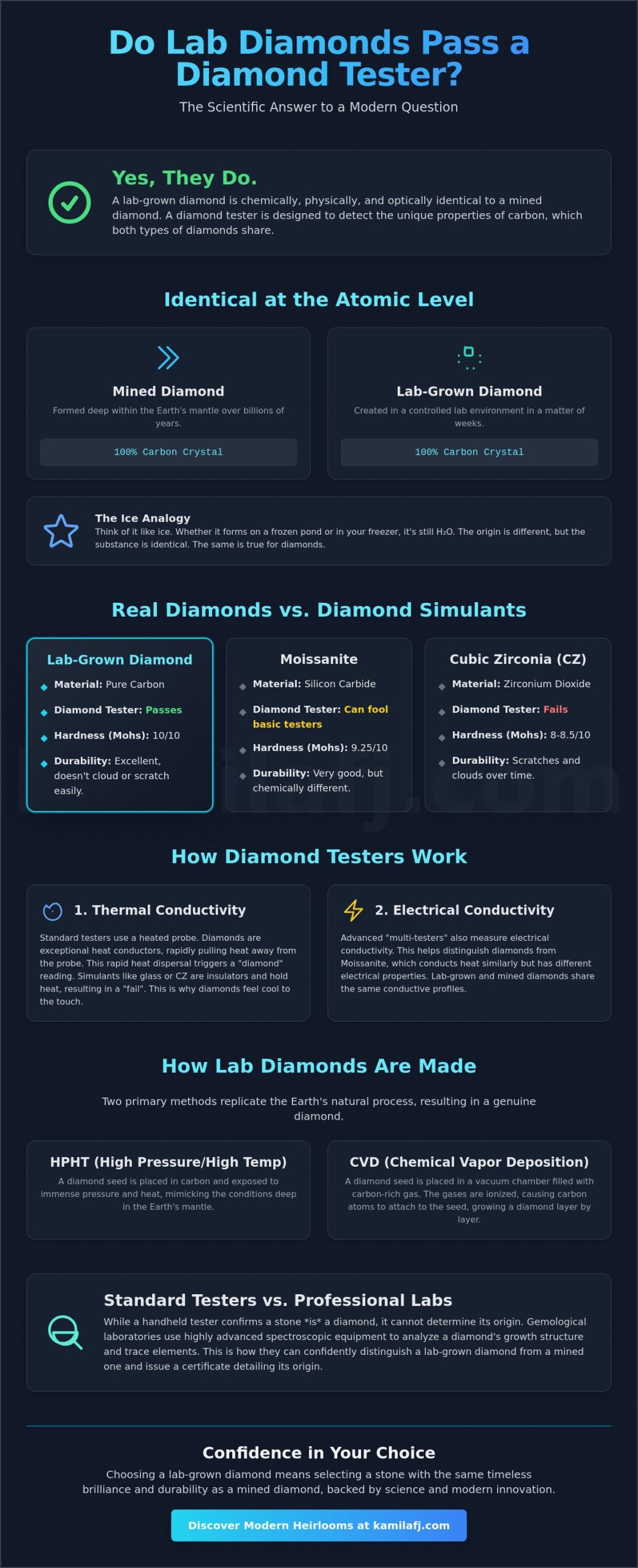
To understand why these modern marvels behave the way they do, we first have to look at their DNA. A lab-grown diamond is 100% pure carbon arranged in a crystalline structure. It isn’t a copy of a diamond; it is a diamond. The only real distinction lies in its provenance. Think of it like ice: whether it forms on a winter pond or inside a modern freezer, the chemical result is identical H2O. This is the core reason why people ask, do lab diamonds pass a diamond tester? The answer is a resounding yes, because the material being tested is exactly what the device is looking for.
While the industry often uses the term Synthetic diamond, this word can be socially misleading. In common language, “synthetic” often implies something imitation, like polyester or faux leather. In science, however, it simply means something created through a controlled process. Because lab-grown stones possess the same optical, physical, and chemical identity as their mined counterparts, they represent a leap forward in sustainable luxury rather than a compromise in quality. This is why when people wonder, do lab diamonds pass a diamond tester, the science confirms they behave exactly like stones pulled from the earth.
The Carbon Lattice: Nature vs. The Laboratory
Creating a diamond requires an environment of immense pressure and heat, replicating the conditions found deep within the Earth’s mantle. Modern artisans use two primary methods to achieve this: Chemical Vapor Deposition (CVD) and High Pressure High Temperature (HPHT). Both techniques allow carbon atoms to bond together, layer by layer, into a rigid structure. The resulting carbon lattice is the specific reason for a diamond’s legendary hardness and unmatched brilliance.
Lab Diamonds vs. Diamond Simulants
It is easy to confuse lab diamonds with simulants like Cubic Zirconia (CZ) or Moissanite, but their chemistry tells a very different story. Simulants only “look” like diamonds; they are composed of entirely different materials that lack the same durability and light refraction. At KaMila Fine Jewellery, we focus on lab diamonds for their ethical brilliance and timeless integrity. Because these stones are genuine carbon, they don’t cloud or scratch over time like imitations do. When you choose a lab-grown piece, you aren’t settling for a lookalike. You’re investing in a stone that carries the same physical weight and emotional significance as any diamond formed by the earth.
Understanding Conductivity: How Diamond Testers Distinguish Real from Fake
Standard handheld testers are essentially thermal conductivity meters. They measure how quickly heat moves through a stone with remarkable precision. Diamonds are unique because they conduct heat more efficiently than almost any other material on Earth. Because lab-grown diamonds are chemically identical carbon, they possess this exact same property. This is why do lab diamonds pass a diamond tester is a question with a very clear scientific answer: yes, because the heat signature is perfect.
Modern multi-testers have added another layer of security by measuring electrical conductivity. While heat is the primary marker, electricity helps refine the results even further. If you’ve ever felt the cool touch of a diamond against your skin, you’ve experienced this physics in action. It’s a quiet confidence that comes from knowing your stone isn’t just a visual match, but a structural one too. For those seeking a piece that stands up to every scrutiny while celebrating their personal journey, exploring custom jewelry options allows you to pair this scientific integrity with artisanal soul.
Thermal Conductivity: The “Ice Cube” Test
Diamonds are often called “ice” not just for their appearance, but because they feel cold to the touch. They draw heat away from your skin instantly. A tester’s metal tip applies a small amount of heat and monitors the rate of dispersal. Materials like glass or Cubic Zirconia (CZ) act as insulators; they hold onto heat, causing the device to stay silent. In contrast, GIA research on lab-grown diamonds confirms that these stones share the same high thermal conductivity as mined ones, triggering that reassuring “Diamond” beep every time.
Electrical Conductivity and Moissanite
Moissanite is a beautiful stone, but it has a trick up its sleeve. It conducts heat well enough to occasionally fool a basic thermal tester. To solve this, modern multi-testers also measure electrical conductivity. Most diamonds, both lab and natural, don’t conduct electricity. Moissanite does. By testing both heat and electricity, jewelers can distinguish between the two with ease. Lab diamonds, being pure carbon, remain non-conductive in most cases, passing the test with flying colors.
To give you a clear picture of how different stones react, here is a quick breakdown of standard tester results:
- Natural Diamond: Passes thermal and electrical tests.
- Lab-Grown Diamond: Passes thermal and electrical tests (identical to natural).
- Moissanite: Passes thermal test; fails electrical test (registers as moissanite).
- Cubic Zirconia: Fails thermal test; fails electrical test.
- Glass: Fails all conductivity tests immediately.
When you hold a lab-grown diamond, you’re holding the result of incredible human ingenuity that honors the laws of physics. The stone doesn’t “trick” the tester. It simply provides the exact data points the tool was designed to find. This scientific reality ensures that your modern heirloom carries the same weight and permanence as any stone found in the earth, allowing you to wear your story with pride and peace of mind.
Standard Testers vs. Professional Lab Equipment: Knowing the Limits
The primary difference lies in the microscopic impurities found within the carbon lattice. Most diamonds formed in the earth billions of years ago contain trace amounts of nitrogen, classifying them as Type Ia diamonds. In contrast, lab-grown stones are often Type IIa, a rare and highly coveted category of diamond that is almost entirely devoid of nitrogen. While a basic tester cannot see these chemical nuances, advanced laboratory machines use light and sensors to map the atomic structure with incredible accuracy. This process isn’t about exposing a “fake,” but rather about celebrating the unique story of a genuine diamond’s creation.
UV Spectroscopy and Fluorescence
Professional laboratories use UV spectroscopy to observe how a stone reacts to specific wavelengths of light. Under this specialized scrutiny, natural diamonds often reveal growth patterns shaped like octahedrons, while lab-grown diamonds show distinct patterns related to their controlled growth environment. These machines look for “growth signatures” that are invisible to the naked eye and even to high-powered jeweler’s loupes. Because this equipment is bulky and expensive, you will rarely find it in a standard retail shop; it is reserved for the quiet, precise halls of institutions like the GIA or IGI.
The Importance of Certification
Because handheld testers have their limits, the most reliable way to verify your stone’s identity is through a professional grading report. Certificates from the GIA or IGI act as a diamond’s passport, detailing its cut, color, clarity, and laboratory origin. These reports are linked to a microscopic laser inscription on the diamond’s girdle, providing a permanent record of transparency that no tester can replicate. At KaMila, we prioritize these certified stones for our engagement rings, ensuring that every piece we create is as honest as it is beautiful.
Ultimately, when you ask, do lab diamonds pass a diamond tester, you are looking for confirmation of quality. The fact that they pass confirms you are wearing a material of unmatched hardness and light. Choosing a lab-grown diamond is a conscious decision to embrace modern innovation without sacrificing the timeless allure of a true diamond. By relying on professional certification rather than just a beeping tool, you gain the peace of mind that your jewelry is exactly what it claims to be: a stunning, enduring expression of your personal narrative.
Troubleshooting a “Fail”: Why a Real Diamond Might Not Register
It is a moment that can cause a heart to skip: you’ve invested in a beautiful stone, but when the probe touches the surface, the device remains silent or, worse, chirps a warning for moissanite. If you are wondering do lab diamonds pass a diamond tester every single time, the reality is that while they should, technical “hiccups” are possible. These false negatives don’t mean your diamond is an imitation. Usually, they are a sign that your stone is actually too pure for a basic tool to understand, or that external factors are interfering with the reading.
Understanding these variables replaces anxiety with confidence. A diamond is a constant companion, meant to be worn through the rhythms of your daily life. Sometimes, those very rhythms, like the lotion on your skin or the temperature of a winter morning, can skew a simple test. If you ever feel uncertain about a stone’s performance, seeking a professional perspective through custom jewelry experts can provide the clarity and reassurance you deserve.
The Type IIa Factor
Most lab-grown diamonds fall into the Type IIa category, which represents the most chemically pure form of diamond. These stones contain almost no nitrogen impurities, a trait shared by only 1 to 2 percent of diamonds found in nature. Paradoxically, this extreme purity can confuse older or lower-quality electrical testers. Some of these devices are programmed to look for the specific nitrogen signatures found in common natural stones; when they don’t find them, they may incorrectly register the stone as moissanite. Type IIa is a mark of exceptional quality and rarity, not a structural flaw.
Environmental and Human Error
Handheld testers are sensitive instruments that require a perfect environment for accuracy. If the metal probe accidentally touches a gold prong or the setting, the electrical circuit is broken, often resulting in a “metal” alert or no reading at all. Temperature also plays a significant role. A stone that has just been brought in from the cold or one that has been held under a warm display light may not disperse heat at its normal rate. Finally, life’s daily traces, like finger oils, soap residue, or hand cream, can create a microscopic barrier between the probe and the carbon lattice, leading to a “simulant” reading.
For the most accurate results at home or in a shop, follow this simple checklist:
- Clean the stone: Use a lint-free cloth to ensure the surface is free of oils and debris.
- Stabilize the temperature: Allow the jewelry to sit at room temperature for at least ten minutes before testing.
- Check the battery: Low power in a handheld device is the most common cause of erratic or weak readings.
- Mind the probe: Ensure the tip is placed firmly in the center of a facet, away from any metal settings.
- Test multiple spots: Take readings from three different facets to ensure consistency across the stone.
By understanding these technical nuances, you can navigate the world of lab-grown brilliance with poise. A false negative is rarely a sign of a “fake” stone; it’s often just a reminder that your diamond’s purity is challenging the limits of simple technology. Trust in the science of the carbon bond and the verified history of your stone’s certification.
Beyond the Tester: Choosing Lab Diamonds with KaMila Fine Jewellery
While the scientific certainty that do lab diamonds pass a diamond tester provides peace of mind, the true value of a diamond lies far beyond the beep of a handheld tool. A tester confirms the carbon, but it cannot measure the artistry, the intention, or the personal narrative woven into a piece of fine jewelry. For the modern individual, choosing a lab-grown diamond is a celebratory act of conscious luxury. It is a decision that honors both the heritage of fine craftsmanship and the innovative spirit of the present day, resulting in a modern heirloom that feels as good as it looks.
When you move past the technical verification, you enter a space where style and soul take center stage. We believe that high-end jewelry should be an intimate expression of your story, not just a formal indulgence. By selecting lab-grown stones, you are embracing a future where beauty and integrity coexist beautifully. The focus shifts from “is it real?” to “what does it represent?”, allowing the brilliance of the stone to reflect your unique identity and the milestones you choose to celebrate.
Modern Minimalism and Ethical Sourcing
One of the most empowering aspects of lab-grown diamonds is the freedom they offer. Because these stones are created in a controlled environment, they allow you to prioritize exceptional cut, color, and clarity without compromise. This often means you can choose a larger, higher-quality stone that fits perfectly within your vision and budget. Knowing that your jewelry aligns with your ethical values adds a layer of quiet confidence to every wear. At KaMila, our commitment to handcrafted excellence in our Israel-based studio ensures that every lab diamond is set in 18k gold with the same precision and care as the rarest earth-mined stone.
Designing Your Story
The journey of a diamond truly begins when it is placed into a setting that speaks to you. Whether you are looking for a timeless gold ring or a one-of-a-kind necklace, lab diamonds provide a versatile canvas for creativity. We specialize in taking these symbols of modern brilliance and incorporating them into custom designs that are as unique as the people who wear them. This transition from technical verification to emotional celebration is where the magic happens. Your jewelry becomes a protective emblem, a spark of joy, and a reflection of your personal history.
If you are ready to explore the possibilities of lab-grown brilliance, we invite you to discover a collection where artistry meets innovation. Whether you are drawn to our existing gold bracelets and necklaces or wish to begin the journey of a custom jewelry design, we are here to help you create something meaningful. Explore the KaMila collection today and find the piece that resonates with your spirit, knowing that its brilliance is as genuine as the story it tells.
Embrace the Future of Fine Jewellery
Choosing a stone that reflects your values is a celebratory act that brings a sense of quiet confidence to your daily life. We have seen how the identical carbon structure of these modern marvels ensures that do lab diamonds pass a diamond tester with ease, providing the same thermal and electrical feedback as any diamond found in the earth. By prioritizing professional certification and understanding the rare Type IIa purity of these stones, you can move past technical worries and focus on the emotional significance of your jewelry.
Your jewelry should be an intimate expression of your story; it’s a modern heirloom that honors both craftsmanship and sustainability. At KaMila, we marry this scientific integrity with an artisan’s touch to create pieces that feel as meaningful as they are beautiful. Discover the brilliance of the KaMila Lab Diamond Collection, featuring certified lab-grown diamonds handcrafted in 18K gold. These ethically sourced and sustainable designs are crafted to be a direct reflection of your identity, allowing you to wear your story with pride and joy.
Common Questions About Lab-Grown Brilliance
Do lab diamonds lose their sparkle over time?
No, they don’t. Lab diamonds possess the same 10/10 hardness on the Mohs scale as mined diamonds, meaning they are incredibly durable. Unlike simulants like cubic zirconia that can scratch or cloud, a lab-grown stone maintains its fire and brilliance for a lifetime. It’s a permanent piece of jewelry that will never fade or lose its light through daily wear.
Can a pawn shop tell if a diamond is lab-grown?
Yes, most professional buyers now use advanced screening equipment. While a simple tool might confirm the stone is genuine carbon, professional labs and shops use spectroscopy to identify the specific growth patterns and chemical signatures of lab-grown stones. They don’t rely on the question do lab diamonds pass a diamond tester; instead, they look for the absence of nitrogen found in most natural stones.
Why did my lab diamond test as moissanite on a basic pen tester?
This is usually due to the “Type IIa” factor. Lab-grown diamonds are exceptionally pure and lack the nitrogen impurities found in most natural stones. Some basic electrical testers are calibrated to look for those impurities; when they don’t find them, the device may incorrectly register the stone as moissanite. It’s actually a sign that your diamond is of superior chemical purity.
Is a lab-grown diamond considered a “real” diamond by the GIA?
Yes, it is. The Gemological Institute of America (GIA) recognizes lab-grown stones as authentic diamonds. They provide full grading reports using the same 4Cs (cut, color, clarity, and carat) used for mined stones. Each report clearly identifies the stone as lab-grown, ensuring transparency while confirming its status as a genuine diamond with identical physical properties.
Do lab diamonds have resale value?
They do have resale value, though it’s typically lower than their mined counterparts. As of early 2026, wholesale prices for lab-grown stones have seen a decline of approximately 14%. Because of this market shift, it’s best to view a lab diamond as a beautiful lifestyle choice and a modern heirloom rather than a traditional financial investment or commodity.
Can you tell the difference between lab and natural diamonds with a loupe?
No, you can’t. Even a master jeweler cannot distinguish between the two using a standard 10x magnification loupe. The differences are microscopic and occur at the atomic level. To determine a stone’s origin, professionals must use specialized laboratory equipment that can detect growth signatures and crystal structures that are completely invisible to the naked eye.
What is the best diamond tester for lab-grown stones?
Standard thermal testers only confirm if a stone is a diamond; they don’t identify its origin. If you want to know if a stone is lab-grown, the best tools are professional-grade devices like the GIA iD100. These machines use sophisticated light analysis to separate natural diamonds from lab-grown ones and simulants, providing a level of certainty that handheld pens cannot match.
Are lab diamonds better for the environment?
They are generally considered a more conscious and sustainable choice. Lab-grown diamonds avoid the significant land displacement and ecosystem disruption associated with traditional earth mining. For the individual who values ethical sourcing and modern innovation, these stones represent a way to enjoy high-end luxury that aligns with a commitment to protecting our natural world.
Related Posts

Finding an English-Speaking Custom Fine Jewelry Designer in Israel: A Complete Guide
-
Posted by
מילה קלר
Your most cherished jewelry shouldn’t just be an accessory; it’s a piece of your history that deserves to be understood without a translator. When…

How to Convince Your Husband to Upgrade Your Wedding Ring
-
Posted by
What if your wedding ring wasn’t just a relic of who you were when you said “I do,” but a luminous reflection of the woman you’ve become today? Many…
Minimalist Gold Rings: A Guide to Curating Your Timeless 18K Collection
-
Posted by
Your jewelry shouldn’t have an expiration date. Too many of us have felt the frustration of a cherished piece tarnishing or causing skin irritation…

Getting a Better Price Than Big Brand Jewelers in Israel: The Insider’s Guide 2026
-
Posted by
That iconic logo on a shopping bag in a Tel Aviv mall might feel like a mark of quality, but it’s often the most expensive way to buy a memory. When…

Common Regrets After Buying an Engagement Ring: How to Choose a Forever Piece
-
Posted by
What if the most significant purchase of your life becomes a source of quiet hesitation every time you get ready in the morning? It’s a heavy…

15 Essential Questions to Ask a Jeweler Before They Start Designing Your Piece
-
Posted by
You’ve spent months dreaming of a piece that captures your unique story, but as the jeweler picks up their pencil, a flicker of anxiety often sets…
Hidden Halo Engagement Rings: A Guide to Subtle, Modern Brilliance (2026)
-
Posted by
What if the most captivating detail of your jewelry wasn’t meant for the rest of the world to see, but was a secret kept just for you? Many couples…

Handcrafted Minimalist Jewelry in Israel: A Guide to Modern Elegance (2026)
-
Posted by
Why settle for jewelry that simply fills a space when you could wear a piece that captures the depth of your own story? If you’ve been searching for…

Stacking Gold Bracelets in Israel: The Ultimate Guide to Curating Your Wrist
-
Posted by
What if your most precious jewelry pieces weren’t reserved for formal galas, but were designed to be lived in every single day? Many women feel a…

Jewish Gold Jewelry: Modern Israeli Artistry for 2026
-
Posted by
Why should a piece of jewelry that represents your deepest identity feel like a heavy, outdated relic from a different century? Most of us have…
Custom 18k Gold Jewelry in Israel: A Guide to Creating Modern Heirlooms
-
Posted by
Most jewelry in local boutiques stops at 14-karat gold, but a true modern heirloom requires the deep, buttery glow that only 18-karat purity can…

Modern Israeli Jewelry Designers: The 2026 Guide to Artisanal Fine Jewelry
-
Posted by
True luxury isn’t found in a crowded mall or a mass-produced catalog. It lives in the quiet, intentional details of a piece that reflects your unique…