
Blog
Ethical Diamond Sourcing in Israel: A Conscious Consumer’s Guide
A diamond is more than just a stone; it’s a symbol of a promise, a celebration of a milestone, a piece of your personal story. But what happens when that sparkle is clouded by uncertainty? The fear of “blood diamonds” and the confusing maze of industry claims can make choosing a diamond feel less like a joy and more like a risk, leaving you to wonder if your beautiful piece carries a heavy history.
This is where clarity and consciousness become the most precious facets of all. For the modern consumer, understanding the journey of their gem is non-negotiable. Navigating the world of ethical diamond sourcing in Israel can feel complex, but it doesn’t have to be. We believe the story behind your diamond should be as beautiful and pure as the stone itself, a true reflection of your values.
This guide is your trusted companion, designed to empower you with knowledge and confidence. We’ll demystify terms like ‘conflict-free,’ explore the key certifications that truly matter, and illuminate the path your diamond takes to our Tel Aviv studio. By the end, you’ll be able to choose a beautiful, ethical stone with the clarity and peace of mind you deserve, ensuring your jewelry is a story you’re proud to wear.
Key Takeaways
- Learn why the term ‘conflict-free’ is just the starting point for a truly ethical diamond and what modern standards entail.
- Understand Israel’s leadership role in the global diamond trade and its impact on the high standards for ethical diamond sourcing Israel is known for.
- Discover the key questions to ask about ethical diamond sourcing Israel to ensure your diamond’s journey aligns with your personal values, beyond basic certifications.
- Explore how lab-grown diamonds offer a modern, beautiful, and completely transparent choice for your fine jewelry.
The Shadow Behind the Sparkle: Understanding the Concern with Mined Diamonds
Choosing a diamond is a deeply personal and emotional journey. It’s a celebration, a promise, a talisman meant to capture a story of love and commitment. But for a piece of jewelry to be truly beautiful, its own story must be one of integrity. For decades, a shadow has lingered over the diamond industry, raising critical questions about the journey these brilliant stones take from the earth to our hands.
At the heart of this concern are ‘conflict diamonds,’ also known as ‘blood diamonds.’ In simple terms, these are gems mined in war-torn regions and sold to fund armed conflict, insurgency, and brutal violence against innocent communities. This dark trade, particularly prominent in parts of Africa during the late 20th century, exposed a troubling side to the industry and ignited a global call for change.
What Makes a Diamond Unethical?
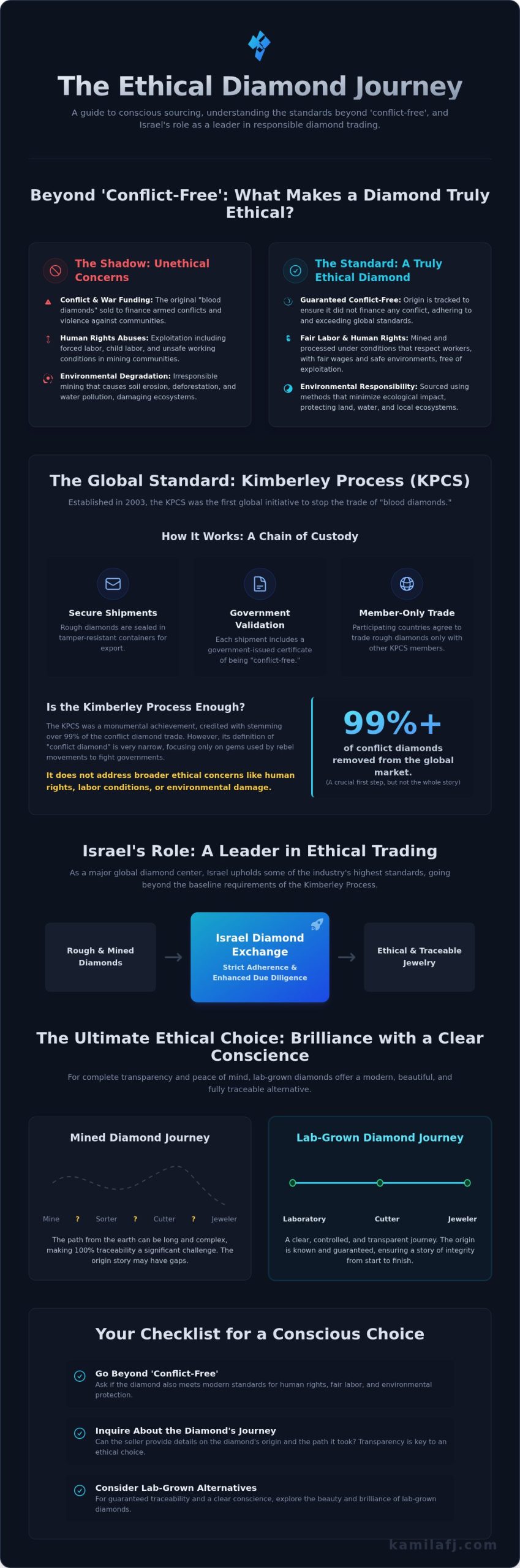
While the term ‘conflict diamond’ is specific to financing war, the modern definition of an unethical diamond has broadened to encompass a wider range of issues. The concerns of a conscious consumer today extend to:
- Human Rights Abuses: Exploitative practices in mining communities, including forced labor, child labor, and other violations of basic human rights.
- Unfair Labor Conditions: Dangerous working environments and wages that are insufficient to provide a sustainable livelihood for miners and their families.
- Environmental Degradation: Irresponsible mining techniques that cause significant harm, such as soil erosion, deforestation, and water pollution, leaving a lasting scar on the land and local ecosystems.
The Power of a Conscious Choice
A diamond should be a pure symbol of joy, not a relic of suffering. Today, your choice is an opportunity to cast a vote for a more responsible world. This growing demand for accountability is the driving force behind ethical diamond sourcing in Israel and globally. In response to these grave concerns, the international community created frameworks like the Kimberley Process Certification Scheme to stem the flow of conflict diamonds. While a crucial first step, the modern standard for ethical diamond sourcing in Israel and beyond demands even greater transparency. Your conscious choice empowers this movement, ensuring the sparkle you wear reflects a story of respect and integrity from start to finish.
The Global Standard: What is the Kimberley Process Certification Scheme?
When you begin the journey of choosing a diamond, its story is just as important as its sparkle. The conversation around ethical sourcing often starts with one landmark initiative: the Kimberley Process Certification Scheme (KPCS). Established in 2003, it was the diamond industry’s first unified response to the devastating “blood diamond” trade that funded civil wars. Its goal was clear and powerful: to prevent diamonds from conflict zones from ever reaching the global market, ensuring that a symbol of love would not be tainted by violence.
How the Kimberley Process Works
The KPCS is a joint initiative involving governments, industry, and civil society. It creates a tightly controlled system for the international trade of rough diamonds. The process is built on a foundation of rigorous requirements that create a documented journey for each stone:
- Secure Shipments: Rough diamonds are sealed in tamper-resistant containers before being exported.
- Government Validation: Each shipment is accompanied by a government-issued Kimberley Process Certificate, which certifies the diamonds are conflict-free according to the KPCS definition.
- Member-Only Trade: Participating countries, including major diamond centers like Israel, agree to trade rough diamonds only with other KPCS members.
This framework establishes a chain of custody from mine to market, forming the baseline for ethical diamond sourcing in Israel and worldwide.
Is the Kimberley Process Enough? Its Strengths and Limitations
The Kimberley Process was a monumental achievement. It is credited with stemming the flow of conflict diamonds by over 99%, bringing greater stability to many regions. It created a global standard where none existed before.
However, for the modern, conscious consumer, it’s important to understand its limitations. The KPCS defines “conflict diamonds” very narrowly-as only those used by rebel movements to finance wars against legitimate governments. This definition, while crucial, doesn’t address broader ethical concerns. The system is supported by global cooperation, as detailed in official frameworks like the U.S. policy on conflict diamonds, but it does not account for:
- Human rights or labor abuses
- Unsafe working conditions
- Environmental degradation
Ultimately, the Kimberley Process is an essential foundation-a floor for ethics, not the ceiling. It’s the starting point of the conversation, paving the way for a deeper, more meaningful approach to ensuring a diamond’s story is as beautiful as its appearance.
Israel’s Role as a Leader in Ethical Diamond Trading
When you choose a diamond, you are choosing a piece of a story. In Israel, the diamond industry is built on a foundation of ensuring that story is one of integrity, transparency, and trust. Far more than just a major trading hub, Israel has cemented its reputation as one of the world’s most reliable centers for diamonds, championing a multi-layered approach to ethical diamond sourcing Israel has pioneered for decades. This commitment begins long before a diamond is ever cut, polished, or set into a timeless piece of jewelry.
Strict Adherence to the Kimberley Process
Israel’s role in ethical sourcing is not a recent development; it was a founding member of the global initiative to eradicate conflict diamonds from the market. This commitment is upheld with unwavering diligence. Every single parcel of rough diamonds that enters or leaves the country is physically inspected by the government’s official Diamond Controller’s office. This office meticulously verifies that each shipment is accompanied by a valid certificate, ensuring full compliance with the Kimberley Process Certification Scheme. This rigorous, hands-on regulation provides an ironclad guarantee that every stone traded within Israel’s borders is certified conflict-free, offering peace of mind that is as clear as the diamonds themselves.
The Israeli Diamond Exchange: A Hub of Trust
Beyond government mandates, the heart of Israel’s ethical diamond trade beats within the Israeli Diamond Exchange (IDE). The IDE is a self-regulating body bound by a strict code of conduct that goes above and beyond international requirements. It fosters a culture of deep-seated accountability, where ethical trading is not just a rule but a core value of the community. Members who violate these principles face severe penalties, including expulsion from the exchange. This internal standard of integrity ensures that the commitment to ethical diamond sourcing in Israel is woven into the very fabric of the industry, creating an environment of unparalleled trust and professionalism.
Our jewelry is handcrafted in Israel, benefiting from these exceptionally high standards of artistry and ethics. Each piece carries with it a story of conscious creation and timeless elegance. Explore our designs and discover the beauty of a diamond you can feel truly good about.
Beyond ‘Conflict-Free’: The Modern Definition of an Ethical Diamond
For decades, the term “conflict-free” has been the primary benchmark for ethical diamonds, assuring us that a stone has not financed civil wars. While this remains a crucial first step, the modern, conscious consumer understands that a diamond’s story is far more complex. Today, a truly ethical diamond must represent more than just the absence of conflict; it must embody a positive legacy of environmental stewardship and social responsibility.
For those exploring ethical diamond sourcing Israel, the conversation has evolved. The new standard asks us to look deeper into a diamond’s journey, considering its impact on both the planet and its people. A truly beautiful gem should have a beautiful origin story, one that aligns with our personal values of care and integrity.
Environmental Considerations
Traditional diamond mining carries a significant environmental weight. The process often involves immense land displacement, vast water consumption that can disrupt local ecosystems, and a considerable carbon footprint from energy-intensive machinery. A single carat of a mined diamond can require the removal of hundreds of tons of earth, leaving a lasting scar on the landscape. This reality has inspired a search for more sustainable alternatives that honor our planet.
Social and Labor Responsibility
Beyond the earth, we must consider the human element. An ethical diamond’s journey includes fair treatment for every person involved in bringing it to light. This means asking critical questions: Are miners receiving fair wages that support their families? Are they working in safe, humane conditions? Furthermore, do the profits generated from these precious natural resources circle back to enrich the local communities with schools, healthcare, and infrastructure?
A truly modern, ethical diamond answers these questions with a resounding “yes.” It is a gem whose sparkle is matched by its clear conscience, ensuring its journey from origin to adornment is one of respect and positivity. This philosophy of mindful luxury is at the heart of our own handcrafted collections, where every piece is designed to tell a story of beauty and integrity.
The Ultimate Ethical Choice: Brilliance with a Clear Conscience
While Israel has made significant strides in ensuring a transparent mined diamond trade, the modern consumer seeks a level of certainty that goes beyond regulations. For those seeking the pinnacle of ethical diamond sourcing in Israel, the conversation now leads to a brilliant, innovative solution: lab-grown diamonds. These are not imitations; they are chemically, physically, and optically identical to their mined counterparts. The only difference is their origin-an origin that is known, documented, and guaranteed. Choosing a lab-grown diamond isn’t a compromise; it’s an upgrade in ethics and a testament to modern values.
Why Lab-Grown Diamonds are Inherently Ethical
The beauty of a lab-grown diamond lies in its flawless provenance. Created in controlled environments using cutting-edge technology that replicates the earth’s natural process, their ethical integrity is built-in from the start. This approach completely removes the ambiguities of traditional supply chains.
- 100% Conflict-Free: By their very nature, lab-grown diamonds are free from the conflicts and human rights concerns that have historically plagued the mining industry.
- Transparent Origins: The supply chain is short, transparent, and fully documented, ensuring you know exactly where your stone came from.
- No Human Toll: Their creation eliminates the risks of unsafe labor practices and exploitation associated with mining operations.
The Sustainable Advantage of Lab-Grown Diamonds
Beyond the human element, choosing a lab-grown diamond is a conscious decision to protect our planet. The environmental impact of traditional diamond mining is immense, involving vast land displacement and resource consumption. In contrast, lab-grown diamonds represent the future of sustainable luxury. They are created with a dramatically smaller footprint, requiring significantly less water and energy while causing zero disruption to fragile ecosystems and local communities.
Your Story, Your Values: Choosing KaMila
At KaMila Fine Jewellery, our commitment to artistry is inseparable from our commitment to integrity. This is why we exclusively use lab-grown diamonds in our handcrafted pieces. We believe the symbol of your love, your achievements, and your personal story should be as pure in its origin as it is in its sparkle. When you wear a KaMila creation, you wear a symbol of love that is beautiful inside and out, reflecting a choice for a more sustainable and compassionate world. This is the new standard for ethical diamond sourcing in Israel.
Let us help you create a meaningful piece that truly represents your values. Discover our custom jewelry.
Embrace Brilliance with a Clear Conscience
As we’ve explored, Israel stands at the forefront of the global diamond trade, championing transparency through frameworks like the Kimberley Process. Yet, the true meaning of an ethical diamond has evolved, now encompassing environmental sustainability and social responsibility. This new standard for ethical diamond sourcing Israel empowers you to choose jewelry that genuinely reflects your personal values.
Choosing a piece of jewelry is a deeply personal act-a celebration of a moment, a milestone, or the simple joy of self-expression. At KaMila Fine Jewellery, we believe the story behind your sparkle should be just as beautiful. That’s why each of our modern designs for everyday elegance is handcrafted with care in Israel, using exclusively sustainable lab-grown diamonds.
We invite you to discover our collection of ethical lab-grown diamond jewelry and find a piece that makes every day feel special. Choose a brilliance that not only shines bright but feels right. Your story deserves nothing less.
Frequently Asked Questions
Are all diamonds sold in Israel guaranteed to be ethical?
Israel is a world leader in the diamond trade and a key participant in the Kimberley Process, which provides a strong foundation for ethical diamond sourcing in Israel. However, “ethical” can mean more than just “conflict-free,” encompassing fair labor and environmental practices. We encourage conscious consumers to choose jewelers who are transparent about their supply chain, ensuring every stone’s journey is as beautiful and meaningful as the final piece.
What is the difference between a ‘conflict diamond’ and a ‘blood diamond’?
The terms ‘conflict diamond’ and ‘blood diamond’ are used interchangeably. They describe rough diamonds mined in war-torn areas and sold to fund conflicts against legitimate governments. The global diamond industry, including Israel’s prominent diamond exchange, has worked diligently through initiatives like the Kimberley Process to eradicate this trade, ensuring the diamonds that reach you are symbols of love and celebration, not conflict.
How can I verify that a mined diamond is conflict-free?
Verification begins with the Kimberley Process Certification Scheme (KPCS), which Israel strictly adheres to. For your personal peace of mind, always ask your jeweler for a statement of warranty. Reputable artisans will proudly provide documentation confirming their diamonds are from conflict-free regions, aligning with a commitment to transparency and artistry you can trust. This ensures the story behind your jewelry is one of integrity.
Are lab-grown diamonds considered ‘real’ diamonds?
Absolutely. A lab-grown diamond is chemically, physically, and optically identical to a mined diamond-the only difference is its origin. One is formed over billions of years, while the other is created in a modern laboratory. They possess the same fire, brilliance, and hardness, making them a stunning and sustainable choice for a modern, meaningful piece of jewelry that will last forever.
Why are lab-grown diamonds often more affordable than mined diamonds?
The affordability of lab-grown diamonds comes from a modern, efficient supply chain. Creating a diamond in a lab requires less infrastructure and time compared to the vast process of mining and transporting natural diamonds. This streamlined origin story allows us to offer exquisite, high-quality diamonds at a more accessible price point, often saving you thousands of shekels (₪) on a comparable stone without compromising on beauty or quality.
Does the Kimberley Process apply to polished diamonds?
The Kimberley Process was designed to regulate the trade of *rough* diamonds to prevent conflict stones from entering the market at the source. Once a diamond is cut and polished, it is no longer covered by the certificate. This is why ethical diamond sourcing in Israel also relies on a system of warranties and trusted relationships to ensure the integrity of every polished stone we handcraft into a timeless piece for you.
Related Posts
Questions to Ask a Jeweler About Their Sourcing Ethics
-
Posted by
מילה קלר
What if “ethically sourced” tells you less than the answer to one careful question? When choosing a piece with personal meaning, it’s natural to want…

Finding an English-Speaking Custom Fine Jewelry Designer in Israel: A Complete Guide
-
Posted by
Your most cherished jewelry shouldn’t just be an accessory; it’s a piece of your history that deserves to be understood without a translator. When…

How to Convince Your Husband to Upgrade Your Wedding Ring
-
Posted by
What if your wedding ring wasn’t just a relic of who you were when you said “I do,” but a luminous reflection of the woman you’ve become today? Many…
Red Flags When Choosing a Custom Jewelry Designer: A 2026 Guide to Protecting Your Vision
-
Posted by
Imagine spending months dreaming of a bespoke 18k gold ring, only to open the velvet box and find a piece that feels like a generic retail cast…
Minimalist Gold Rings: A Guide to Curating Your Timeless 18K Collection
-
Posted by
Your jewelry shouldn’t have an expiration date. Too many of us have felt the frustration of a cherished piece tarnishing or causing skin irritation…
Getting a Better Price Than Big Brand Jewelers in Israel: The Insider’s Guide 2026
-
Posted by
That iconic logo on a shopping bag in a Tel Aviv mall might feel like a mark of quality, but it’s often the most expensive way to buy a memory. When…

18k Gold Earrings for New Piercings: Safe Styling Guide
-
Posted by
What if the most rewarding part of your piercing journey wasn’t the initial appointment, but the moment you finally swap those generic studs for…

18k Gold Minimalist Bracelets: The Ultimate Guide to Timeless Everyday Luxury
-
Posted by
True minimalism isn’t about having less; it’s about requiring more from the few pieces you choose to wear every day. If you’ve ever felt the…

18k Gold Stud Earrings: The Ultimate Guide to Everyday Luxury
-
Posted by
Why should the jewelry you wear every single day be the piece that irritates your skin or loses its radiance before the season even turns? It’s a…

Common Regrets After Buying an Engagement Ring: How to Choose a Forever Piece
-
Posted by
What if the most significant purchase of your life becomes a source of quiet hesitation every time you get ready in the morning? It’s a heavy…

15 Essential Questions to Ask a Jeweler Before They Start Designing Your Piece
-
Posted by
You’ve spent months dreaming of a piece that captures your unique story, but as the jeweler picks up their pencil, a flicker of anxiety often sets…
Hidden Halo Engagement Rings: A Guide to Subtle, Modern Brilliance (2026)
-
Posted by
What if the most captivating detail of your jewelry wasn’t meant for the rest of the world to see, but was a secret kept just for you? Many couples…