

Blog
Unhappy With Your Final Custom Ring? Here’s What to Do Next
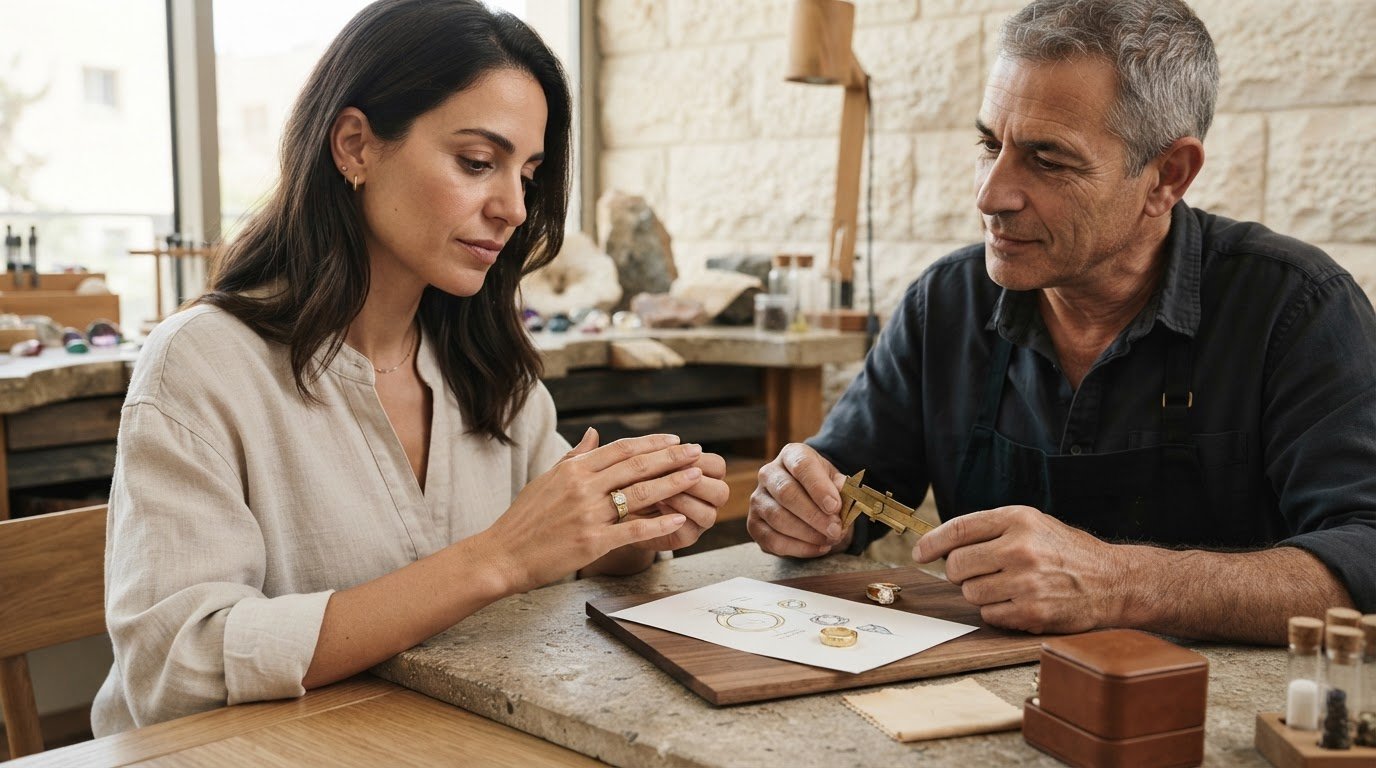
What if I’m unhappy with my final custom ring, even though I approved the design? A finished piece can feel different on your hand than it did in a sketch or rendering. Noticing a concern doesn’t mean you’re out of options, but it also doesn’t mean a particular remedy is guaranteed. Start by identifying what feels wrong and checking what you and the jeweler agreed.
It’s understandable to feel disappointed or unsure whether the issue is fit, finish, the stone, or the ring’s proportions. A clear, thoughtful conversation with the original jeweler is a sensible first step. This guide explains how to compare the ring with approved design details, gather useful photos and records, and describe your concerns constructively. It also covers how to ask about possible next steps, which may depend on the order terms, the nature of the issue, the jeweler’s policies, and any consumer protections that apply in Israel. Begin with details you can verify, then make a specific request.
Key Takeaways
- If you’re asking “what if I’m unhappy with my final custom ring,” identify the specific concern and separate personal preference from a possible mismatch with agreed details.
- Compare the ring with your approved design and order records. Note observable differences and questions that need clarification.
- Contact the jeweler with a concise message, relevant order details, and clear photos of the concern.
- Ask what options may be considered, but don’t assume a remake, exchange, refund, or alteration is available. Terms and circumstances matter.
- For a future custom order, clarify design details, materials, approval stages, timing, and applicable terms in writing before proceeding.
Unhappy with your final custom ring? First identify what feels wrong
Disappointment is worth discussing, even when a ring was made to your personal design. Before deciding what to ask for, describe the concern as specifically as you can. Is it the fit, stone, setting, finish, proportions, or engraving? A precise description helps distinguish a change in taste from a possible difference between the finished ring and the details you approved. Asking what if I’m unhappy with my final custom ring is a starting point, not a conclusion about which remedy may be available.
Write down what you notice and where. “The ring feels uncomfortable against my neighboring finger” gives the jeweler a clearer point to assess than “it doesn’t feel right.” For a visual concern, identify the feature and the angle or setting in which it stands out. This makes it easier to keep the conversation specific and constructive.
Is the ring different from the approved design?
Review the written brief, sketches, digital renderings, and messages confirming changes or approvals. Compare documented details such as the metal, stone, dimensions, setting, and ring size with the finished piece. If you need terminology, this overview of materials used in rings offers basic context. Your order documents are the relevant reference for the specific piece.
Note apparent differences, but don’t assume that a change in appearance proves a manufacturing error. Lighting, scale, and how a design looks on your hand can affect perception. Ask the jeweler how the approved details were interpreted and whether the feature you noticed matches the documented specifications.
Is it a change of taste or a practical issue?
Describe whether your concern is about appearance, comfort, everyday wearability, or a stated specification. A setting may look more prominent than you imagined, while a ring that catches on clothing or feels tight raises a practical question. These concerns may call for different conversations, and neither should be dismissed before the details are understood.
Record when you first noticed the issue and whether you’ve worn the ring. If the fit varies, describe when it feels tight or loose rather than guessing at the cause. If you suspect a defect or a mismatch with an agreed detail, explain exactly what you observed and point to the relevant approval or specification.
- Fit: Note where the ring feels tight, loose, or uncomfortable, and when you notice it.
- Proportions: Identify which element looks larger, smaller, wider, or higher than expected.
- Setting or finish: Describe the specific area that appears different or feels rough.
- Stone or engraving: Compare its placement or appearance with the approved details.
A clear concern doesn’t automatically determine whether an alteration, remake, refund, or another outcome is available. That depends on the circumstances and applicable terms. For now, focus on what you can observe and how it compares with what was agreed.
How to raise concerns about a custom ring clearly and constructively
Once you’ve identified what feels wrong, contact the jeweler promptly through the order channel or contact details provided. A calm, focused message gives the maker a useful starting point and creates a written record. Include your order reference, describe what you observed, and state what you’d like first: clarification, an assessment, or a conversation about possible options.
Before asking for a remedy, compare the ring with the documented approvals. This anchors the discussion in agreed details rather than memory or a general sense that the piece looks different. If the issue concerns a gemstone, include relevant order details or documentation. The Gemological Institute of America (GIA) also offers educational resources about gemstones, but it can’t determine whether your ring matches its approved design.
What evidence should you gather before contacting the jeweler?
Collect your order confirmation, design brief, approved sketches or renderings, and written correspondence about changes. Photograph the ring in clear, even light. Include close views of the area in question and wider views that show its proportions. Keep the packaging and care information with your records. Don’t attempt an alteration or repair before asking the jeweler how to proceed, since a change could make the original concern harder to assess.
How should you explain what you want addressed?
Be specific and neutral. Instead of saying “it looks wrong,” describe the detail: “The center stone appears higher than in the approved side-view rendering.” Ask the jeweler to explain the difference and clarify whether it corresponds with the approved specifications. If you’re unsure of the cause, avoid presenting it as fact. Share what you can observe and invite the jeweler’s assessment.
You can adapt this message:
Subject: Question about custom ring order [reference]
Hello, I’ve received my custom ring and have a concern about [specific feature]. Compared with [the approved detail or document], I’ve noticed [clear observation]. I’ve attached photographs and the relevant design reference. Could you clarify whether this matches the approved design and advise how we can assess it? At this stage, I’m looking for [information/an assessment/a discussion of possible options]. Thank you.
Keep the original message and replies with your order records. If you’re wondering what if I’m unhappy with my final custom ring, clear, documented first contact helps establish the issue without presuming the outcome. For a future design, you can explore KaMila’s custom jewelry design and discuss expectations and approval details as part of the conversation.
Custom ring expectations versus documented details: assess the difference
A custom design takes shape through conversation, references, and approvals. The finished ring may still feel different from what you pictured, but that feeling alone doesn’t establish whether the piece departs from the agreement. Compare what you can observe with the details documented in your order, then ask the jeweler how any specifications are assessed. Don’t assume a difference is a workmanship issue, and don’t invent a tolerance that wasn’t agreed.
Which ring details can you compare against the agreement?
Check the written design brief and approvals for the metal, ring size, stone selection, setting, shape, and any documented dimensions. If the stone’s color or appearance was described, look for specific measurements, references, or other agreed details. For a diamond, confirm whether the order identifies it as lab-grown or natural. A rendering can help communicate a design, but it may not show exactly how the finished ring will look in three dimensions or under different lighting.
Agreed detail | Finished-ring observation | Question to ask
Metal | The ring’s color looks different from the reference. | What metal and color were specified, and how can I confirm them?
Stone | The stone appears different in color or size. | Which stone details were agreed, and how are they assessed?
Setting or shape | The stone looks higher, or the profile seems broader than expected. | How does the finished profile compare with the approved design?
Ring size or dimensions | The ring feels tight, or a documented measurement seems different. | Which measurement was approved, and how was it checked?
Use these examples as prompts, not as a remote diagnosis. A photograph or rendering may look different from a finished ring because of viewing angle, scale, or lighting. If a detail seems inconsistent, ask the jeweler to explain the comparison and the method used to assess it.
What if the ring simply does not feel like you?
A design that felt right on screen or in a sketch can feel unfamiliar once it’s three-dimensional and worn. That may be a change in preference rather than a departure from the approved details. Name what feels unlike you: the proportions, prominence of the stone, or how the ring sits alongside other jewelry. Then separate that reaction from any specific feature you believe differs from the agreement.
If you’re asking, what if I’m unhappy with my final custom ring, you can ask whether an alteration is feasible without assuming it will be offered or suitable. The answer may depend on the ring, the concern, and the order terms. Ask what can be assessed and what options, if any, may be available.
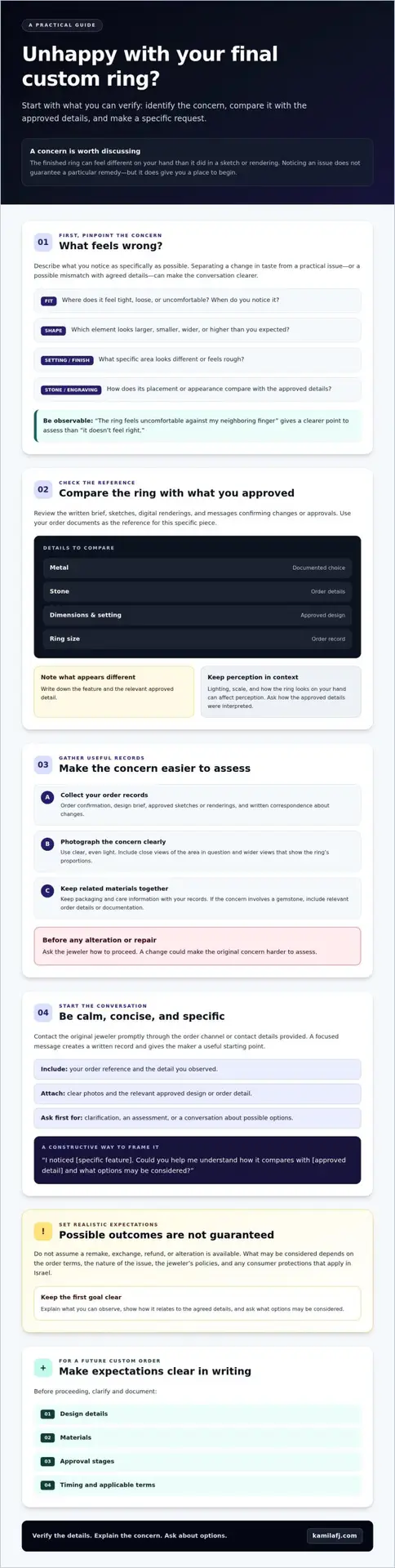
What options might exist if a custom ring disappoints you?
A disappointing result doesn’t automatically mean you have no choices, but it also doesn’t guarantee a particular remedy. The next step is to understand what was agreed, what the concern is, and which terms apply to your order. A conversation with the jeweler may involve clarifying a design detail, assessing a suspected discrepancy, or asking whether an alteration is feasible.
Review the terms and policies supplied with your order rather than assuming that a remake, exchange, refund, or repair will be offered. Ask the jeweler to explain the relevant terms and possible next steps in writing. A clear written response helps you understand the proposal before deciding how to proceed.
Does a custom order mean you have no options?
Not necessarily. Avoid treating “custom” as an automatic no-return rule or as a promise of a refund. The agreement and applicable policy matter, as may the reason for the concern and the details of the purchase. If the ring appears inconsistent with an approved specification, explain the difference and ask how it will be assessed. If the issue is a change in preference, ask what possibilities, if any, can be discussed under your order terms.
Consumer rights depend on where you bought the ring and the circumstances of the transaction. If you need legal guidance, consult an appropriate local consumer-advice source in Israel, such as the Israel Consumer Protection and Fair Trade Authority, or seek advice from a qualified professional. Don’t rely on rules that apply in another country without checking whether they cover your purchase.
When should you ask about an assessment or alteration?
Ask the original jeweler before taking the ring to another workshop or authorizing a change. Altering a piece first could affect the jeweler’s ability to assess the concern or may have implications under the order terms. Describe the issue and ask what an assessment would involve, whether a proposed alteration is feasible, what risks it may carry, and which terms would apply. Request the explanation in writing before agreeing to work.
If you’re asking, what if I’m unhappy with my final custom ring, begin with a calm review of the agreement and a direct question to the jeweler. For a future design, you can explore KaMila’s custom jewelry service and discuss expectations, approvals, and applicable terms before commissioning a piece.
Before commissioning another custom ring, make expectations clear
A thoughtful design collaboration starts with more than an appealing sketch. Before work begins, agree on the details that will guide the finished ring and keep a written record of decisions. Clear expectations won’t guarantee that every detail looks exactly as imagined, but they make it easier to understand what each approval means and raise questions early.
What should you agree on before the jeweler begins?
Use this checklist to shape the conversation, then ask the jeweler to confirm the relevant details and terms in writing:
- Design: Record the ring size, metal, stone details, setting, shape, and any agreed dimensions. Share visual references and clarify which features are essential.
- Approvals: Ask who approves sketches or renderings, what each approval confirms, and how requested changes will be recorded. Find out whether approval means the design direction is accepted or whether specific details are being finalized.
- Timing: Confirm the expected timeline and how you’ll be updated if it changes.
- Terms: Request the applicable order, delivery, cancellation, and post-delivery terms before committing. Ask how fit concerns, changes, or questions after delivery are handled.
Keep the final written brief and approval messages together. If an image is only a design reference, ask what it does and doesn’t establish about the finished piece. These clarifications can prevent assumptions from forming on either side.
How can you choose a jeweler for a personal design?
Look for clear communication, transparent information about materials, and a design process that explains how ideas become approvals. Notice whether you can ask questions and receive specific answers about the details that matter to you. For more selection context, read this guide to choosing a fine jewelry store. If you’re planning an engagement design, the complete engagement ring guide can help you consider what you want the ring to express.
Ask directly how the jeweler handles revisions, fit questions, and post-delivery concerns, and keep the answers with your order documents. If you’re still wondering what if I’m unhappy with my final custom ring, discussing these terms before placing an order can help you understand the process and what has been agreed.
KaMila Fine Jewellery offers custom jewelry by request. Explore custom jewelry by KaMila Fine Jewellery and raise your questions before deciding whether to place an order.
Take the next step with clarity and confidence
If you’re asking, “what if I’m unhappy with my final custom ring,” begin with what you can verify: describe the concern, compare it with the approved details, and ask the jeweler to explain the applicable terms and possible next steps. A clear record can help distinguish a preference change from a concern about fit, finish, or agreed specifications.
There’s no need to assume a particular outcome before you understand your order and the circumstances. A thoughtful conversation can bring clarity, whether you’re discussing an existing piece or planning a future design. Before commissioning a ring, confirm the materials, design approvals, timing, and relevant policies in writing.
KaMila Fine Jewellery offers custom jewelry by request, with work featuring 18-karat gold, gemstones, and lab-grown diamonds. Explore custom jewelry by KaMila Fine Jewellery and raise your questions before placing an order. Clear expectations and open communication can help you move toward a design that feels personal and considered.
Frequently Asked Questions
What should I do first if I am unhappy with my final custom ring?
Start by comparing the ring with your order details, approved design, and written messages. Photograph the specific concern in clear light, then contact the jeweler through the order channel. Describe what differs or feels uncomfortable and ask for an explanation and the options available under your agreement. If you’re asking what if I’m unhappy with my final custom ring, avoid making alterations before speaking with the original jeweler.
Can I ask a jeweler to change a custom ring after it is finished?
Yes, you can ask whether a change is possible, but don’t assume it can be done or that it’s included in your order. Feasibility depends on the ring’s construction, the requested alteration, the jeweler’s assessment, and applicable terms. A change may affect the setting, stone, or structure. Ask the jeweler to explain the process and any relevant terms in writing before authorizing work or taking the ring elsewhere.
Does a custom ring have to match its digital rendering exactly?
Not necessarily. A digital rendering communicates a design, but how closely it represents the finished ring depends on the specifications and approval process. Compare documented details, such as materials, dimensions, stone selection, and setting, with the delivered piece. If something appears different, ask the jeweler to explain the variation. Don’t assume every visual difference is acceptable or proves a fault without reviewing the agreement and the details it records.
Can I get a refund if I dislike my custom ring?
A refund isn’t automatic simply because you dislike the finished design, but don’t assume it’s unavailable in every situation either. The order terms, reason for dissatisfaction, seller policy, and consumer rules that apply to your purchase all matter. Review your documents and ask the jeweler to explain any options in writing. If you need guidance on your rights, consult a suitable consumer-advice source in the jurisdiction relevant to your transaction.
What if the custom ring does not fit or feels uncomfortable?
Contact the jeweler promptly and explain where or when the ring feels tight, loose, or uncomfortable. Include the ring size stated in your order and clear photographs if they help illustrate the concern. Ask whether an assessment or adjustment is possible and what terms apply. If the ring feels loose enough to slip off, or wearing it could risk damage, avoid wearing it until you’ve discussed how to proceed.
Should I take my custom ring to another jeweler for a repair?
Speak with the original jeweler first, especially if the concern may involve the approved design, workmanship, or order terms. Another workshop may be able to assess the ring, but outside work could complicate a later discussion with the original seller. Before authorizing an inspection, alteration, or repair elsewhere, ask the original jeweler in writing whether it could affect their assessment or any options under your agreement.
Related Posts

Questions to Ask a Jeweler About Their Sourcing Ethics
-
Posted by
מילה קלר
What if “ethically sourced” tells you less than the answer to one careful question? When choosing a piece with personal meaning, it’s natural to want…

Jewelry Design in Haifa: What to Expect in 2026
-
Posted by
If you’re searching “jewelry design consultation in Haifa what to expect,” you may be wondering what to bring, which decisions you’ll need to make,…
Is My Diamond Too Big for My Hand? A Personal Style Guide
-
Posted by
A diamond can look dramatic in a product photo and feel perfectly at home on your hand; a smaller stone can still make a striking statement. If…
Ensuring Your Final Ring Matches the 3D Render
-
Posted by
What if the image you approved is a beautiful preview, but not a complete specification for the ring being made? Ensuring the final ring matches the…
From Sketch to Sparkle: Ensuring the Final Piece Matches Your Jewelry Design
-
Posted by
You’ve spent weeks dreaming of a ring that captures your story, but as you look at the artist’s rendering, a small doubt creeps in. Will that…
How to Give Constructive Feedback on a Jewelry Design: A Client’s Guide
-
Posted by
What if telling your jeweler you dislike a detail isn’t an insult, but the exact spark they need to craft your dream heirloom? When you first open…
Designing a Custom 18k Gold Ring: 2026 Bespoke Guide
-
Posted by
What if the most exquisite jewelry you ever own isn’t reserved for formal galas, but crafted to enrich your daily life? When you start exploring…
Red Flags When Choosing a Custom Jewelry Designer: A 2026 Guide to Protecting Your Vision
-
Posted by
Imagine spending months dreaming of a bespoke 18k gold ring, only to open the velvet box and find a piece that feels like a generic retail cast…

Common Regrets After Buying an Engagement Ring: How to Choose a Forever Piece
-
Posted by
What if the most significant purchase of your life becomes a source of quiet hesitation every time you get ready in the morning? It’s a heavy…

15 Essential Questions to Ask a Jeweler Before They Start Designing Your Piece
-
Posted by
You’ve spent months dreaming of a piece that captures your unique story, but as the jeweler picks up their pencil, a flicker of anxiety often sets…

Hidden Halo Engagement Rings: A Guide to Subtle, Modern Brilliance (2026)
-
Posted by
What if the most captivating detail of your jewelry wasn’t meant for the rest of the world to see, but was a secret kept just for you? Many couples…
What if I Change My Mind During the Custom Jewelry Design Process?
-
Posted by
You have spent weeks dreaming of a sleek, minimalist gold band, but suddenly, a more ornate, symbolic setting is calling your name. It is a common…