
Blog
Questions to Ask a Jeweler About Their Sourcing Ethics
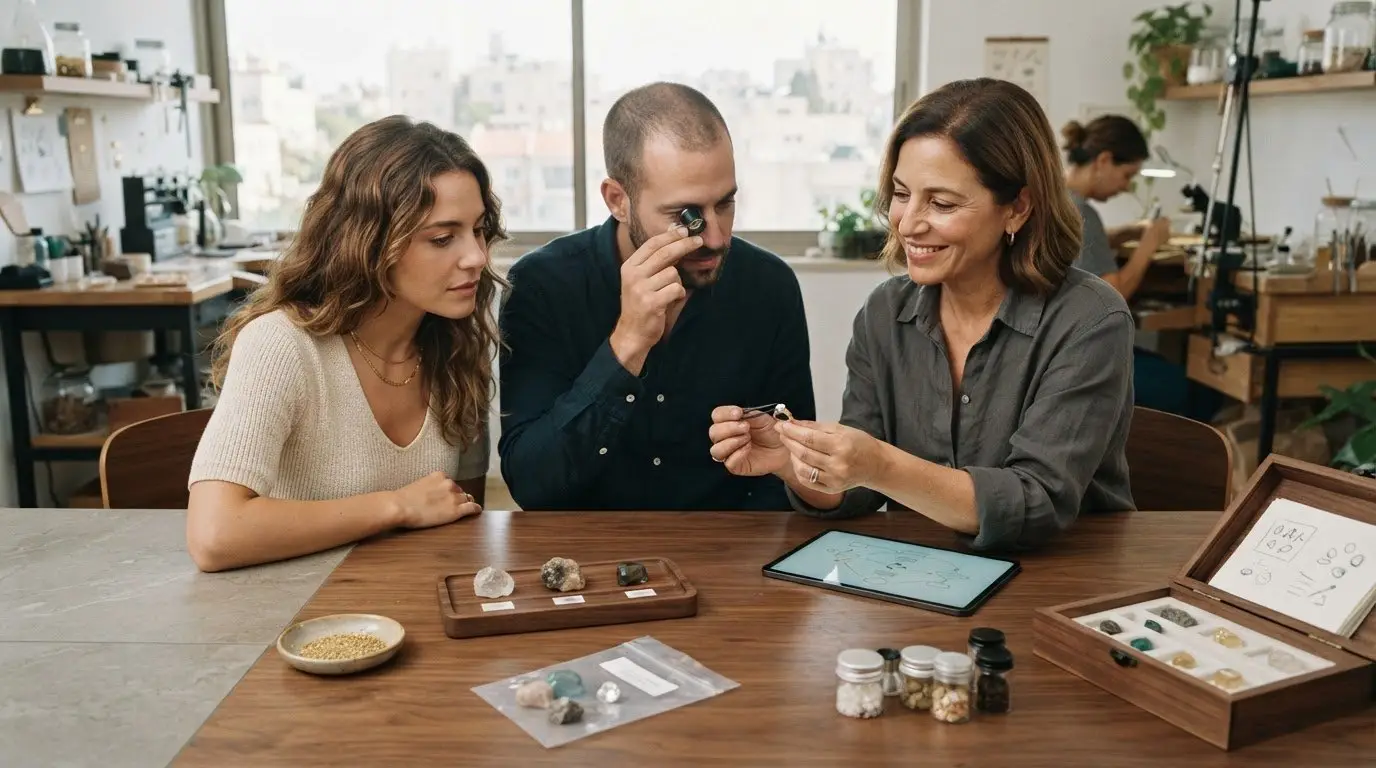
What if “ethically sourced” tells you less than the answer to one careful question? When choosing a piece with personal meaning, it’s natural to want to know where its gold or gemstones came from. Suppliers can sit between a mine or lab and the jeweler, and a label may not explain that journey. The questions to ask a jeweler about their sourcing ethics can help you move from reassuring language to useful detail.
It’s reasonable to feel unsure about how much to ask, or what to make of an answer that doesn’t name every supplier. You don’t need to interrogate anyone or expect a flawless supply chain. Clear explanations, relevant records, and honesty about what can’t be verified are more useful than a broad promise.
This guide offers specific questions about gold, mined and lab-grown diamonds, and other gemstones, along with evidence to look for and follow-up prompts when an answer is vague. You’ll learn how to check what a certification or document actually covers, so you can make a choice that better reflects your values.
Key Takeaways
- Ask specific questions to learn what a jeweler knows about a gemstone’s origin, its supplier chain, and any supporting documents.
- Ask whether gold is newly mined, recycled, or a mix. Remember that 18-karat purity describes gold content, not its origin.
- The questions to ask a jeweler about their sourcing ethics should clarify which materials and supply-chain stages each claim covers.
- Assess answers by asking clearly, checking the scope, requesting evidence, and noting what remains unknown.
- Before choosing a piece, weigh the sourcing information available alongside its design, craftsmanship, and what matters most to you.
What ethical jewelry sourcing means, and what a jeweler’s claims actually cover
A piece of jewelry has more than one story. Its materials may pass through several suppliers and stages of work before they become finished jewelry, so “ethical sourcing” isn’t a single quality confirmed by one broad label. It involves asking where materials come from, how people are treated, what environmental effects are considered, and how a business checks and describes its supply chain.
Sourcing transparency means explaining what is known, how it is known, and where information stops. It doesn’t guarantee every ethical outcome across a supply chain. This distinction helps keep the conversation fair and specific. A jeweler may have documentation for one stone but limited information about the gold setting, or know a material’s supplier without knowing its original source.
Why “ethical” and “conflict-free” are not complete answers
Terms such as “ethical,” “responsible,” and “conflict-free” can refer to different commitments. Ask what the statement applies to: which material, supplier, product, or stage of production? Does it address labor conditions and environmental impact, or a narrower concern?
For diamonds, the Kimberley Process Certification Scheme is an international effort focused on preventing conflict diamonds from entering the mainstream market. Its definition of conflict is limited, so citing the scheme shouldn’t be treated as proof that every human-rights or environmental concern has been addressed. Ask: “What does this assurance cover, and what doesn’t it cover?”
Which parts of a piece have their own sourcing story?
Ask about each material separately. An answer about a center diamond doesn’t establish the sourcing history of its gold setting, side stones, or other components. Apply the same care to colored gemstones and lab-grown diamonds: ask what the jeweler knows about the material’s source and which steps they can document.
Raw-material origin is only part of the picture. You can also ask where and by whom a piece was cut, assembled, or finished, and what the jeweler knows about the working conditions involved. If the jeweler can describe one stage but not another, that’s useful information too. Keep the questions to ask a jeweler about their sourcing ethics focused on clear boundaries: “Which parts of this piece does your sourcing information cover?” and “Where does your knowledge end?” A precise, limited answer is more informative than a sweeping assurance.
Questions to ask about gemstone origin, diamonds, and supporting documents
A stone’s beauty is easy to see; details of its journey may be less clear. Ask what the jeweler knows directly, what information comes from suppliers, and where the trail becomes incomplete. These questions to ask a jeweler about their sourcing ethics can turn a general assurance into a discussion about a specific stone and the evidence available for it.
What to ask about a diamond or colored gemstone
Keep your questions open and practical. You’re looking for a clear account of what is known, not a promise that every link in the chain is documented.
- “Can you identify the country or region where this stone was mined or produced?”
- “Can you show documentation connecting this stone, or its batch, to the source?”
- “Which parts of its supplier chain do you know firsthand?”
- “If the exact source isn’t available, what information can you verify instead?”
For a lab-grown diamond, ask what the jeweler can substantiate about its production location, producer, and route through suppliers. If you’re considering this material, KaMila’s lab-grown diamonds guide offers more context. The aim is to understand what information exists, not to assume that “lab-grown” answers every question about production or supply.
How to read reports without overclaiming what they prove
Before relying on a document, ask who issued it, which stone or batch it identifies, and what facts it records. A report may describe gem identity, grading characteristics, or a stated geographic origin. These are distinct claims. For example, the GIA Diamond Origin Report concerns country of origin for diamonds within the report’s scope. It isn’t, by itself, an assessment of labor conditions throughout the supply chain.
A document supports only the claims within its stated scope. It doesn’t automatically verify parts of a stone’s story that it doesn’t address. A grading report, for instance, should not be treated as proof of where a stone was mined or how workers were treated. Match each document to the jeweler’s exact claim, and check whether it refers to the individual stone or a broader batch.
If you’re planning custom jewelry, discuss the stone and available sourcing information before settling on the design. You can explore custom jewelry design as a starting point for considering material choices alongside the piece you have in mind.
Questions about gold, skilled makers, and the wider jewelry supply chain
A stone may draw the eye, but the metal and the people who shape it are part of the piece’s story too. Ask about these separately. For gold, find out whether it’s newly mined, recycled, or a mixture, and what information supports that description. “Recycled” can refer to different material streams or stages, so ask what the claim covers and whether it applies to the whole piece or only some of its gold.
What to ask about gold and other precious metals
Try asking: “How do you distinguish recycled gold from newly mined gold?” and “What documentation supports this claim, and does it cover this piece or a wider batch?” If the answer is based on a supplier’s statement, ask whether the jeweler has records connecting that information to the material used in the jewelry.
An 18-karat mark describes gold content. It doesn’t reveal whether the gold was mined or recycled, where it originated, or the conditions involved in its production. Treat purity and sourcing as separate questions.
Who makes the jewelry, and what can the jeweler tell you?
Ask whether the piece is made in-house or by an external workshop, where the work takes place, and what the jeweler knows about the people or businesses involved. You can also ask how the jeweler learns about working conditions and whether any oversight or checks are documented. A specific answer about the maker is useful, but it doesn’t automatically verify every condition across the supply chain.
For more ideas on assessing a jeweler’s approach, see this guide to choosing a jewelry store. The questions to ask a jeweler about their sourcing ethics should invite a clear account, not demand information the jeweler can’t reasonably provide.
The comparison below helps separate a claim from its supporting information and its limits.
| Claim | Useful follow-up | Evidence offered | Remaining uncertainty |
|---|---|---|---|
| “The gold is recycled.” | Does this apply to all the gold in this piece? | Supplier statement or material records | Whether the records cover this specific piece and the full supply chain |
| “We work with skilled makers.” | Where is the piece made, and what do you know about the workshop? | Workshop details or documented checks | How fully working conditions are assessed |
Use the final column as a prompt, not a verdict. A jeweler who identifies what they can verify and what remains unknown gives you a more useful basis for deciding whether the piece fits your priorities.
How to assess answers, evidence, and sourcing red flags without demanding perfection
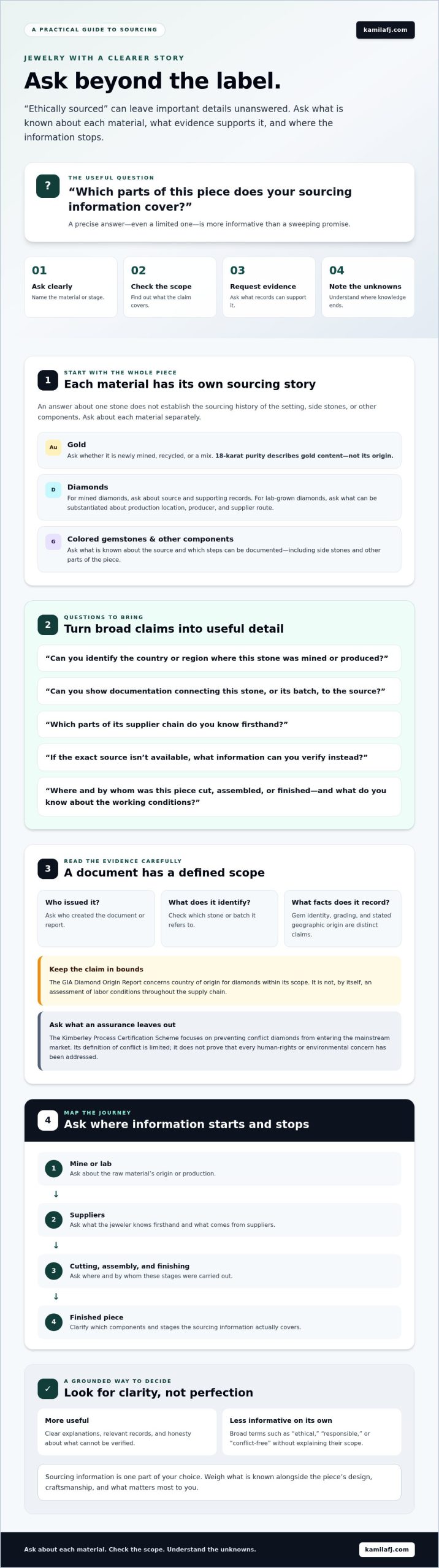
A sourcing conversation doesn’t need to end with a complete map of every supplier. What matters is whether the jeweler answers plainly, explains the limits of their knowledge, and distinguishes documented facts from assumptions. Use this four-step check to keep the discussion focused:
- Ask specifically: Name the material or claim you want to understand.
- Identify the scope: Find out which product, material, supplier, or stage the answer covers.
- Request support: Ask what relevant record or information the jeweler can share.
- Note what remains unknown: Separate verified details from gaps or unanswered questions.
A clear answer might sound like: “Our supplier confirms the gold is recycled, and we can share the material specification. We don’t have mine-level information.” That response gives you a claim, its support, and a limit. Compare it with “Everything we use is ethical,” which leaves the meaning and evidence unclear. An incomplete answer isn’t automatically a red flag. Evasion, changing explanations, or unwillingness to clarify a broad claim may deserve closer attention.
What a clear, useful answer sounds like
Check that any evidence relates to the piece or material you’re considering, rather than an unrelated product or general company policy. If a jeweler offers to follow up, note what they say they’ll provide and when. Keeping a short record of the claim, document, and open question makes it easier to compare options later.
How to follow up when the answer is incomplete
Supplier confidentiality can be a legitimate limit. You don’t need private names, contracts, or commercially sensitive details to ask for meaningful support. Try: “Could you share a supplier statement, material specification, or summary with confidential details removed?” Then ask whether the same information applies to ready-to-wear pieces and custom orders. A custom design may involve different material choices or suppliers, so confirm rather than assume.
If the jeweler can’t provide a document, ask what they can verify and what steps they take to check supplier information. The questions to ask a jeweler about their sourcing ethics are most useful when you compare responses using the same criteria. Review another jeweler’s disclosures too, and assess the full explanation rather than judging by one label or missing detail alone.
Considering a piece shaped around your ideas? Explore custom jewelry design and ask about materials and documentation before you commit.
Turn sourcing questions into a jewelry choice that reflects your values
Good sourcing decisions don’t require perfect information. Start by identifying what matters most to you, then weigh the jeweler’s answers alongside the piece’s design, craftsmanship, and personal meaning. One shopper may prioritize a gemstone’s origin; another may care more about recycled-metal documentation or who made the jewelry. Your priorities can guide your questions and help you decide what level of uncertainty feels acceptable.
A simple checklist to take into your next jeweler conversation
Before you choose, use this checklist to keep the conversation focused:
- Materials: Identify the gold, diamonds, colored gemstones, or other components you want to ask about.
- Origin: Ask what is known about where each material came from and which steps of its journey are documented.
- Maker: Find out where the piece is made and what the jeweler can share about the people or workshops involved.
- Evidence: Note what records or explanations support each specific claim, and whether they apply to the piece you’re considering.
- Open questions: Write down what remains unknown, then decide whether those gaps matter to your choice.
The questions to ask a jeweler about their sourcing ethics are there to support your decision, not produce a pass-or-fail score. A jeweler may be able to explain some parts of a material’s story but not others. Consider how directly they communicate, whether their evidence matches their claims, and how those details align with your values. Then weigh that information against the qualities you’ll live with every day: the design, the feel of the craftsmanship, and what the piece represents to you.
When a custom design gives you room to ask more
Custom jewelry lets you discuss material choices while the design is still taking shape. Ask which options are available for a one-of-a-kind piece, and what sourcing information the jeweler can share about each option. Clarify what can be confirmed before approving the materials or finalizing design details. This gives you a chance to consider the piece as a whole instead of trying to resolve sourcing questions after the choices have already been made.
KaMila Fine Jewellery designs handcrafted fine jewelry and offers custom design, alongside pieces in 18-karat gold with precious gemstones and lab-grown diamonds. To explore its work, visit KaMila Fine Jewellery and bring your questions about materials and available information into the conversation.
Choose a Piece with Confidence
The questions to ask a jeweler about their sourcing ethics can help you look beyond broad labels and understand what a claim covers, what evidence supports it, and what remains unknown. Ask about each material and the people involved in making the piece. Then weigh the answers alongside design, craftsmanship, and the values that matter most to you.
You don’t need perfect information to make a thoughtful choice. A jeweler who explains what they know, acknowledges limits, and responds clearly gives you a stronger basis for deciding whether a piece feels right for your story.
KaMila Fine Jewellery offers handcrafted jewelry in 18-karat gold, with precious gemstones and lab-grown diamonds, as well as custom design. If you’re exploring a piece, bring your material questions into the process and ask what information is available. Explore KaMila Fine Jewellery to find a design that feels meaningful to wear.
Frequently Asked Questions
What questions should I ask a jeweler about ethical sourcing?
Ask where each gemstone and metal comes from, who made the piece, what the jeweler knows about suppliers, and what documentation supports each claim. The questions to ask a jeweler about their sourcing ethics should also clarify the scope of any assurance: does it apply to this specific item, one material, or only part of the supply chain? Ask what remains unknown, and look for answers tied to the materials you’re considering rather than a general ethical label.
How can I tell if a jeweler is transparent about sourcing?
Look for direct answers that separate confirmed information from details the jeweler can’t verify. Ask which materials and supply-chain stages a statement covers, then request relevant supporting information, such as a material specification or supplier statement. A jeweler may not be able to disclose private supplier details, but should be able to explain the limits of their knowledge. Polished language alone isn’t evidence; clarity about scope and uncertainty is more useful.
Does a diamond certificate prove that a diamond was ethically sourced?
Not necessarily. A certificate or report has a defined purpose and scope, which may concern a stone’s characteristics or other recorded details rather than labor conditions or its complete supply chain. Ask who issued the document, which stone it identifies, and what claims it supports. A report can be useful evidence for the details it covers, but don’t treat any single document as proof of every ethical consideration connected to a diamond.
Are lab-grown diamonds automatically ethical?
No. Lab-grown diamonds differ in how they’re produced, but the label alone doesn’t answer every question about energy use, labor, suppliers, or production practices. Ask what the jeweler can substantiate about the specific diamond, its producer, and the information available about its production and supply. Then weigh those details, along with any gaps in the answer, against your priorities. Don’t assume every lab-grown diamond has the same impact or supply-chain story.
What should I ask about the sourcing of gold jewelry?
Ask whether the gold is newly mined, recycled, or a mixture, how that description is verified, and what information is available about suppliers and production. A karat mark describes gold content, not its origin or the conditions under which it was produced. For a particular piece, check whether the answer applies to all its gold or only some of it, and ask to see any relevant documentation the jeweler can share.
What if a jeweler cannot tell me where a gemstone came from?
Ask what the jeweler does know, why the exact origin is unavailable, and whether supplier or chain-of-custody records can be shared. An incomplete answer isn’t automatically proof of wrongdoing, but it gives you information to consider. Notice whether the jeweler explains the limitation clearly, distinguishes known facts from assumptions, and responds to follow-up questions. Then decide whether the remaining uncertainty fits your values and comfort level before purchasing.
Are recycled metals always the most ethical choice?
No single material choice guarantees that every ethical concern has been addressed. Recycled content can be relevant, but it doesn’t establish every detail about processing, labor, or the full supply chain. Ask how the jeweler defines “recycled,” what proportion of the piece or product the claim covers, and what evidence supports it. Compare the answer with your priorities rather than treating recycled metal as a universal measure of responsibility.
Related Posts

Jewelry Design in Haifa: What to Expect in 2026
-
Posted by
מילה קלר
If you’re searching “jewelry design consultation in Haifa what to expect,” you may be wondering what to bring, which decisions you’ll need to make,…
Unhappy With Your Final Custom Ring? Here’s What to Do Next
-
Posted by
What if I’m unhappy with my final custom ring, even though I approved the design? A finished piece can feel different on your hand than it did in a…

How to Convince Your Husband to Upgrade Your Wedding Ring
-
Posted by
What if your wedding ring wasn’t just a relic of who you were when you said “I do,” but a luminous reflection of the woman you’ve become today? Many…
Red Flags When Choosing a Custom Jewelry Designer: A 2026 Guide to Protecting Your Vision
-
Posted by
Imagine spending months dreaming of a bespoke 18k gold ring, only to open the velvet box and find a piece that feels like a generic retail cast…
Minimalist Gold Rings: A Guide to Curating Your Timeless 18K Collection
-
Posted by
Your jewelry shouldn’t have an expiration date. Too many of us have felt the frustration of a cherished piece tarnishing or causing skin irritation…

Common Regrets After Buying an Engagement Ring: How to Choose a Forever Piece
-
Posted by
What if the most significant purchase of your life becomes a source of quiet hesitation every time you get ready in the morning? It’s a heavy…

Handcrafted Minimalist Jewelry in Israel: A Guide to Modern Elegance (2026)
-
Posted by
Why settle for jewelry that simply fills a space when you could wear a piece that captures the depth of your own story? If you’ve been searching for…
Custom 18k Gold Jewelry in Israel: A Guide to Creating Modern Heirlooms
-
Posted by
Most jewelry in local boutiques stops at 14-karat gold, but a true modern heirloom requires the deep, buttery glow that only 18-karat purity can…
Lab Grown Diamonds vs. Natural: A Modern Guide to Conscious Luxury (2026)
-
Posted by
What if the only difference between a billion-year-old miracle and a modern masterpiece was the address where it was born? When exploring the nuances…
Modern Engagement Ring Styles: A Guide to 2026 Trends and Timeless Design
-
Posted by
70% of millennials now prefer lab-grown diamonds, proving that the modern standard for brilliance is rooted in conscience. If you’re searching for…
Minimalist Gold Rings: A Guide to Timeless Elegance
-
Posted by
A piece of jewelry is never just an object; it’s a silent language and an intimate expression of your personal history that you carry through every…

18k Gold Lab Diamond Rings: Modern Heirlooms for Everyday Luxury
-
Posted by
Why save your most meaningful jewelry for a safe deposit box when it could be the most luminous part of your Tuesday morning? You deserve a piece…