
Blog
Lab-Grown vs. Natural Diamonds: The Pros, Cons & How to Choose
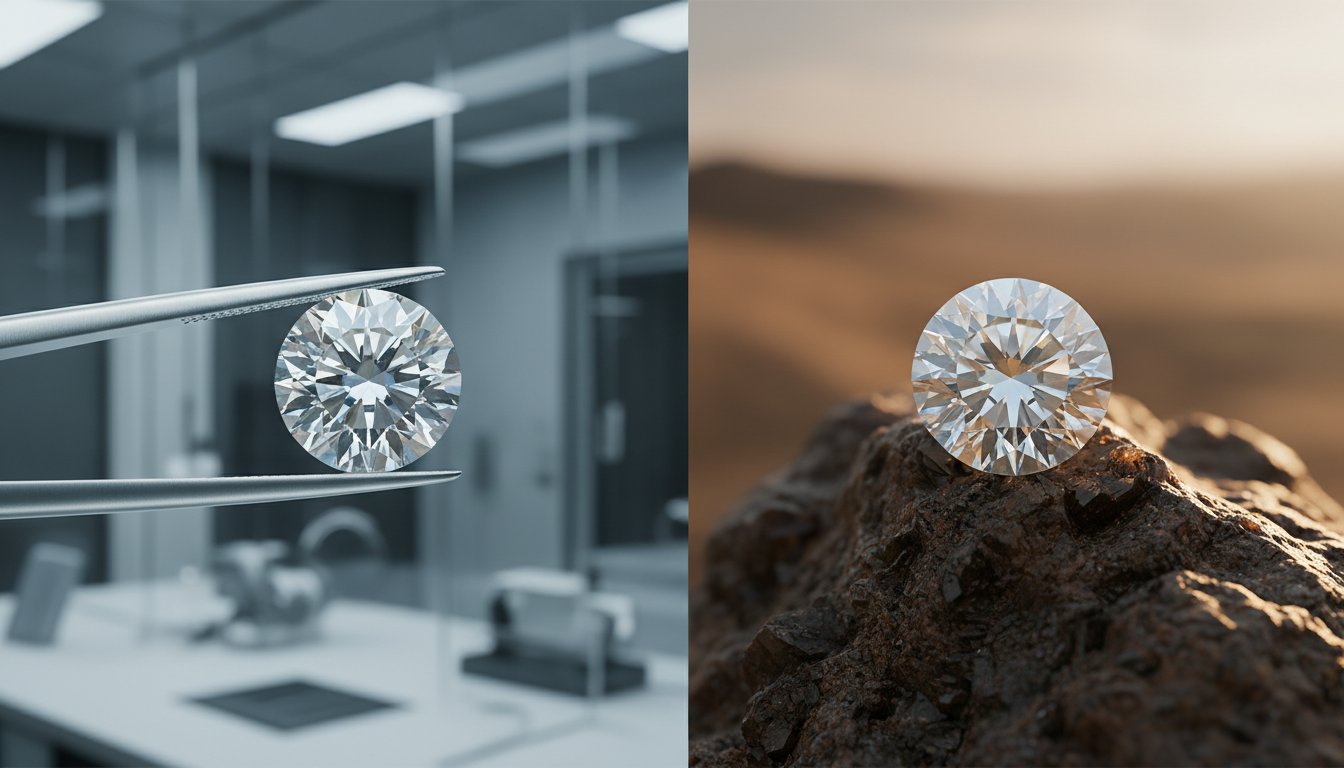
Choosing a diamond is a deeply personal moment. It’s not just a purchase; it’s the beginning of a story, a symbol of a milestone meant to be cherished for a lifetime. But today, that story begins with a significant question: lab-grown or natural? If you’re feeling caught between the allure of a billion-year-old stone and the modern promise of a lab-created one, you’re not alone. Navigating the lab grown vs natural diamond pros and cons can be overwhelming, filled with conflicting information that leaves you wondering if you’ll make a choice you’ll love forever.
We believe this decision should be empowering and joyful, not confusing. In this thoughtful guide, we move beyond the marketing jargon to offer a clear, honest comparison. We’ll explore the real differences in quality, ethical considerations, and price-including the significant savings in shekels that a lab-grown diamond can offer here in Israel. Our promise is to give you the clarity and confidence to choose the stone that doesn’t just sparkle, but one that perfectly reflects your values and beautifully tells your story.
Key Takeaways
- Discover why lab-grown diamonds are chemically, physically, and optically identical to natural diamonds, making them both equally real and brilliant choices for your jewelry.
- Understand how choosing a lab-grown diamond can significantly increase your stone’s size and quality for your budget in Israeli Shekel (₪), offering modern luxury without compromise.
- Explore how the origin story of your diamond-whether from a lab or the earth-can align with your personal values of sustainability and ethical transparency.
- Weighing the lab grown vs natural diamond pros and cons isn’t about finding a “better” stone, but about confidently selecting the one that best reflects your unique story.
What Is the Real Difference? The Science Behind the Sparkle
At their very heart, a lab-grown diamond and a natural diamond are one and the same. They share the exact same chemical, physical, and optical properties. Both are pure, crystallized carbon that dazzle with unparalleled fire and brilliance. It’s essential to understand that both are real diamonds-not to be confused with simulants like cubic zirconia or moissanite.
The only true difference is their origin story. One is a tale of ancient geology, the other a testament to modern innovation. When considering the lab grown vs natural diamond pros and cons, this distinction is the single most important factor, influencing everything from rarity to personal values.
The Journey of a Natural Diamond
A natural diamond is a piece of the Earth’s ancient history. Formed over billions of years under immense pressure and heat deep within the Earth’s mantle, each stone is a timeless miracle. Carried to the surface by volcanic eruptions, its journey is one of chance and rarity. To wear a natural diamond is to wear a unique treasure from our planet, a symbol of enduring legacy and natural artistry.
The Creation of a Lab-Grown Diamond
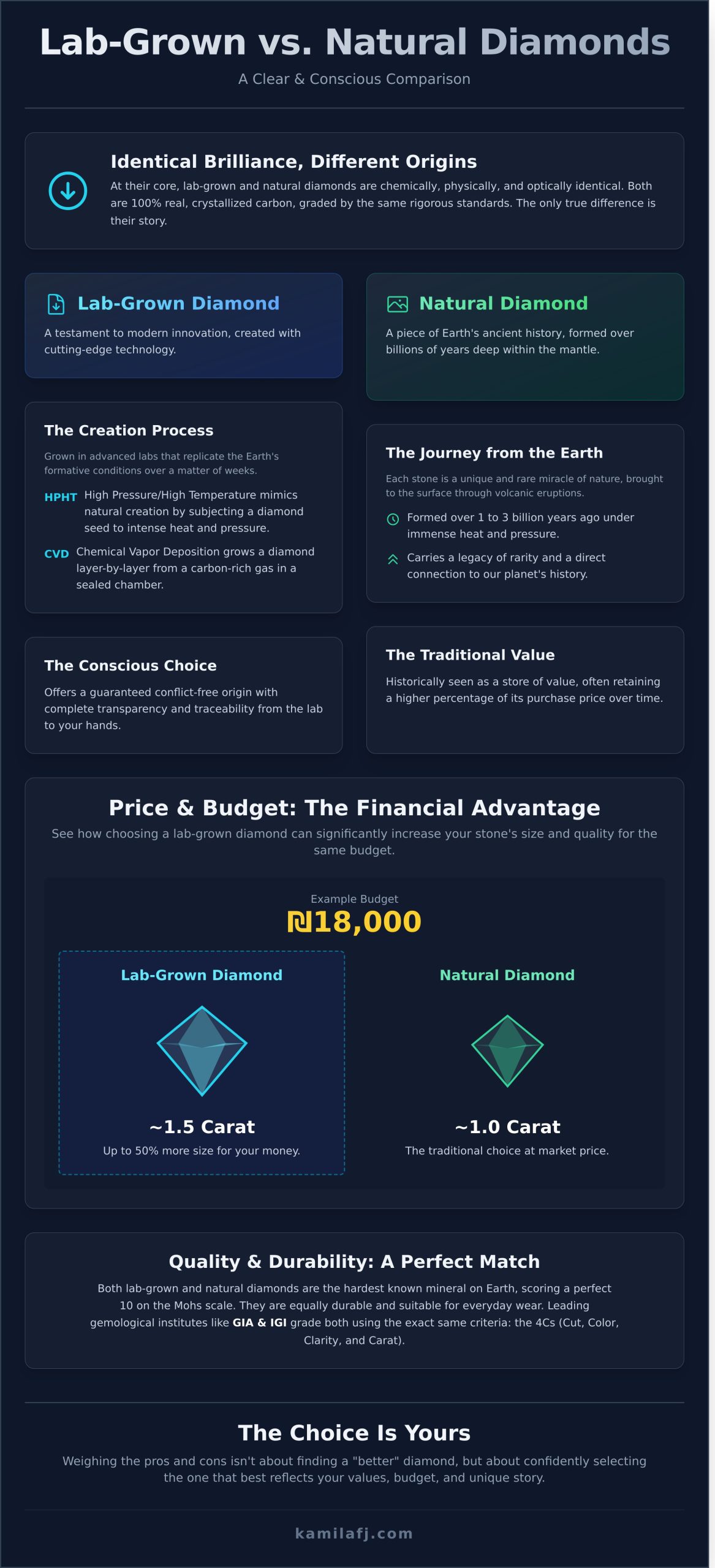
A lab-grown diamond tells a story of human ingenuity. Created in advanced laboratories that replicate the Earth’s formative conditions, these diamonds are a celebration of modern technology. Scientists use one of two primary methods:
- HPHT (High Pressure/High Temperature): A diamond seed is placed in carbon and subjected to intense pressure and heat, mimicking its natural underground creation.
- CVD (Chemical Vapor Deposition): A seed is placed in a sealed chamber filled with carbon-rich gas, which is then ionized to grow the diamond, layer by delicate layer.
This controlled process results in a diamond of exceptional quality and purity, representing a conscious and forward-thinking choice. Ultimately, whether its story began in the earth or in a lab, the sparkle is identical. The world’s most respected gemological institutes, including GIA and IGI, grade and certify both types of diamonds using the same rigorous standards, a testament to their shared identity.
Price & Budget: The Financial Pros and Cons
Choosing a diamond is a deeply personal journey, and for many, the budget is a guiding star. This is where one of the most significant differences between lab-grown and natural diamonds comes into brilliant focus. Understanding the financial aspects helps you make an empowered choice that aligns perfectly with your desires and your story.
The Modern Brilliance of a Lab-Grown Diamond
The most compelling advantage of a lab-grown diamond is its accessible price point. Typically costing 30-50% less than a natural diamond of comparable quality-the same cut, color, clarity, and carat-they open up a world of possibilities. For example, a budget of ₪18,000 might afford a stunning 1.5-carat lab-grown diamond, whereas the same budget for a natural diamond might secure a 1.0-carat stone. This empowers you to prioritize what matters most:
- A larger, more breathtaking stone that makes a statement.
- A higher grade of clarity or color for exceptional sparkle.
- The freedom to invest in a more intricate, handcrafted setting.
For those who value size and visual impact, a lab-grown diamond ensures your piece is a perfect reflection of your vision without compromise.
The Enduring Value of a Natural Diamond
Natural diamonds carry a legacy of rarity and have historically been seen as a store of value. While they tend to retain a higher percentage of their original purchase price over the long term, it is crucial to view this with a modern perspective. A diamond should be chosen for its beauty and personal meaning, not as a primary financial investment. The resale market for both natural and lab-grown diamonds is significantly lower than retail, so its true, lasting value lies in the joy and story it represents every day.
Ultimately, when weighing the lab grown vs natural diamond pros and cons, the financial decision is less about which is ‘better’ and more about what you cherish. A lab-grown diamond offers undeniable size and sparkle for your budget-a modern celebration of artistry and technology. A natural diamond offers a connection to geological history and a more traditional value proposition. The choice is yours to make, a beautiful detail in the story you are about to tell.
Ethics & Sustainability: The Conscious Consideration
For many modern buyers, a diamond’s journey is as meaningful as its sparkle. The story of its origin-how it came to be and the impact it had on the world-is a vital part of its beauty. This is where the discussion of lab grown vs natural diamond pros and cons becomes deeply personal, moving beyond simple aesthetics to reflect your core values.
The choice is not always simple, as both paths have their own complexities. However, one offers a level of certainty that is increasingly sought after by the conscious consumer. Let’s explore the ethical and environmental landscape of each.
The Case for Lab-Grown Diamonds
A lab-grown diamond represents a modern choice for transparency and sustainability. Created with cutting-edge technology that replicates the earth’s natural process, its origin story is clear, controlled, and guaranteed. This provides peace of mind that is simply unattainable with many mined stones.
- Guaranteed Conflict-Free: With a known and documented origin, lab-grown diamonds are inherently free from the ethical concerns of conflict mining.
- A Lighter Environmental Footprint: The creation process has a significantly smaller impact on our planet. For every carat, lab-grown diamonds use substantially less water and cause no direct land displacement or ecosystem disruption.
- Complete Traceability: You know exactly where your diamond came from, ensuring its journey aligns with your values from start to finish.
The Nuances of Natural Diamonds
The story of natural diamonds is one of tradition, but also of complexity. While the industry has made efforts to improve, significant challenges remain. The Kimberley Process was established to prevent the trade of “conflict diamonds,” and mining does provide essential jobs and support economies in many developing nations.
However, the environmental toll of large-scale mining-including soil erosion, deforestation, and massive water usage-is a major concern. Furthermore, even with regulations, tracing a natural diamond’s exact path from a specific mine to the jeweller can be incredibly difficult, leaving lingering questions about its true origin. When weighing the lab grown vs natural diamond pros and cons, this uncertainty is a critical factor for many.
Quality, Appearance & Durability: A Test of Perception
Perhaps the most pressing question on anyone’s mind is a simple one: can you, or anyone else, actually tell the difference? The answer, to the naked eye, is a definitive no. Chemically, physically, and optically, a lab-grown diamond is identical to a natural one. Both are crystallized carbon, and both score a perfect 10/10 on the Mohs hardness scale, making them the most durable gemstones on earth, perfect for jewelry designed to be worn and cherished every day.
Even a trained gemologist cannot distinguish between the two without the aid of highly specialized equipment designed to detect minute differences in their growth patterns. When you weigh the lab grown vs natural diamond pros and cons, it’s essential to know that the beauty, sparkle, and strength you see are one and the same. The choice isn’t about what is visibly superior, because neither is-it’s about what resonates with your personal story.
Purity and Brilliance
Where a subtle, microscopic difference lies is in their purity. Lab-grown diamonds are frequently classified as Type IIa, a category of diamond so pure it’s found in less than 2% of all natural diamonds. This near-perfect crystalline structure can result in exceptional brightness and a breathtaking, clear brilliance. In contrast, natural diamonds often contain tiny inclusions-what we lovingly call ‘birthmarks’-that tell the story of their billion-year journey. These unique markers can add character but may also influence the stone’s overall clarity.
Certification and the 4Cs
A diamond’s quality is ultimately defined not by its origin, but by its verifiable characteristics. Both lab and natural diamonds are graded by the same independent gemological labs, such as GIA and IGI, using the universal standard of the 4Cs: Cut, Color, Clarity, and Carat. This certification is your guarantee of quality, offering an objective assessment that empowers you to make an informed choice. It ensures the stone you select is a true and lasting symbol of your celebration. Let us help you find the perfect ethically-sourced lab diamond ring that reflects your values and your story with complete confidence.
How to Choose the Diamond That Tells Your Story
The journey to finding the perfect diamond is deeply personal. After carefully considering the lab grown vs natural diamond pros and cons, the final choice isn’t about right or wrong-it’s about what is right for you. This stone will become a part of your life, a symbol of a precious moment or a celebration of self. The most beautiful diamond is the one that resonates with your values, your aesthetic, and your unique story.
To help you find clarity, reflect on what truly matters most to you. Here is a simple framework to guide your heart.
Choose a Lab-Grown Diamond If…
A lab-grown diamond is a testament to modern artistry and conscious choice. It is chemically and optically identical to its mined counterpart, offering a brilliant alternative that aligns with a forward-thinking perspective. This may be your perfect match if:
- Your priority is presence and sparkle. You want to maximize your budget in shekels, allowing for a larger carat size or a higher quality grade without compromising on breathtaking beauty.
- A guaranteed origin is meaningful to you. You value the peace of mind that comes with a transparent, sustainable, and ethical creation process from start to finish.
- You are drawn to the story of innovation. The fusion of human ingenuity and cutting-edge science captivates you, and you see beauty in a gem born from modern technology.
Choose a Natural Diamond If…
A natural diamond carries the mystique of the earth within its facets. Each one is a finite, billion-year-old miracle of nature, a tiny piece of history. This timeless treasure may be the one for you if:
- You cherish romance and rarity. The story of a gem formed deep within the Earth, a unique and rare treasure, holds a powerful and romantic appeal for you.
- Tradition holds a special place in your heart. The enduring legacy and history of mined diamonds as the ultimate symbol of love and commitment are deeply meaningful to you.
- Long-term value is a significant factor. You appreciate the historical value retention of natural diamonds and see your jewelry as a traditional heirloom to be passed down through generations.
A Final Thought: It’s Your Symbol
Ultimately, the debate over lab grown vs natural diamond pros and cons fades away, leaving one simple truth: your diamond is a personal talisman. It’s a reflection of your journey, your love, and your individuality. It’s not just jewelry; it’s you, in a form that sparkles.
Choose the stone that you will wear with absolute joy and pride, the one that feels like it was always meant to be yours. Whether born from the earth or from a modern laboratory, this is the beginning of a modern heirloom, crafted for you and ready to tell your story for years to come.
Your Story, Your Sparkle: The Final Choice
Navigating the world of diamonds comes down to a beautiful, personal decision. As we’ve explored the lab grown vs natural diamond pros and cons, the key takeaway is that both are chemically and visually identical-the true difference lies in their origin and the story you want to tell. Lab-grown diamonds offer a modern, conscious path to luxury, providing exceptional value that allows you to invest in a breathtaking stone that aligns with both your budget and your principles, without ever compromising on quality or brilliance.
At KaMila Fine Jewellery, we celebrate this modern choice. We believe in crafting jewelry that becomes part of your story, which is why we specialize in pairing exquisite lab diamonds with sustainable 18k gold. Every piece is a testament to handcrafted artistry, designed to make every day feel special. Let your values shine as brightly as your jewelry. Discover our collection of handcrafted lab-grown diamond jewelry and find the modern heirloom that’s waiting to celebrate you.
Frequently Asked Questions
Are lab-grown diamonds real diamonds?
Absolutely. Lab-grown diamonds are chemically, physically, and optically identical to diamonds mined from the Earth. They are pure, crystallized carbon with the same fire, brilliance, and hardness. The only difference is their origin-one is created through modern artistry and science, while the other is formed geologically. They are not imitations; they are true diamonds, crafted for the modern world.
Can a jeweler tell the difference between a lab-grown and a natural diamond?
To the naked eye, even for a trained jeweler, there is no visible difference. Both types of diamonds exhibit the same magnificent sparkle. A distinction can only be made using specialized gemological equipment that detects microscopic differences in their growth patterns. At KaMila, we believe in full transparency and always clearly identify the origin of every beautiful stone we set.
Do lab-grown diamonds have resale value?
While any diamond’s resale value is less than its initial purchase price, the market for pre-owned lab-grown diamonds is still evolving. They typically retain a smaller percentage of their value compared to natural diamonds. However, because their initial cost is significantly lower-often by thousands of shekels-the overall monetary loss can be substantially less, making them a financially savvy choice for many.
Are lab-grown diamonds more environmentally friendly?
Yes, choosing a lab-grown diamond is a more conscious and sustainable decision. The process bypasses the large-scale land disruption and water usage associated with traditional mining. While creating them is energy-intensive, leading laboratories are increasingly using renewable energy sources. This makes them a beautiful, ethical alternative that aligns with a modern commitment to protecting our planet for future generations.
Do lab-grown diamonds get cloudy or change over time?
Never. A lab-grown diamond is a genuine diamond, ranking a 10 on the Mohs hardness scale. It will not become cloudy, fade, or change its appearance over time. Like any piece of fine jewelry, it can accumulate oils from daily wear, but a simple cleaning will instantly restore its brilliant sparkle. Your diamond is a timeless talisman, designed to shine brightly for a lifetime.
Why are lab-grown diamonds cheaper if they are the same?
The price difference is a reflection of their modern origin and supply chain. Natural diamonds are a finite resource requiring expensive, large-scale mining operations. In contrast, lab-grown diamonds are created using advanced technology in a controlled setting. This efficient and streamlined process reduces costs significantly, allowing us to offer the same exceptional beauty and quality at a more accessible price point.
Which type of diamond is better for an engagement ring?
The “better” choice is a deeply personal one that should reflect your unique story and values. A natural diamond carries the romance of geological history, while a lab-grown diamond represents modern innovation and sustainability. When weighing the lab grown vs natural diamond pros and cons, consider what matters most to you. Both are exquisite symbols of love, and the perfect choice is the one that resonates with your heart.
Related Posts
Questions to Ask a Jeweler About Their Sourcing Ethics
-
Posted by
מילה קלר
What if “ethically sourced” tells you less than the answer to one careful question? When choosing a piece with personal meaning, it’s natural to want…
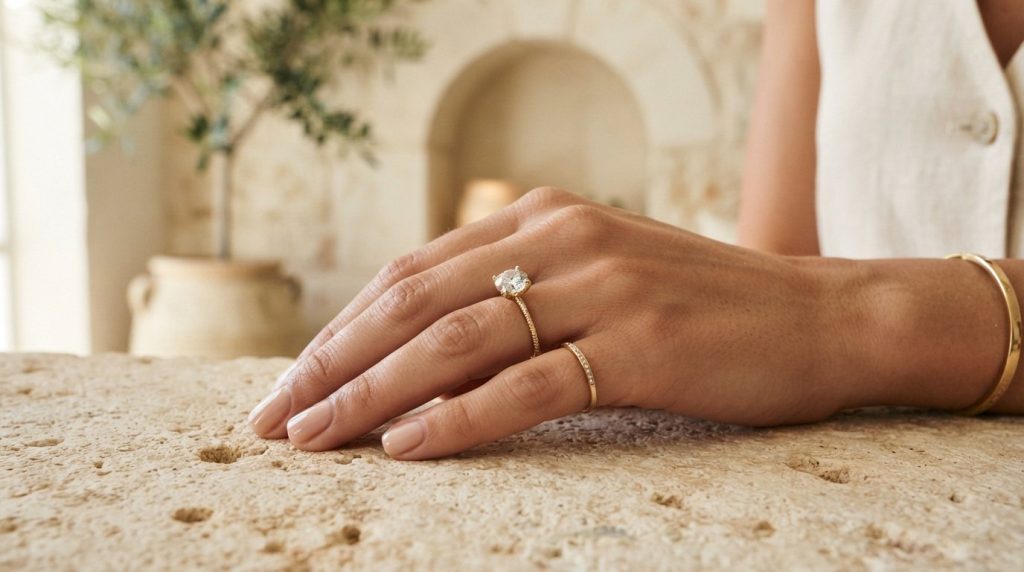
Is My Diamond Too Big for My Hand? A Personal Style Guide
-
Posted by
A diamond can look dramatic in a product photo and feel perfectly at home on your hand; a smaller stone can still make a striking statement. If…
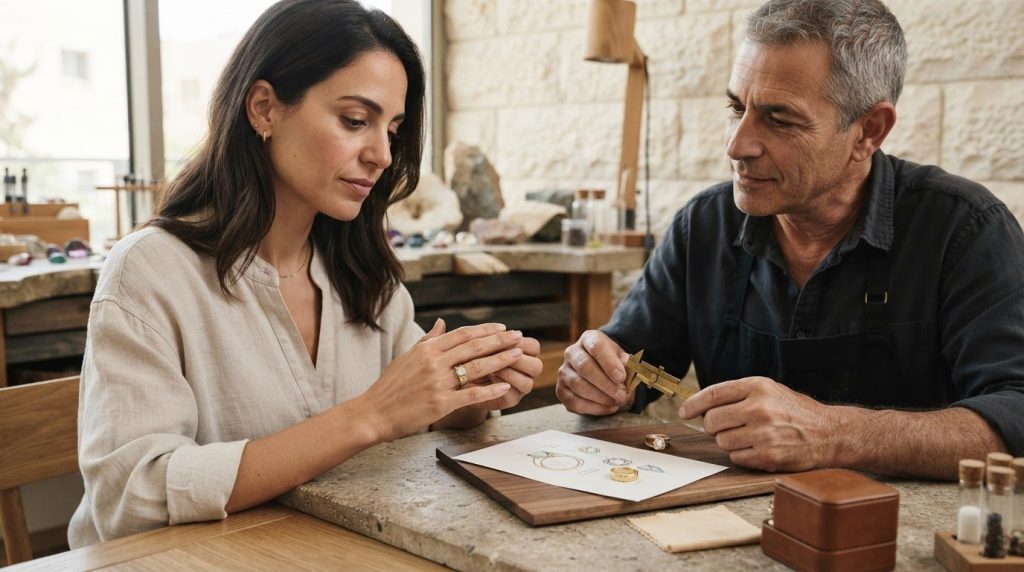
Unhappy With Your Final Custom Ring? Here’s What to Do Next
-
Posted by
What if I’m unhappy with my final custom ring, even though I approved the design? A finished piece can feel different on your hand than it did in a…

Finding an English-Speaking Custom Fine Jewelry Designer in Israel: A Complete Guide
-
Posted by
Your most cherished jewelry shouldn’t just be an accessory; it’s a piece of your history that deserves to be understood without a translator. When…

How to Convince Your Husband to Upgrade Your Wedding Ring
-
Posted by
What if your wedding ring wasn’t just a relic of who you were when you said “I do,” but a luminous reflection of the woman you’ve become today? Many…
Red Flags When Choosing a Custom Jewelry Designer: A 2026 Guide to Protecting Your Vision
-
Posted by
Imagine spending months dreaming of a bespoke 18k gold ring, only to open the velvet box and find a piece that feels like a generic retail cast…
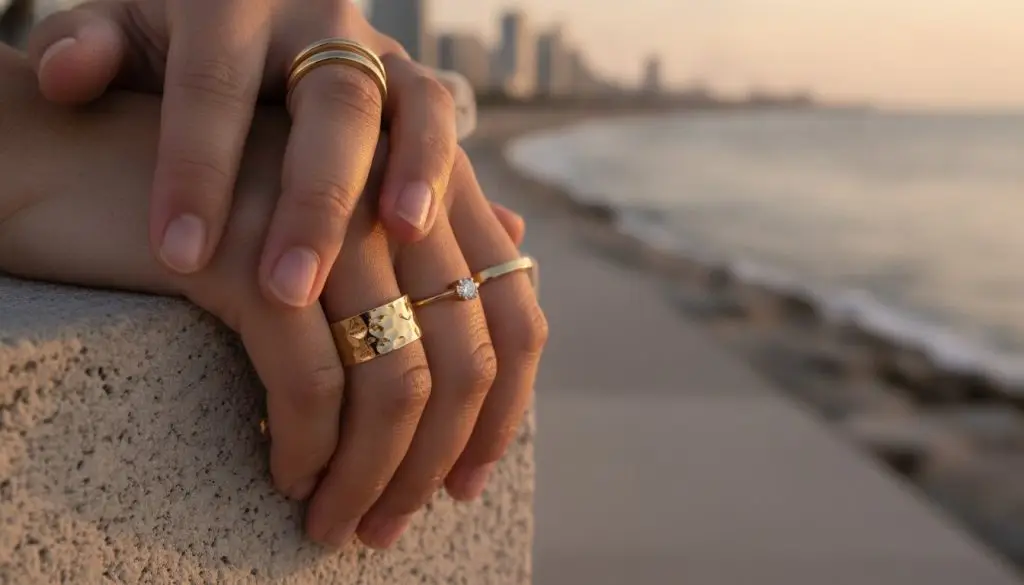
Minimalist Gold Rings: A Guide to Curating Your Timeless 18K Collection
-
Posted by
Your jewelry shouldn’t have an expiration date. Too many of us have felt the frustration of a cherished piece tarnishing or causing skin irritation…
Getting a Better Price Than Big Brand Jewelers in Israel: The Insider’s Guide 2026
-
Posted by
That iconic logo on a shopping bag in a Tel Aviv mall might feel like a mark of quality, but it’s often the most expensive way to buy a memory. When…

Common Regrets After Buying an Engagement Ring: How to Choose a Forever Piece
-
Posted by
What if the most significant purchase of your life becomes a source of quiet hesitation every time you get ready in the morning? It’s a heavy…

15 Essential Questions to Ask a Jeweler Before They Start Designing Your Piece
-
Posted by
You’ve spent months dreaming of a piece that captures your unique story, but as the jeweler picks up their pencil, a flicker of anxiety often sets…
Hidden Halo Engagement Rings: A Guide to Subtle, Modern Brilliance (2026)
-
Posted by
What if the most captivating detail of your jewelry wasn’t meant for the rest of the world to see, but was a secret kept just for you? Many couples…

Handcrafted Minimalist Jewelry in Israel: A Guide to Modern Elegance (2026)
-
Posted by
Why settle for jewelry that simply fills a space when you could wear a piece that captures the depth of your own story? If you’ve been searching for…