

Blog
How to Tell If a Gemstone Is Real: A Guide to Authenticity and Value
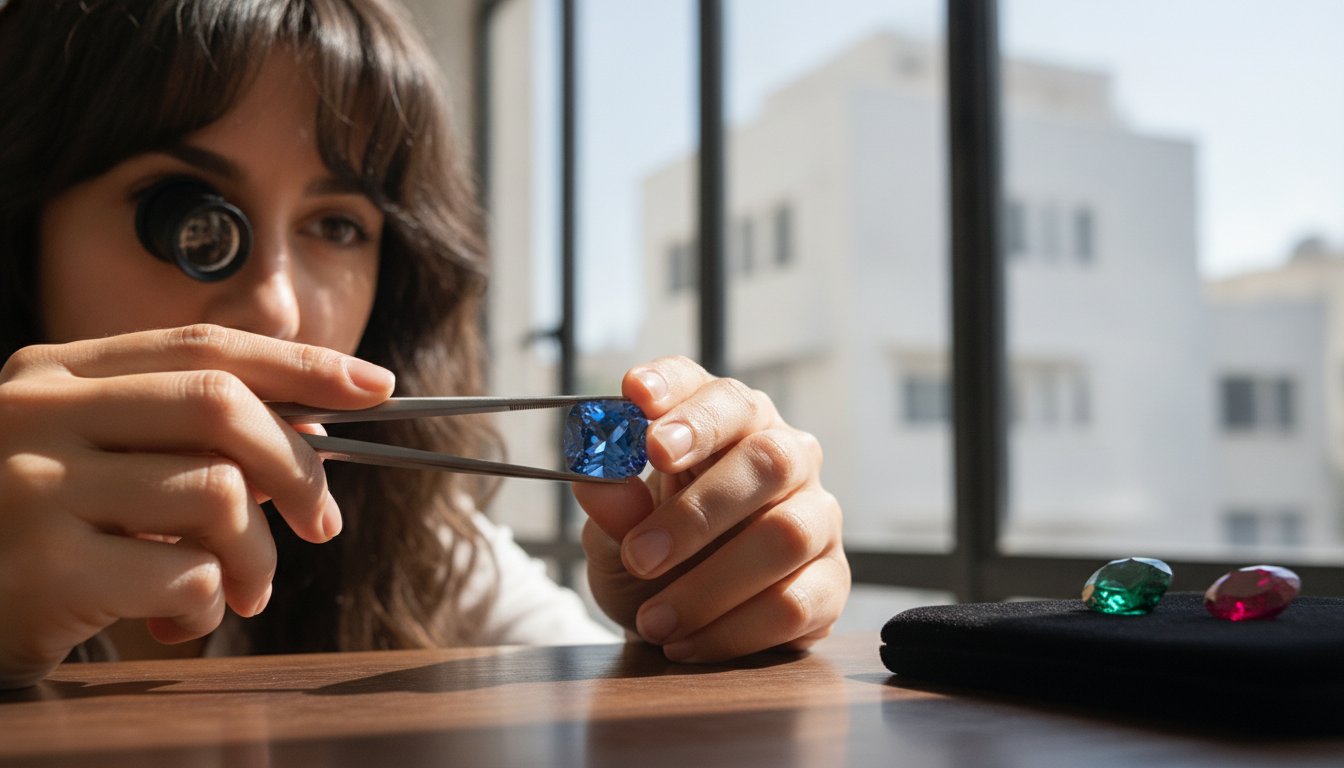
Imagine holding a vibrant emerald that has been passed down through your family, only to wonder if its brilliant green glow is a gift from the earth or a factory. That tiny seed of doubt can turn a moment of joy into a source of stress, especially when you’re choosing gemstones for custom jewelry or evaluating a precious heirloom. It’s a common fear, and honestly, the world of imitations has become incredibly sophisticated. You shouldn’t have to worry about whether your investment is genuine or if a simple test might accidentally damage your piece.
You deserve to feel a sense of quiet confidence every time you wear your jewelry. This guide will show you how to master the techniques needed to distinguish genuine precious stones from clever imitations. We’ll help you understand the latest 2026 GIA grading standards, including new country-of-origin services that add a significant value premium to your pieces. Whether you’re looking at a ₪2,500 sapphire or a rare investment-grade ruby, you’ll have the knowledge to protect your heart and your investment. By the end, you’ll know exactly how to identify common fakes and when it’s time to consult a professional artisan to ensure your collection is as authentic as your own story.
Key Takeaways
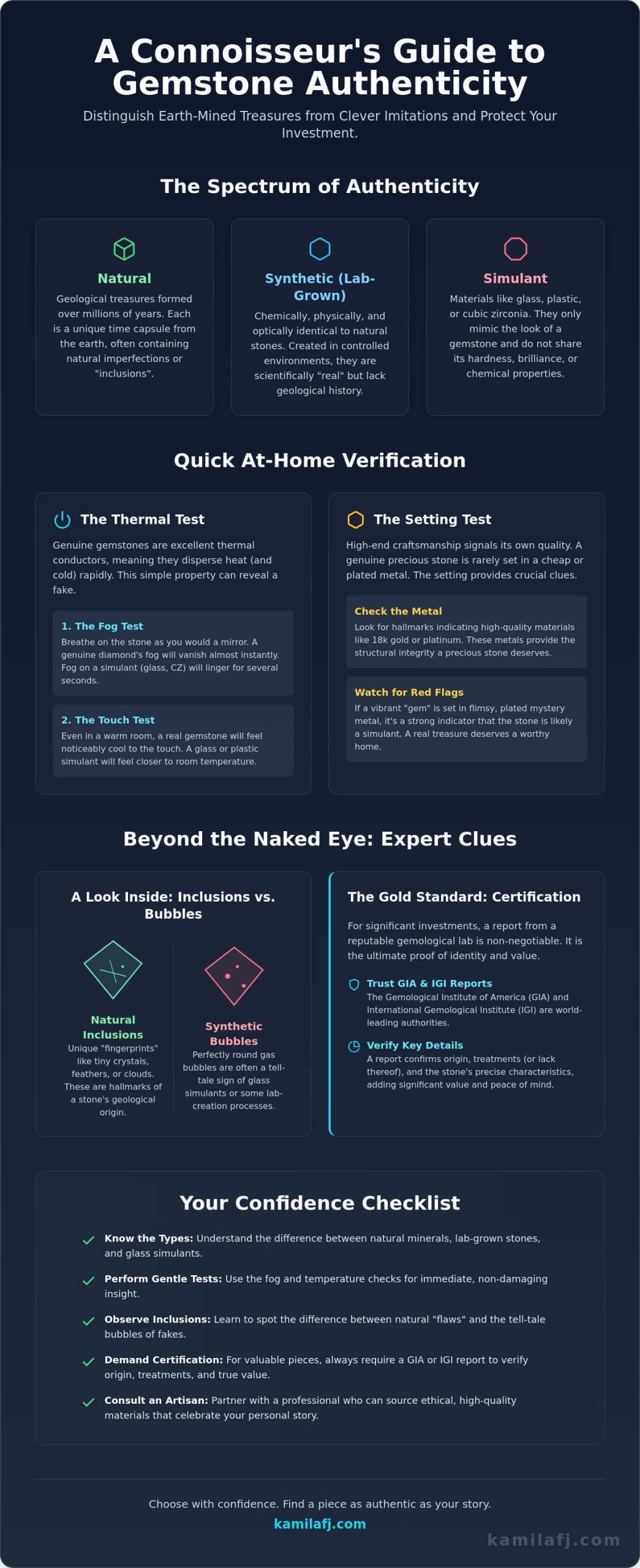
- Distinguish between natural minerals, chemically identical lab-grown stones, and glass simulants to ensure your investment matches your expectations.
- Practice gentle at-home verification methods like the fog test and temperature checks to gain immediate insight into a stone’s authenticity.
- Gain confidence in choosing gemstones for custom jewelry by learning to spot natural inclusions versus the synthetic bubbles found in common imitations.
- Learn to navigate professional GIA and IGI certification reports to verify the origin, treatments, and true value of your precious materials.
- Understand the role of the modern artisan in sourcing ethical, high-quality materials that celebrate your unique personal narrative.
Beyond the Sparkle: Choosing Gemstones for Custom Jewelry with Confidence
Selecting a stone is more than just picking a color; it’s about finding a piece of the universe that resonates with your soul. When you’re choosing gemstones for custom jewelry, the first step is understanding what “real” truly means in the modern world of Gemology. A genuine gemstone isn’t always one pulled from a mine. Today, authenticity is a spectrum that includes both geological wonders and scientific triumphs. Knowing the difference allows you to invest in a piece that feels right for your ethics, your budget, and your personal narrative.
High-end craftsmanship often signals its own quality through the materials surrounding the stone. In Israel, where jewelry is deeply personal and often celebratory, 18k gold is the standard for a reason. It’s a heavy, rich metal that provides the structural integrity a precious stone deserves. If you find a vibrant “gem” set in plated mystery metal, it’s a red flag. A real treasure deserves a home that won’t tarnish or wear away with time.
Natural vs. Synthetic vs. Simulant
Understanding these three categories is the key to making an informed choice. They aren’t just technical labels; they define the history and value of your jewelry.
- Natural Gemstones: These are geological treasures formed over millions of years under intense heat and pressure. Each one is a unique time capsule of the earth’s history.
- Synthetic (Lab-Grown) Gemstones: These share the exact physical, chemical, and optical properties of natural stones. They are “real” in every scientific sense, created in a controlled environment that mimics the earth’s process.
- Simulants: Materials like glass, plastic, or cubic zirconia are non-precious. They merely mimic the look of a gemstone without possessing its hardness or brilliance.
Why Authenticity Matters for Your Story
Choosing a genuine material is about more than just resale value. It’s about the emotional weight of the object. This commitment to authenticity ensures the longevity of engagement rings, which must withstand the beautiful rigors of daily life. When you wear a natural or lab-grown stone, you’re wearing something that will never fade or scratch easily. These materials are durable enough to become modern heirlooms, passed down through generations of Israeli families.
Authenticity also preserves the sentimental value of your fine jewelry. There’s a quiet confidence that comes from knowing your piece is exactly what it claims to be. Whether you’re choosing gemstones for custom jewelry to mark a milestone or to celebrate your own strength, the integrity of the materials makes the occasion feel truly special. Real minerals feel cold to the touch and carry a weight that simulants simply cannot match, grounding your story in something tangible and lasting.
Simple At-Home Tests for Initial Gemstone Verification
There is a unique thrill in holding a gemstone and wondering about its journey from the earth to your hand. While professional equipment offers the final word, a few gentle, sensory tests can provide immediate clues about a stone’s identity. These methods allow you to interact with your pieces on a deeper level, transforming the act of choosing gemstones for custom jewelry into a mindful experience of discovery. By using your own breath, touch, and sight, you can begin to separate the geological treasures from the simple glass imitations.
The Fog and Breath Test
One of the most reliable ways to check a diamond’s authenticity is through thermal conductivity. Diamonds are incredible heat dispersers. If you breathe on a genuine diamond as you would a mirror, the fog should vanish almost instantly. Because the stone pulls the heat away so efficiently, the moisture cannot linger. In contrast, a glass simulant or a cubic zirconia will hold that condensation for several seconds. This test is particularly helpful for stones already set in gold settings, as it requires no specialized tools and poses zero risk to the piece.
Real minerals also possess a distinct thermal signature that you can feel against your skin. Even in the warm Mediterranean climate of Israel, a natural gemstone will feel noticeably cold to the touch when you first pick it up. Glass or plastic imitations quickly reach room temperature and will feel “lukewarm” by comparison. Beyond temperature, pay attention to the “heft” or density of the stone. Natural gems are typically much denser than glass. If a large stone feels surprisingly light in your palm, it likely lacks the mineral structure of a genuine precious stone.
Visual Clarity and the Read-Through Test
The way a stone interacts with light is a primary marker of its value. For loose stones, the “Read-Through” test is a classic technique. Place the gemstone flat side down over a piece of paper with fine print. A real diamond has such high light refraction that it will bend the light completely, making it impossible to see the letters through the stone. If you can clearly read the text or even see distorted black lines, you are likely looking at a simulant with lower refractive properties. You can find more detailed profiles on these optical behaviors in the GIA Gem Encyclopedia.
While you might be tempted to try a “scratch test” to check hardness, please resist this urge. This outdated advice can cause permanent, heart-breaking damage to genuine but softer stones like emeralds or opals. When you are styling fine jewelry, the goal is to preserve the pristine finish of both the stone and its 18k gold home. Instead of testing for hardness, look for “silk” or tiny mineral inclusions through a magnifying glass. These small, natural “birthmarks” are often the most beautiful proof of a stone’s organic origin. If you are ever unsure about a piece in your collection, our studio can help you verify the integrity of your materials while choosing gemstones for custom jewelry that truly reflects your story.
The Art of Observation: Identifying Inclusions and Quality Settings
While your initial senses provide a foundation, a closer look through a jeweler’s loupe reveals the secret history of a stone. This small tool, offering 10x magnification, allows you to peer into the heart of the mineral. When you’re choosing gemstones for custom jewelry, this level of scrutiny isn’t about finding perfection; it’s about finding proof. A truly “flawless” stone is an extreme rarity in nature. If a gem appears completely devoid of internal character under magnification, it may actually be a high-quality simulant or a synthetic creation.
Inclusions: Nature’s Fingerprints
Inclusions are tiny minerals, liquids, or gases trapped inside the stone during its ancient formation millions of years ago. Think of them as nature’s fingerprints. For instance, “silk” in rubies refers to fine, needle-like rutile inclusions that create a soft, internal glow. This presence is a beautiful indicator of a natural, unheated origin. Understanding these physical properties for identifying gems helps you appreciate that what some call “flaws” are actually the stone’s birthmarks. If you instead see perfectly spherical bubbles, you’re likely looking at glass, as natural geological processes don’t produce air pockets like a factory furnace does.
Inspecting the Setting and Hallmarks
The home you choose for your stone says as much about its value as the gem itself. A thoughtful artisan will rarely place a high-investment natural sapphire in a cheap, plated metal. In Israel, the standard for fine craftsmanship is 18k gold, a metal that offers the perfect balance of purity and durability. When examining a gold necklace or ring, look for the “750” or “18k” hallmark stamped inside the band or on the clasp. This mark signifies that the piece is 75% pure gold, a common indicator that the gemstone within was deemed worthy of a premium setting.
Pay attention to the precision of the prong work. High-quality settings feature secure, symmetrical prongs that protect the stone without overwhelming its brilliance. When choosing gemstones for custom jewelry, look for crisp, sharp lines where the facets of the stone meet. Because genuine minerals are significantly harder than glass, they maintain these razor-sharp edges even after years of wear. Glass simulants often show rounded, slightly worn facet junctions, a tell-tale sign of a softer material that cannot hold a precision cut. By observing these subtle details, you ensure your jewelry is an authentic reflection of your own journey.
Professional Certification: The Key to Choosing Gemstones for Custom Jewelry
While the sensory tests we’ve discussed create a personal bond with your treasure, professional certification offers the final, undeniable word on its identity. In the world of fine craftsmanship, a certificate is more than just paper; it’s a scientific blueprint of a stone’s soul. When you’re choosing gemstones for custom jewelry, relying on third-party laboratories like the GIA (Gemological Institute of America) or the IGI (International Gemological Institute) ensures that the information you receive is completely unbiased. These institutions don’t sell jewelry; they provide the objective truth that protects both the artisan and the wearer.
It’s vital to distinguish between a gemological lab report and an insurance valuation. An insurance document assigns a monetary value in Israeli Shekels (₪) for replacement purposes, which can fluctuate with market trends. A lab report, however, is a permanent record of the stone’s physical properties. As of 2026, the GIA has expanded its country-of-origin services to include stones like Opal, Peridot, and Demantoid Garnet. This added layer of provenance can add a 15% to 20% value premium to stones with verified prestigious origins, making the certificate a critical tool for understanding long-term value.
Understanding Grading Reports
When to Visit a Professional Gemologist
At-home observations have their limits, especially when distinguishing between high-quality natural stones and their lab-grown counterparts. This is where advanced equipment like refractometers and spectrometers becomes essential. A professional gemologist can identify subtle treatments, such as the oiling of emeralds or the heat-enhancement of rubies, which significantly impact a stone’s rarity. Before any official inspection, a professional cleaning is required to ensure that every facet is visible and free of microscopic debris. If you’re ready to begin your journey with a stone of verified integrity, explore our custom jewelry services to see how we prioritize transparency and artistry in every selection.
Choosing with Confidence: The KaMila Fine Jewellery Standard
A gemstone is more than a beautiful object; it’s a quiet witness to your most meaningful moments. At our Israeli atelier, we transform the process of choosing gemstones for custom jewelry into a collaborative journey of discovery. We believe that true luxury lies in the harmony of artistic vision and material integrity. That’s why we hand-select every stone, ensuring it possesses the “life” and fire necessary to tell your story. Our commitment to 18k gold provides a rich, durable foundation that honors the inherent value of the minerals we source, creating a piece that feels as substantial as the memories it holds.
Ethical Brilliance and Modern Innovations
The modern era has brought a beautiful shift in how we perceive precious materials. We are proud to feature lab diamonds as a cornerstone of our contemporary collections. These gems are not imitations; they are chemically identical to earth-mined stones, sharing the same crystalline structure and breathtaking refraction. Choosing lab-created stones allows for a level of transparency and environmental consciousness that aligns with the values of the modern, conscious consumer. We blend this 2026-era technology with traditional 18k gold craftsmanship, ensuring your piece is both forward-thinking and timelessly elegant. This fusion allows us to offer stones of incredible clarity and scale that remain accessible for daily celebration.
Your Personal Jewelry Consultant
We don’t believe in the sterile, high-pressure environment of mass-market retail. Instead, we act as your personal guide through the intricate world of gemology. We encourage you to ask about the origin, the treatments, and the unique characteristics of every stone we present. Choosing gemstones for custom jewelry is a deeply personal act, and having a designer-led perspective ensures that your stone is vetted for more than just a grade on a certificate. We look for the soul of the stone, the way it catches the light in our local Mediterranean sun, and how it complements your individual style.
Every milestone deserves to be celebrated with authentic brilliance. Whether you are marking a new beginning or honoring a long-held memory, your jewelry should be as genuine as the emotion it represents. We invite you to explore the possibilities of custom creation, where every detail is an intimate expression of who you are. With the right knowledge and a trusted artisan by your side, you can wear your treasures with a sense of quiet confidence and joy every single day. Your story is unique, and the materials you choose to tell it should be nothing less than extraordinary.
Embrace the Brilliance of Authenticity
Understanding the difference between a geological treasure and a clever simulant is the first step toward building a collection with lasting integrity. From the simple fog test to the microscopic “silk” found in natural rubies, you now have the tools to identify stones that carry genuine value. This knowledge is especially powerful when choosing gemstones for custom jewelry, as it allows you to invest in materials that will truly endure. Professional certification remains your ultimate safeguard, ensuring that the story behind your piece is backed by scientific truth and third-party neutrality.
At KaMila, we specialize in 18k gold and sustainable lab-grown diamonds, handcrafted in our Israeli atelier with a focus on minimalist elegance. Our designer-led sourcing ensures that every bespoke piece we create is as authentic as the individual who wears it. Discover our collection of handcrafted 18k gold and authentic gemstone jewelry and find a piece that resonates with your own personal narrative. You deserve a treasure that is as real as the milestones you celebrate.
Frequently Asked Questions
Can I use a diamond tester on other gemstones?
Standard diamond testers are specifically calibrated to measure the thermal conductivity of diamonds and won’t work accurately on other gemstones. While some advanced multi-testers can identify moissanite, they aren’t designed to distinguish between colored stones like rubies or emeralds. Relying on a diamond tester for other minerals often leads to misleading results during the delicate process of choosing gemstones for custom jewelry.
Do real gemstones always have inclusions or visible flaws?
Most natural gemstones contain internal characteristics, though they aren’t always visible to the naked eye. These “birthmarks” are often the most beautiful proof of a stone’s organic origin and ancient history. While eye-clean stones are highly prized, a completely flawless appearance under 10x magnification is extremely rare in nature and often suggests a synthetic or glass imitation rather than a geological treasure.
Is a lab-grown diamond considered a fake stone?
Lab-grown diamonds are chemically, physically, and optically identical to earth-mined diamonds, meaning they are scientifically real stones. They possess the same hardness of 10 on the Mohs scale and the same breathtaking fire. The only difference is their origin in a controlled laboratory environment, which makes them a transparent and conscious choice for those who value modern material innovations in their fine jewelry.
What is the water test and is it reliable for all gems?
The water test involves dropping a loose stone into water to see if it sinks, but it is not a reliable method for professional identification. While real diamonds have high density and sink quickly, many glass simulants and other minerals will also sink. This test doesn’t provide enough specific data to confirm authenticity and can’t distinguish between different types of genuine minerals or high-quality synthetics.
Why does my gemstone look different in sunlight versus indoor lighting?
This shift is due to how different light sources interact with the stone’s chemical structure and is a key factor when choosing gemstones for custom jewelry. Sunlight contains a full spectrum of colors, while indoor lighting often leans toward warmer or cooler wavelengths. This natural interaction, sometimes called pleochroism, is a beautiful hallmark of genuine minerals that adds a sense of movement and life to your piece.
How can I tell if a sapphire is real or just blue glass?
Check the temperature of the stone and the crispness of its facet edges. Real sapphires feel cold to the touch and maintain razor-sharp lines where facets meet because of their incredible hardness. Blue glass is much softer, so its edges often look rounded or worn under a loupe. Glass may also contain tiny, perfectly round air bubbles that never occur in natural sapphire formations.
What should I do if I suspect my inherited jewelry is not real?
You should take the piece to a professional gemologist for a non-invasive inspection and a detailed cleaning. An expert can use specialized tools like a refractometer to determine the stone’s identity without any risk of damage. If the piece carries sentimental weight, they can also guide you through the process of obtaining a formal laboratory report to verify its long-term value and integrity.
Are there any gemstones that naturally lack inclusions?
Certain minerals, such as topaz and citrine, are categorized as “Type I” stones, meaning they are frequently found in nature with very few visible inclusions. These gems typically grow in large, clean crystals that appear flawless to the eye. However, even these stones usually show microscopic evidence of their growth environment under high magnification, which helps artisans distinguish them from factory-made glass or plastic imitations.
Related Posts

Jewelry Design in Haifa: What to Expect in 2026
-
Posted by
מילה קלר
If you’re searching “jewelry design consultation in Haifa what to expect,” you may be wondering what to bring, which decisions you’ll need to make,…
Is My Diamond Too Big for My Hand? A Personal Style Guide
-
Posted by
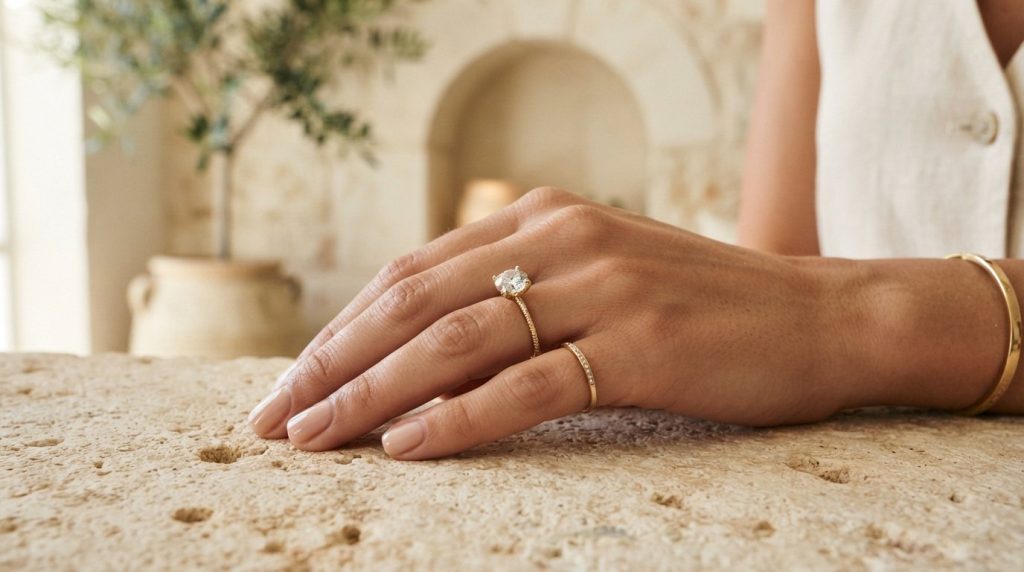
A diamond can look dramatic in a product photo and feel perfectly at home on your hand; a smaller stone can still make a striking statement. If…
Unhappy With Your Final Custom Ring? Here’s What to Do Next
-
Posted by
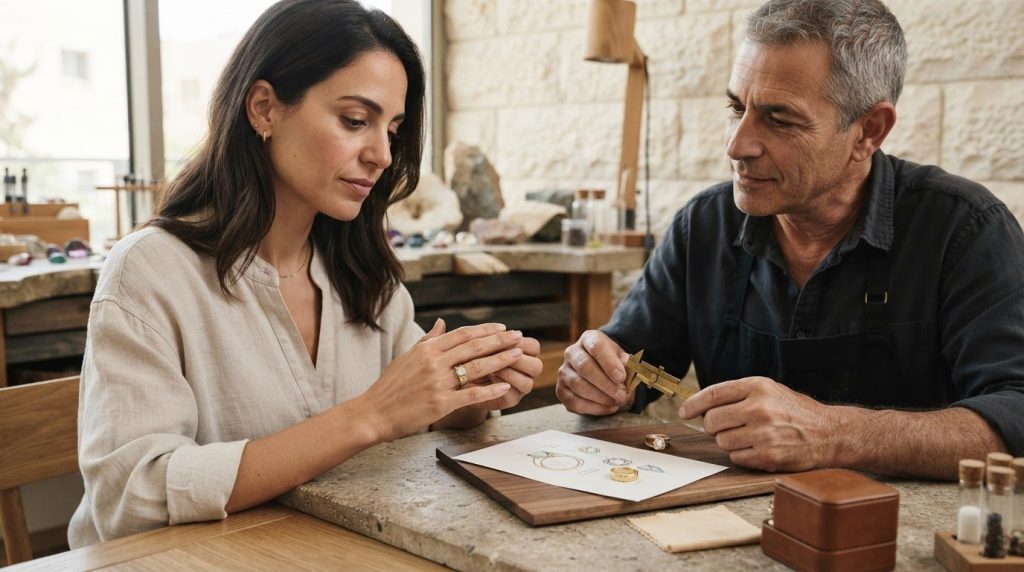
What if I’m unhappy with my final custom ring, even though I approved the design? A finished piece can feel different on your hand than it did in a…
Ensuring Your Final Ring Matches the 3D Render
-
Posted by
What if the image you approved is a beautiful preview, but not a complete specification for the ring being made? Ensuring the final ring matches the…
From Sketch to Sparkle: Ensuring the Final Piece Matches Your Jewelry Design
-
Posted by
You’ve spent weeks dreaming of a ring that captures your story, but as you look at the artist’s rendering, a small doubt creeps in. Will that…
How to Give Constructive Feedback on a Jewelry Design: A Client’s Guide
-
Posted by
What if telling your jeweler you dislike a detail isn’t an insult, but the exact spark they need to craft your dream heirloom? When you first open…
Designing a Custom 18k Gold Ring: 2026 Bespoke Guide
-
Posted by
What if the most exquisite jewelry you ever own isn’t reserved for formal galas, but crafted to enrich your daily life? When you start exploring…

How to Convince Your Husband to Upgrade Your Wedding Ring
-
Posted by
What if your wedding ring wasn’t just a relic of who you were when you said “I do,” but a luminous reflection of the woman you’ve become today? Many…
Red Flags When Choosing a Custom Jewelry Designer: A 2026 Guide to Protecting Your Vision
-
Posted by
Imagine spending months dreaming of a bespoke 18k gold ring, only to open the velvet box and find a piece that feels like a generic retail cast…

Common Regrets After Buying an Engagement Ring: How to Choose a Forever Piece
-
Posted by
What if the most significant purchase of your life becomes a source of quiet hesitation every time you get ready in the morning? It’s a heavy…

15 Essential Questions to Ask a Jeweler Before They Start Designing Your Piece
-
Posted by
You’ve spent months dreaming of a piece that captures your unique story, but as the jeweler picks up their pencil, a flicker of anxiety often sets…
What if I Change My Mind During the Custom Jewelry Design Process?
-
Posted by
You have spent weeks dreaming of a sleek, minimalist gold band, but suddenly, a more ornate, symbolic setting is calling your name. It is a common…