
Blog
Gold Jewelry That Doesn’t Tarnish: Your 2026 Guide to Forever Pieces
You reach for your favorite gold necklace, the one you’ve worn almost daily for the past six months, and notice something heart-sinking. The brilliant shine has dulled, and a faint, tell-tale green mark is appearing on your skin. It’s a deeply frustrating feeling. You chose that piece to celebrate a moment or simply to bring a little joy to your day, not to be reminded of fading alloys and broken promises of quality.
This is where the story changes. Your search for beautiful, enduring gold jewelry that doesn’t tarnish ends here. We believe your personal treasures should be worn and loved without a second thought, becoming a radiant part of your identity. This guide promises to empower you with the confidence to choose a true forever piece, a personal talisman that makes every day feel special. We’ll illuminate the meaningful difference between gold-plated and solid 18K gold, helping you confidently select a handcrafted piece that honours your story and shines as brightly as you do, day after day.
Key Takeaways
- Learn the surprising reason why some gold jewelry changes color while other pieces stay brilliant forever.
- Understand the difference between 10K, 14K, and 18K to select beautiful gold jewelry that doesn’t tarnish.
- Discover why solid gold is the ultimate choice for a lasting investment and how it compares to gold-plated and vermeil options.
- Find simple daily habits to ensure your most cherished gold pieces maintain their radiant glow for a lifetime.
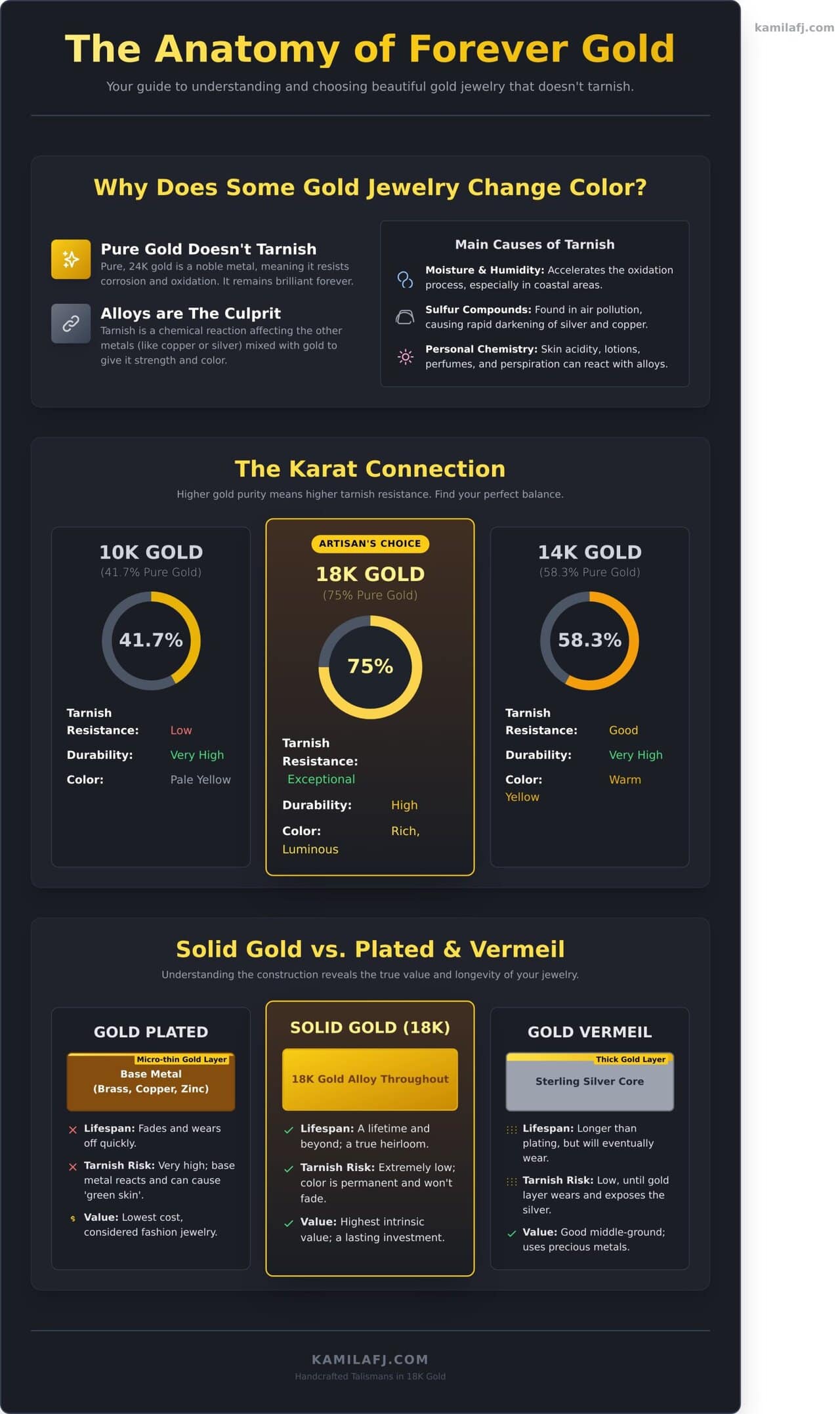
What is Tarnish and Why Does Some Gold Jewelry Change Color?
You’ve felt that small pang of disappointment. The brilliant, sun-kissed chain you adored now has a dull, darkened patina. Or worse, your favorite ring has left a faint green mark on your skin. It’s a common story, but it’s not a reflection of your care; it’s a story of chemistry. The secret is that pure gold itself doesn’t tarnish. The change in color comes from the other metals it’s mixed with, a thoughtful process of artistry designed to give your jewelry strength and its unique hue.
At its core, tarnish is a natural chemical reaction. It occurs when the non-gold metals in an alloy-like copper, silver, or nickel-react with elements in your environment. Think of it as the metal’s response to the world around it. The main culprits are often part of our daily lives, especially here in Israel:
- Moisture & Humidity: The beautiful, humid air along the Tel Aviv coastline that’s so good for the soul can unfortunately accelerate the oxidation process on less durable metals.
- Sulfur Compounds: These are present in the air from pollution and can cause a rapid darkening of silver and copper alloys.
- Personal Chemistry: The unique acidity of your skin, along with lotions, perfumes, and perspiration, can interact with the metals in your jewelry.
This is why 24-karat gold, which is 99.9% pure, remains brilliant forever. It’s a noble metal, meaning it resists corrosion and oxidation. However, its purity makes it incredibly soft, with a Mohs hardness of only 2.5, making it too delicate for a piece meant to be worn and loved every day. To create durable, timeless jewelry, artisans blend gold with stronger metals. These masterful blends, known as gold alloys, give each piece its unique character and resilience. Understanding this balance is the first step toward choosing gold jewelry that doesn’t tarnish.
The Chemistry of the Glow
When oxygen and moisture meet the copper or silver in your jewelry, a slow-burn reaction called oxidation begins, forming a thin layer of corrosion that we see as tarnish. Environmental factors can speed this up; air quality reports from 2023 show that urban areas with higher traffic can have more sulfur in the air, which is particularly reactive with lower-karat pieces. It’s crucial to distinguish this chemical change from simple surface dirt, which can be cleaned away to restore shine. Tarnish is a degradation of the metal itself.
Common Misconceptions About ‘Gold-Colored’ Metals
The term ‘gold-tone’ you see on fast-fashion pieces, often costing under ₪150, is a marketing label, not a measure of quality. It simply means the piece has the color of gold, typically from a micro-thin plating over a mystery base metal like brass or zinc. These base metals react very quickly, causing that dreaded ‘green skin’ when the copper within them oxidizes against your skin. Tarnish is a surface oxidation of the base metals mixed with gold, not a flaw in the gold itself. Investing in quality alloys from a trusted jeweler eliminates this risk entirely.
The Karat Connection: Finding the Tarnish-Resistance Sweet Spot
The secret to finding gold jewelry that doesn’t tarnish lies in a single, simple number: its karat. You’ve seen the markings, 10K, 14K, or 18K, stamped discreetly on a clasp or inner band. This isn’t just a label; it’s the DNA of your jewelry, defining its purity, color, and resilience against time and the elements.
Think of karats as a recipe measured in 24 parts. Pure, 24K gold is 100% gold, but it’s far too soft for crafting durable jewelry. To create pieces that can be worn and cherished daily, gold is mixed with stronger alloy metals like silver, copper, and zinc. The karat number tells you the ratio of pure gold to these other metals.
- 18K Gold: Contains 18 parts gold and 6 parts alloy (75% pure gold).
- 14K Gold: Contains 14 parts gold and 10 parts alloy (58.3% pure gold).
- 10K Gold: Contains 10 parts gold and 14 parts alloy (41.7% pure gold).
It’s the alloy metals, particularly copper and silver, that react with oxygen, moisture, and chemicals, causing tarnish. Therefore, the lower the gold content, the higher the risk of discoloration. This makes the choice of karat the single most important factor in your search for forever-gold.
Why 18K Gold is the Modern Artisan’s Choice
With its 75% purity, 18K gold strikes the perfect balance between the eternal radiance of pure gold and the structural integrity needed for handcrafted designs. Its high gold content means there are far fewer reactive alloys, making it exceptionally resistant to oxidation. This is the gold that holds its warm, luminous glow, even after years of wear. It serves as the ideal ‘forever’ material for securing precious lab-grown diamonds, ensuring your most meaningful pieces remain pristine.
14K Gold: The Practical Alternative?
14K gold is a popular and durable option, often presented as a more budget-friendly choice. An engagement ring that costs ₪4,000 in 14K gold might be priced closer to ₪5,200 in 18K. However, its higher alloy content (41.7% vs. 18K’s 25%) makes it more susceptible to tarnishing over time. In Israel’s humid coastal climate, from Tel Aviv to Haifa, the moisture and salt in the air can accelerate this process on 14K pieces. You might find a 14K piece requires professional polishing every 12-18 months to maintain its shine, while an 18K piece often needs nothing more than a gentle wipe.
Ultimately, the choice comes down to a rich, unmistakable color and lasting peace of mind. The higher gold content in 18K imparts a deeper, more saturated warmth that simply cannot be replicated. This commitment to lasting beauty is why our handcrafted collection exclusively uses 18K gold, creating true, investment-worthy gold jewelry that doesn’t tarnish and is made to be part of your story for a lifetime.
Solid Gold vs. Plated vs. Vermeil: A Durability Comparison
Understanding the language of gold is the first step toward choosing a piece that lasts a lifetime. The terms “gold plated,” “gold vermeil,” and “solid gold” describe entirely different creation processes, resulting in vastly different levels of quality, durability, and value. This isn’t just about price; it’s about the story your jewelry will tell for years to come.
Let’s break down what you can truly expect from each type.
- Gold Plated: This is the most temporary form of gold jewelry. A microscopically thin layer of gold (often just 0.5 microns) is electroplated over a base metal like brass or copper. These pieces are designed for fashion, not forever. Expect the gold to fade and the base metal to show through within 6 to 12 months of regular wear, often causing skin discoloration. A plated necklace might cost ₪200, but it’s a fleeting accessory, not a future heirloom.
- Gold Vermeil: A significant step up from plated, vermeil has specific standards. To be legally called “vermeil” in markets like the U.S., a piece must have a thick layer of gold (at least 2.5 microns) over a sterling silver core. While the silver base is a precious metal, the gold layer is still susceptible to friction and will eventually wear away, revealing the silver beneath.
- Solid Gold: This is the only material that offers a lifetime of luminous color. The gold is a core component of the metal alloy itself, not just a surface coating. Whether it’s 14K or 18K, the piece is gold through and through. Scratches can be polished away because the color is consistent. This is the definitive choice for gold jewelry that doesn’t tarnish and is meant to be worn daily and passed down through generations.
The Truth About Gold Vermeil
Gold vermeil is an attractive option, but its longevity has limits. That legally required 2.5-micron layer is 5 times thicker than standard plating, offering much better durability for its price. It’s an acceptable choice for a trendy, statement piece you won’t wear daily. However, for a ring, a bracelet, or a signature necklace you never take off, the constant contact and friction will wear down the gold layer within 3 to 5 years, exposing the sterling silver which can then oxidize.
Why Solid 18K Gold is a Sustainable Investment
Choosing solid gold is an act of conscious investment in both your personal story and the planet. Think of it as ‘Cost Per Wear.’ A vermeil ring at ₪750 might seem like a bargain, but if it needs replacing every 4 years, you’ve spent ₪3,750 over two decades on temporary items. A timeless, solid 18K gold ring from KaMila at ₪4,000 will look just as beautiful in 20 years, making its daily cost negligible. It’s a piece you buy once and love forever. Furthermore, solid gold is infinitely recyclable; it can be melted and re-formed into new treasures without ever losing its precious value. Our focus on 18K solid gold is our commitment to creating true heirlooms, celebrating sustainable artistry over disposable trends.
How to Keep Your 18K Gold Shining for a Lifetime
You chose 18K gold because it represents the perfect balance of purity and strength. It’s the standard for fine gold jewelry that doesn’t tarnish under normal conditions, a timeless choice meant to be part of your story for years to come. Protecting that brilliant, warm glow isn’t about avoiding life; it’s about incorporating a few simple, mindful habits that preserve its artistry and meaning. Think of it as a small daily ritual that honors the piece and the moments it represents.
The most significant impact on your gold’s luster comes from daily exposure to chemicals. Your beauty routine, while essential for you, can be a minefield for fine jewelry. Perfumes, hairsprays, lotions, and cosmetics contain chemicals and oils that build up on the gold’s surface, creating a film that dulls its shine. The best practice is a simple one: make your jewelry the last thing you put on before you leave and the first thing you take off when you get home. This single habit can reduce cleaning frequency by over 50%.
Equally important is where your pieces rest when you’re not wearing them. Tossing them onto a nightstand or into a drawer with other items is a primary cause of surface wear. Proper storage in a lined jewelry box prevents the microscopic scratches that can dull gold’s natural brilliance. Remember, even a diamond earring back can scratch the soft surface of a gold band. Give each piece its own space to breathe.
Finally, be mindful of harsh environments. Chlorine is one of gold’s worst enemies. The chemical, found in swimming pools and hot tubs, can react with the alloy metals (like copper and silver) in 18K gold. Over time, this exposure can lead to discoloration and even weaken the prongs holding your precious gemstones. Always remove your gold jewelry before taking a dip.
Caring for your jewelry’s brilliant glow is a wonderful ritual of external self-care. For those who also prioritize their internal vitality, exploring other precious substances from nature can be a complementary practice. For example, some natural wellness enthusiasts learn more about Gold Rock Shilajit, a substance sometimes called “the gold of the mountains,” as part of their daily routine.
The 30-Second Weekly Cleaning Routine
For pieces you wear every day, a quick weekly refresh is all it takes to remove the buildup of skin oils and daily grime. Simply soak your jewelry for two to three minutes in a bowl of warm water with a few drops of mild, phosphate-free dish soap. Gently use a soft-bristled baby toothbrush to clean any crevices, rinse with clean water, and pat completely dry with a soft, lint-free cloth. For a complete guide, explore our tutorial on How to Clean Your Fine Jewelry at Home Safely.
Professional Maintenance for Heirloom Pieces
For beloved pieces, especially rings or bracelets worn daily, we recommend a professional check-up every 12 to 18 months. An artisan jeweler can perform an ultrasonic cleaning to remove deep-set dirt and professionally polish the surface to restore its original, mirror-like finish. Here in Israel, this service typically costs between ₪150 and ₪300. More importantly, this visit is a crucial opportunity to check the security of gemstone settings and prongs, ensuring your treasured stones are safe for another year of wear.
Your jewelry is a living part of your personal narrative. With a little intentional care, its golden glow will continue to celebrate you for a lifetime. If you feel your handcrafted pieces need an expert’s touch to restore their shine, explore our professional jewelry care and restoration services.
KaMila Fine Jewellery: Handcrafted Talismans in 18K Gold
In a world of fleeting trends, the enduring glow of pure gold remains a constant. At our Tel Aviv studio, we believe that fine jewelry should be a personal extension of you, a story told in precious metal. That’s why we exclusively work with solid 18K gold. This isn’t just a choice of material; it’s a commitment to creating timeless, handcrafted talismans that celebrate the modern woman. Our approach merges clean, minimalist design with the inherent warmth and permanence of high-karat gold, resulting in pieces that are meant to be worn, loved, and lived in every single day.
Our dedication to lasting quality is the reason we build our collections around 18K gold. Composed of 75% pure gold alloyed with other metals for strength, it possesses a rich, deep hue that won’t fade. More importantly, it provides a lifetime of wear without discoloration. This is the essence of true gold jewelry that doesn’t tarnish. To complement this timeless metal, we exclusively use lab-grown diamonds. This conscious choice reflects our modern values, offering physically and chemically identical diamonds to their mined counterparts but with a clear, ethical origin. Each stone is selected for its exceptional quality, typically VVS clarity and an Excellent cut, ensuring your piece sparkles with integrity and brilliance.
While our collections are thoughtfully curated, we know the most meaningful stories are often the ones you write yourself. Our custom design process is a collaborative journey to transform your vision into a one-of-a-kind reality. Whether it’s reimagining a family heirloom or creating a unique engagement ring that captures your personal narrative, we guide you through every step. The process, from initial sketch to finished piece, typically takes 4-6 weeks, with bespoke rings starting from around ₪3,500, ensuring your milestone is marked with a creation as unique as the moment itself.
Not Just Jewelry. You, in Gold.
A piece from KaMila is designed to become part of your story. It’s a silent companion that gathers memories and ages gracefully with you, its warm luster a constant reminder of your own journey. We create sophisticated, wearable art to empower and celebrate your strength and softness. Our ‘Beans of Happiness’ collection embodies this philosophy perfectly. Each polished gold bean is a tiny, tangible symbol of life’s simple pleasures, a personal talisman to carry with you always.
Start Your Forever Collection Today
Building a collection of meaningful jewelry begins with a single, perfect piece. We believe your first 18K gold staple should be something you’ll never want to take off, like a simple band or a delicate pendant that feels like a second skin. It’s an investment in yourself and your story. When you’re ready to mark a significant milestone, our custom design process makes creating a unique heirloom a seamless and personal experience. Discover jewelry that makes every day feel special. Explore the KaMila 18K Gold Collection.
Your Forever Gold Awaits
Your journey to lasting jewelry begins with understanding its heart. We’ve seen how 18K solid gold stands as the pinnacle of beauty and resilience, offering a perfect balance of pure, radiant color and the durability needed for daily life. The quest for gold jewelry that doesn’t tarnish truly ends when you choose high-quality, solid pieces designed for a lifetime of wear.
At KaMila Fine Jewellery, this philosophy is at the core of everything we create. Each piece is a personal talisman, thoughtfully handcrafted in Israel from lustrous 18K gold and paired with brilliant, ethical lab-grown diamonds. Our modern, minimalist designs aren’t meant to be saved for special occasions; they’re crafted to become a radiant part of your daily narrative, making every moment feel special.
It’s time to invest in artistry that lasts. Discover Your Forever Piece in Our 18K Gold Collection and begin wearing your story in gold that’s as enduring and brilliant as you are.
Frequently Asked Questions
Does 14K gold tarnish if worn every day?
No, solid 14K gold doesn’t truly tarnish, but its surface may darken slightly with constant daily wear. This happens because the other metals in the alloy, like silver and copper, can react slowly to elements in your environment. It’s not a permanent change like rust. This subtle patina is a natural part of a well-loved piece’s story and can be easily cleaned to restore its original, warm glow, making it perfect for your everyday talismans.
Is 18K gold better than 14K gold for people with sensitive skin?
Yes, 18K gold is generally a better choice for those with sensitive skin. Containing 75% pure gold, it has a significantly lower percentage of alloy metals compared to 14K gold’s 58.3%. Skin sensitivities are most often triggered by these other metals, particularly nickel. By choosing 18K gold, you are selecting a purer, more hypoallergenic option, ensuring your jewelry feels as beautiful as it looks, every single day.
Can I wear my 18K gold jewelry in the shower?
While a quick rinse won’t harm your solid 18K gold, we advise against wearing it in the shower regularly. Soaps, oils, and conditioners can leave a dull film on the gold’s surface and behind any gemstones, diminishing their sparkle. To preserve the handcrafted brilliance of your piece and keep it looking its best, it’s a good practice to remove it before you shower. This small step helps maintain its lifelong beauty.
Why did my gold ring turn my finger green?
A ring turns your finger green when the copper in its metal alloy reacts with your skin’s pH or external chemicals like lotions. This is a natural chemical reaction and doesn’t mean the gold isn’t real, though it’s more common with lower karats. Choosing high-quality gold jewelry that doesn’t tarnish, such as solid 14K or 18K pieces, dramatically reduces the copper content and virtually eliminates the chance of this happening.
What is the difference between gold-filled and gold-plated jewelry?
The main difference is the amount of gold and its durability; gold-filled jewelry has a much thicker, pressure-bonded layer of gold. A gold-filled piece must legally contain 5% gold by weight. In contrast, gold-plating is a micro-thin layer, often less than 0.05% of the item’s weight, that can wear off quickly. For lasting beauty and daily wear, gold-filled is a far superior and more valuable choice that resists discoloration.
How do I know if my jewelry is real solid gold?
The most reliable sign of real solid gold is a hallmark, which is a small stamp on the piece. In Israel, you’ll typically find “585” for 14K gold or “750” for 18K gold. You may need a magnifying glass to see it clearly. Additionally, solid gold is not magnetic. For absolute certainty, a professional jeweler can perform an acid test, which usually costs between 50₪ and 100₪ and provides a definitive answer.
Can 18K gold be worn at the beach or in the pool?
We strongly recommend removing your 18K gold jewelry before swimming at the beach or in a pool. The harsh chlorine in pools can slowly erode the gold alloy and damage delicate gemstones over time. Similarly, the abrasive sand and corrosive salt from the ocean can scratch the metal’s polished surface, dulling its beautiful finish. It’s best to keep your treasured pieces safely stored away to preserve their artistry and shine.
Does white gold tarnish differently than yellow gold?
Yes, white gold’s appearance can change differently due to its rhodium plating. Most white gold is plated with a thin layer of rhodium to give it a bright, silvery-white luster. With daily wear, this plating can gradually wear off, revealing the slightly warmer, yellowish tone of the underlying gold alloy. This isn’t tarnish, and it can be easily restored by having a jeweler re-plate the piece for around 200₪ to 350₪.
Related Posts
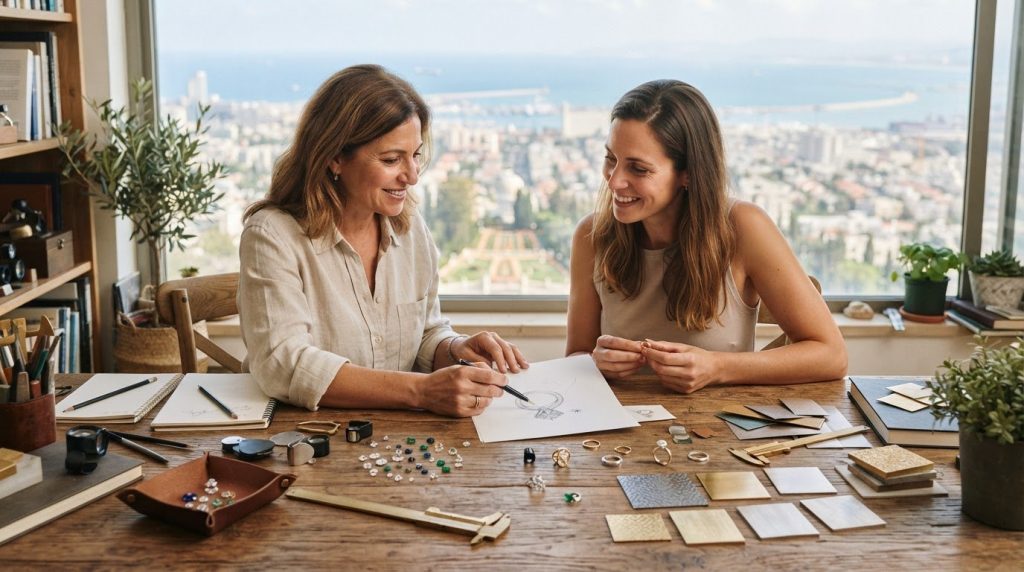
Jewelry Design in Haifa: What to Expect in 2026
-
Posted by
מילה קלר
If you’re searching “jewelry design consultation in Haifa what to expect,” you may be wondering what to bring, which decisions you’ll need to make,…
From Sketch to Sparkle: Ensuring the Final Piece Matches Your Jewelry Design
-
Posted by
You’ve spent weeks dreaming of a ring that captures your story, but as you look at the artist’s rendering, a small doubt creeps in. Will that…
Repurposing Heirloom Stones into Modern Custom Jewelry: The Complete 2026 Guide
-
Posted by
What if keeping an inherited ring tucked away in a dark jewelry box isn’t protecting your family history, but silencing it? It’s completely natural…
Designing a Custom 18k Gold Ring: 2026 Bespoke Guide
-
Posted by
What if the most exquisite jewelry you ever own isn’t reserved for formal galas, but crafted to enrich your daily life? When you start exploring…
Red Flags When Choosing a Custom Jewelry Designer: A 2026 Guide to Protecting Your Vision
-
Posted by
Imagine spending months dreaming of a bespoke 18k gold ring, only to open the velvet box and find a piece that feels like a generic retail cast…
Jewelry That Makes Me Feel Protected and Strong: A Guide to Modern Talismans
-
Posted by
Most people view a necklace or a ring as a simple finishing touch, but for the modern woman, it’s often the first layer of emotional armor she puts…
How to Stack Rings: The Art of Curating Your Personal Story in 18K Gold
-
Posted by
What if your jewellery box wasn’t just a collection of objects, but a living timeline of your most cherished milestones? You’ve likely looked at a…
Minimalist Gold Rings: A Guide to Curating Your Timeless 18K Collection
-
Posted by
Your jewelry shouldn’t have an expiration date. Too many of us have felt the frustration of a cherished piece tarnishing or causing skin irritation…
Getting a Better Price Than Big Brand Jewelers in Israel: The Insider’s Guide 2026
-
Posted by
That iconic logo on a shopping bag in a Tel Aviv mall might feel like a mark of quality, but it’s often the most expensive way to buy a memory. When…

18k Gold Earrings for New Piercings: Safe Styling Guide
-
Posted by
What if the most rewarding part of your piercing journey wasn’t the initial appointment, but the moment you finally swap those generic studs for…

18k Gold Minimalist Bracelets: The Ultimate Guide to Timeless Everyday Luxury
-
Posted by
True minimalism isn’t about having less; it’s about requiring more from the few pieces you choose to wear every day. If you’ve ever felt the…

18k Gold Stud Earrings: The Ultimate Guide to Everyday Luxury
-
Posted by
Why should the jewelry you wear every single day be the piece that irritates your skin or loses its radiance before the season even turns? It’s a…