

Blog
Lab Grown Diamonds vs. Natural: A Modern Guide to Conscious Luxury (2026)
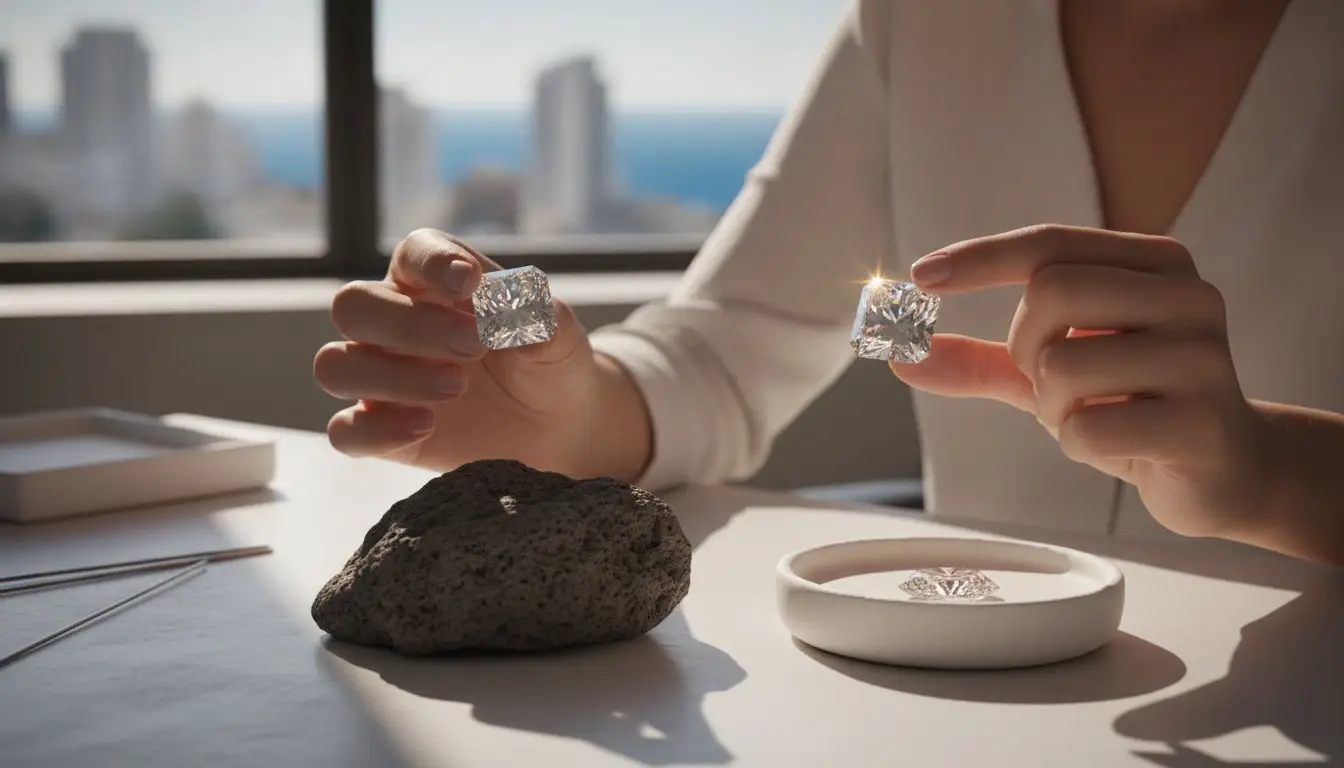
What if the only difference between a billion-year-old miracle and a modern masterpiece was the address where it was born? When exploring the nuances of lab grown diamonds vs natural, it’s easy to feel caught between the romance of tradition and the brilliance of modern innovation. You want a piece that feels like a true reflection of your story, yet you’re likely navigating the noise of price gaps and the quiet anxiety of whether a lab-grown stone is truly “real.” It’s a deeply personal decision that deserves clarity rather than confusion.
With lab-grown diamonds now making up 61% of engagement ring sales, choosing your stone is no longer about settling; it’s about intentionality. This guide will help you discover the definitive differences and surprising similarities between these gems so you can choose the perfect stone for your modern heirloom. We’ll demystify their technical identities, look at the latest 2026 GIA grading standards, and show you how to style these luminous treasures in handcrafted 18k gold for a look that’s both timeless and uniquely yours. You’ll finish this guide feeling confident that your choice aligns with your values and your aesthetic.
Key Takeaways
- Understand that lab-grown diamonds are chemically, physically, and optically identical to earth-mined stones, providing the same timeless brilliance and durability for daily wear.
- Navigate the personal choice of lab grown diamonds vs natural by balancing the ancient rarity of geological history with the modern innovation and ethical clarity of laboratory settings.
- Discover how to maximize your budget with lab-grown diamonds, which typically offer significant savings that allow for larger stones or more intricate custom designs.
- Learn why 18k gold is the superior setting for modern heirlooms, offering the perfect balance of rich, warm color and lasting strength for your most meaningful pieces.
- Gain confidence with an overview of the 2026 GIA grading updates, ensuring you can verify the quality and authenticity of your diamond with professional precision.
The Science of Sparkle: Defining Lab-Grown vs. Natural Diamonds
Sparkle is a universal language, yet its origins have never been more diverse. Choosing between lab grown diamonds vs natural isn’t about deciding between “real” and “artificial.” Scientifically, these stones are identical. They share the same crystal structure, chemical composition, and optical properties. Whether a diamond spent a billion years under the earth or a few weeks in a controlled environment, it remains the hardest substance known to man, sitting at a 10 on the Mohs scale. Leading laboratories like the Gemological Institute of America (GIA) and IGI treat both with the same professional rigor, providing grading reports that verify their quality for your peace of mind.
How Natural Diamonds Form in the Earth
Natural diamonds are ancient storytellers. They began their journey roughly 100 miles below the earth’s surface, where intense heat and crushing pressure transformed carbon over billions of years. Deep-seated volcanic eruptions eventually carried these stones to the crust, making them accessible to us. There’s a profound romance in wearing a stone that’s existed since the dawn of time. Because high-quality natural diamonds are finite and rare, they carry a sense of heritage that feels deeply connected to the planet’s history. For many, this geological journey is what makes a diamond a true heirloom.
The Laboratory Process: CVD and HPHT Explained
Modern innovation allows us to recreate the earth’s power in a controlled setting. The Science of Synthetic Diamonds focuses on two primary methods: Chemical Vapor Deposition (CVD) and High Pressure High Temperature (HPHT). In CVD, a thin “seed” of diamond is placed in a chamber filled with carbon-rich gas. Plasma then breaks the gas down, allowing carbon atoms to layer onto the seed like falling snow. HPHT uses massive presses to mimic the extreme heat and pressure of the earth’s core. Neither process involves “faking” a diamond. They simply provide a time-accelerated environment for carbon to do what it does best: crystallize into brilliance. These stones are then meticulously set into 18k gold, ensuring your choice between lab grown diamonds vs natural is supported by the highest standards of traditional craftsmanship.
The Invisible Difference: Chemical and Optical Identicality
To the naked eye, the debate between lab grown diamonds vs natural is practically invisible. Even a seasoned gemologist, peering through a 10x loupe, won’t find a visual cue that distinguishes one from the other. This is because both stones are composed of the same crystal carbon lattice. The light interacts with each stone in the exact same way, creating that signature fire, the flashes of colored light, and scintillation, the rhythmic sparkle you see as the stone moves. According to GIA on Diamond Identification, the only way to separate them is through specialized laboratory equipment that detects trace growth characteristics.
For transparency and peace of mind, modern lab-grown stones feature a microscopic laser inscription on the girdle. This tiny birth certificate is invisible without high magnification, ensuring that your choice is always clear and documented. It’s a thoughtful way to celebrate authenticity while embracing the beauty of innovation. This transparency allows you to focus on the emotional value of the piece rather than the technicalities of its origin.
The 4Cs in the Modern Era
The 4Cs—Cut, Color, Clarity, and Carat—serve as the universal language for diamond quality across both natural and lab-grown origins. In today’s market, lab-grown diamonds often achieve higher color and clarity grades at a more accessible price point than their natural counterparts. While size and purity are alluring, the Cut remains the most vital factor; a masterfully cut stone is what truly unlocks a diamond’s inner light and personality. In essence, the 4Cs provide a structured framework that ensures lab-grown diamonds maintain a consistent, high-end standard for modern luxury.
Durability and the Mohs Scale
A diamond is a symbol of endurance for a reason. Both natural and lab-grown stones rank at a 10 on the Mohs scale, making them the hardest gems on the planet. They won’t cloud, scratch, or lose their luster over time, regardless of where they were formed. This resilience makes them perfect for gold bracelets and other pieces designed for daily wear. Whether you’re celebrating a milestone or simply making the everyday feel special, these stones are built to withstand the story of your life. You can explore our collection of handcrafted 18k gold pieces to find a setting that honors this lasting brilliance.
Investment vs. Ethics: Navigating the Market and Resale Values
The conversation surrounding lab grown diamonds vs natural often centers on the concept of value. While natural diamonds have long been marketed as financial assets, the reality of the 2026 market tells a more nuanced story. Today, a one-carat lab-grown diamond typically costs between $800 and $1,000. This represents a significant saving of 60% to 90% compared to a natural stone of the same quality. This price gap allows for a meaningful “opportunity cost.” For the modern woman, those savings might mean investing in a more intricate 18k gold custom design or perhaps funding a life-changing travel experience. Choosing a lab-grown stone isn’t about compromise; it’s about prioritizing how you want to allocate your resources toward the life you’re building.
The Truth About Resale Value
It’s time to be honest about the resale market. Jewelry is rarely a traditional financial investment. Upon purchase, both types of stones lose a portion of their retail value. In 2026, natural diamonds generally retain 25% to 60% of their original price, while lab-grown diamonds retain about 10% to 40%. While natural diamonds hold a higher percentage, the lower entry price of lab diamonds means you’ve risked less capital from the start. We believe the truest value of a diamond lies in the joy it brings you every day. An heirloom’s worth is measured by the stories it carries and the personality it expresses, not just its eventual sale price.
Sustainability and the Conscious Consumer
For many, the choice is rooted in an ethical footprint. Natural diamond mining often involves significant land displacement and complex labor histories. In contrast, the lab-grown path offers a transparent supply chain and a reduced environmental impact on the earth’s surface. While laboratories do require energy to replicate the heat of the earth’s mantle, many modern facilities are transitioning toward renewable sources. This makes lab-grown stones a conscious choice for those who want their luxury to align with their integrity.
By choosing a stone that reflects your values, you ensure your jewelry is a pure expression of who you are. You can explore this topic further in our Lab Diamonds Pillar, where we dive deep into the ethics of modern brilliance. Whether you value the ancient rarity of the earth or the mindful innovation of the laboratory, your decision should feel like a celebration of your own personal narrative.
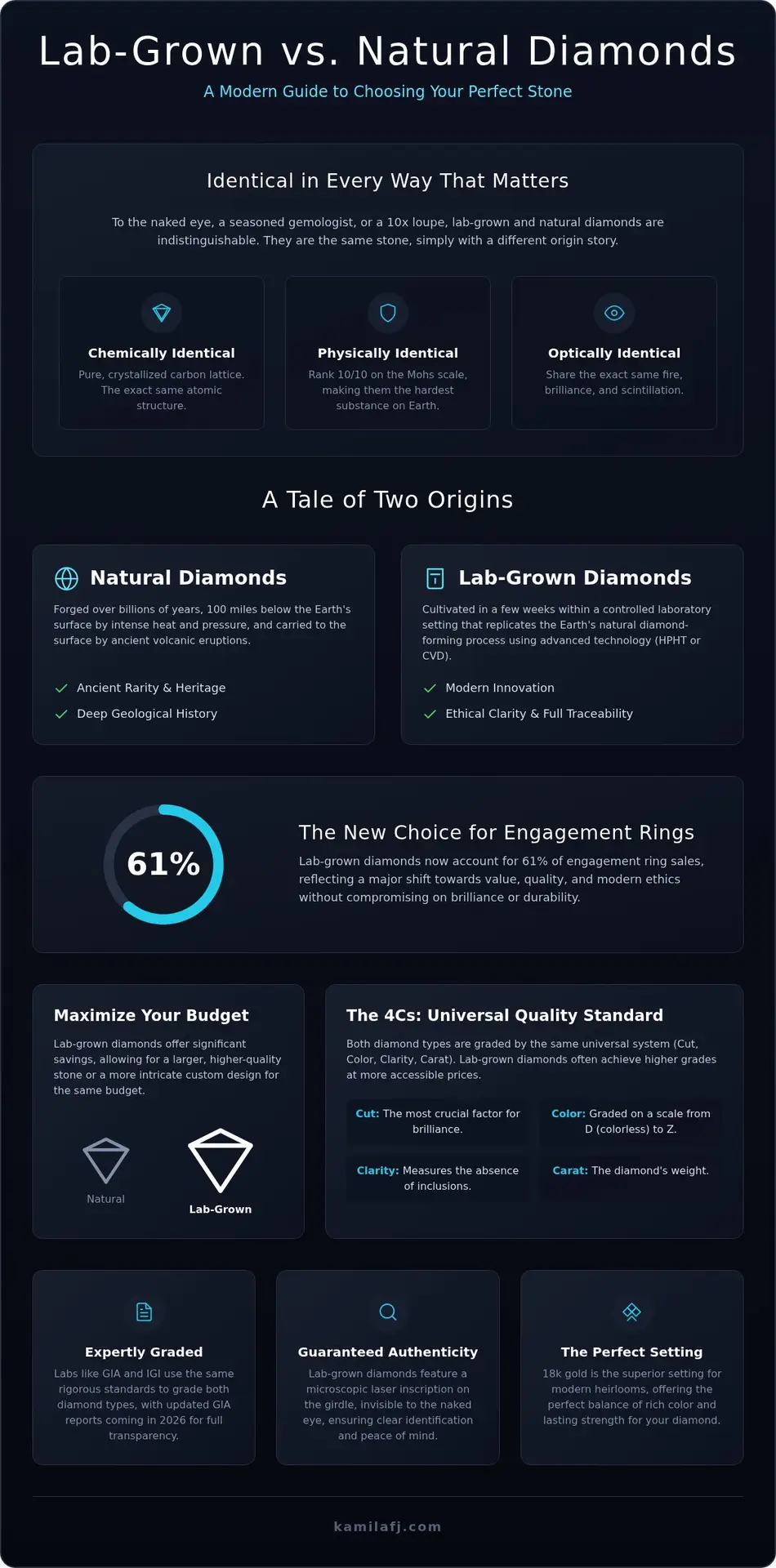
Making the Choice: How to Decide Which Diamond Suits Your Narrative
Deciding on a stone is an intimate act of self-expression. It’s about finding the gem that resonates with your personal philosophy and the life you lead. For the “Naturalist,” the appeal lies in the antiquity of the earth. They see a natural diamond as a billion-year-old miracle; a finite piece of history that connects them to the planet’s deep past. For this person, the knowledge that their stone was forged by geological time is the primary emotional driver. They value the rarity and the “story of the earth” above all else.
On the other hand, the “Modernist” views luxury through the lens of innovation and ethics. They prioritize clarity and size, often choosing lab grown diamonds vs natural because they want the most brilliant stone their budget allows. This choice reflects a belief that beauty should be accessible and consciously created. When weighing lab grown diamonds vs natural, the Modernist values the ability to secure a higher-grade stone without the traditional premium. Neither path is superior; they simply represent different ways of celebrating your identity. The setting plays a crucial role here, too. We use 18k gold for all our designs because it provides the rich, warm luster that only high-purity gold can offer. It’s durable enough for daily life yet soft enough to be worked into the minimalist, artistic shapes that define our aesthetic.
When to Choose a Lab-Grown Diamond
Lab-grown stones are an exceptional choice for those looking to build a versatile “diamond wardrobe.” They allow you to own a collection of necklaces and bracelets that elevate your daily look without compromise. This is also the ideal path for engagement rings where you might prioritize a higher clarity or a larger carat weight to tell your love story. If your personal narrative is defined by a strict ethical stance on mining and a desire for a transparent supply chain, a lab-grown stone is your perfect match. They offer the same chemical brilliance as natural stones but with a footprint that feels lighter on the soul.
When to Choose a Natural Diamond
A natural diamond is the right choice when the ancient origin of the stone is your main source of joy. If you’re purchasing a piece intended to be a traditional financial heirloom, the rarity of a natural stone may hold more weight. It’s for the individual who finds deep meaning in the fact that their diamond is a unique, one-of-a-kind creation of nature that has survived for eons before reaching their hand. These stones are often reserved for singular heritage pieces where the antiquity of the material is the focal point of the narrative.
Ready to find the stone that reflects your identity? Discover our collection of handcrafted 18k gold jewelry and choose the brilliance that speaks to you.
KaMila Fine Jewellery: Celebrating Your Story with 18k Gold and Sustainable Brilliance
At KaMila Fine Jewellery, we believe that the choice between lab grown diamonds vs natural is ultimately a chapter in your personal story. Our philosophy is rooted in the idea that luxury should be an intimate expression of your identity; a quiet confidence that accompanies you through the rhythms of daily life. We don’t see jewelry as an occasional indulgence, but as a meaningful emblem of your milestones. Every piece we create is a fusion of modern, minimalist aesthetics and the timeless traditions of high-end craftsmanship. By focusing on ethical sourcing and artistic integrity, we ensure that your chosen brilliance reflects both your style and your soul.
The foundation of our work is our commitment to 18k gold. While many brands choose lower purities, we set our diamonds exclusively in 18k gold to ensure a rich, warm hue that complements the fire of the stone. This metal is 75% pure gold, providing the perfect balance of prestige and durability. It’s resilient enough to protect your diamond for decades, yet it possesses a soft luster that 14k gold simply cannot match. Each setting is handcrafted in Israel, where our artisans pay meticulous attention to the subtle curves and textures that make a piece feel truly personal.
The KaMila Aesthetic: Minimalist Luxury
We design for the “everyday celebration.” Our pieces aren’t meant to sit in a safe; they’re meant to be worn, loved, and layered. We celebrate the versatility of gold necklaces with lab-grown accents, creating designs that transition effortlessly from a morning meeting to a celebratory dinner. The “quiet confidence” of a KaMila design lies in its restraint. We remove the unnecessary to let the light of the stone and the warmth of the gold speak for themselves. This minimalist approach ensures that your jewelry never overpowers you; it simply highlights the strength and grace you already possess.
Custom Creations and Your Personal Journey
Your journey is unique, and sometimes a pre-designed piece isn’t enough to tell your story. We invite you to collaborate with us through our custom jewelry service to create a one-of-a-kind treasure. Whether you’ve decided on lab grown diamonds vs natural, we help you source the perfect stone that fits your vision and your values. We guide you through the selection process with transparency, ensuring you understand the character of your gem before it’s set into its forever home. Let us help you create an heirloom that is as singular as the life it celebrates. Explore the KaMila Collection today and find the piece that resonates with your narrative.
Choosing Your Forever Brilliance
The journey of selecting between lab grown diamonds vs natural is ultimately an invitation to define what luxury means to you. We’ve explored how both stones share an identical chemical soul and a lasting durability that ranks at a 10 on the Mohs scale. Whether you’re drawn to the ancient, geological story of a natural stone or the innovative, ethical clarity of a lab-grown diamond, your choice is a valid reflection of your personal values. What truly matters is how that stone fits into your daily life and the memories you’ll create while wearing it.
At KaMila Fine Jewellery, we’re here to help you frame those memories in high-purity, handcrafted 18k gold. Our pieces celebrate artisanal Israeli craftsmanship and a commitment to sustainably sourced lab diamonds, ensuring that your jewelry is as conscious as it is beautiful. Every design is crafted to be a protective emblem of your unique journey, designed for the everyday celebration rather than the occasional indulgence.
Discover your next modern heirloom in the KaMila collection and find the piece that speaks to your heart. Embrace the brilliance that aligns with your story, knowing that the most precious part of any jewel is the individual narrative it represents.
Frequently Asked Questions
Is a lab-grown diamond a real diamond?
Yes, a lab-grown diamond is 100% real. It shares the exact same chemical composition and crystal structure as a stone mined from the earth. Both are pure carbon. Because they possess the same optical properties, they exhibit the identical fire and brilliance that you expect from a high-quality gem. The only difference is the point of origin, making them a beautiful, authentic choice for your modern fine jewelry collection.
Can a jeweler tell if a diamond is lab-grown?
A jeweler cannot distinguish between lab grown diamonds vs natural using only their eyes or a standard jeweler’s loupe. Because the stones are identical in every physical way, detection requires advanced laboratory equipment that identifies trace growth patterns. Most lab-grown stones also feature a microscopic laser inscription on the girdle for transparency. This ensures that while the beauty is indistinguishable, the history of your stone is always clear and documented.
Do lab-grown diamonds have any resale value?
Lab-grown diamonds do have resale value, though it is typically lower than that of natural stones. In 2026, lab-grown diamonds generally retain about 10% to 40% of their original purchase price. While natural diamonds often retain a higher percentage, the significantly lower initial cost of lab-grown stones means you’ve committed less capital upfront. We suggest choosing a diamond based on the joy and personal meaning it brings to your daily life.
Why are lab-grown diamonds so much cheaper than natural ones?
The price difference is primarily due to the efficiency of the modern supply chain. Creating diamonds in a laboratory removes the massive costs associated with land displacement, heavy machinery, and deep-earth mining. Because lab-grown stones can be produced in weeks rather than over billions of years, the supply is more consistent. This allows us to offer larger, higher-quality stones at a price point that makes luxury feel accessible for daily life.
Do lab-grown diamonds get cloudy over time?
No, lab-grown diamonds will never get cloudy, yellow, or lose their brilliance over time. Since they are physically identical to natural diamonds, they possess the same permanent crystal structure. They rank at a 10 on the Mohs scale, meaning they are incredibly resistant to scratching and environmental changes. Your stone will remain as clear and luminous as the day you first wore it, serving as a lasting emblem of your story.
Is lab-grown diamond jewelry considered “fine jewelry”?
Absolutely. Lab-grown diamond jewelry is considered fine jewelry when it’s crafted with precious metals and high-quality stones. At KaMila, we elevate these gems by setting them in handcrafted 18k gold. This combination of sustainable brilliance and traditional artisanal metalwork ensures your piece meets the highest standards of luxury. It’s a modern approach to high-end craftsmanship that prioritizes both aesthetic beauty and ethical consciousness for the discerning wearer.
Can I get a GIA certificate for a lab-grown diamond?
Yes, the Gemological Institute of America (GIA) provides full grading reports for lab-grown diamonds. In late 2025, GIA updated their reports to include Premium and Standard categories to help consumers understand the quality of their stones. These certificates provide an objective analysis of the stone’s characteristics, just like they do for natural diamonds. This professional verification gives you total confidence in the quality and authenticity of your lab grown diamonds vs natural choice.
What happens if I want to upgrade my lab-grown diamond later?
Upgrading a lab-grown diamond is entirely possible through our custom jewelry services. While trade-in policies vary across the industry, we focus on helping you evolve your collection as your story grows. You can choose to reset your original stone into a new 18k gold design or source a larger diamond for a special milestone. Our goal is to ensure your jewelry remains an intimate expression of your personality at every stage of your life.
Related Posts
Questions to Ask a Jeweler About Their Sourcing Ethics
-
Posted by
מילה קלר
What if “ethically sourced” tells you less than the answer to one careful question? When choosing a piece with personal meaning, it’s natural to want…
Is My Diamond Too Big for My Hand? A Personal Style Guide
-
Posted by
A diamond can look dramatic in a product photo and feel perfectly at home on your hand; a smaller stone can still make a striking statement. If…
Unhappy With Your Final Custom Ring? Here’s What to Do Next
-
Posted by
What if I’m unhappy with my final custom ring, even though I approved the design? A finished piece can feel different on your hand than it did in a…
From Sketch to Sparkle: Ensuring the Final Piece Matches Your Jewelry Design
-
Posted by
You’ve spent weeks dreaming of a ring that captures your story, but as you look at the artist’s rendering, a small doubt creeps in. Will that…
Repurposing Heirloom Stones into Modern Custom Jewelry: The Complete 2026 Guide
-
Posted by
What if keeping an inherited ring tucked away in a dark jewelry box isn’t protecting your family history, but silencing it? It’s completely natural…

Finding an English-Speaking Custom Fine Jewelry Designer in Israel: A Complete Guide
-
Posted by
Your most cherished jewelry shouldn’t just be an accessory; it’s a piece of your history that deserves to be understood without a translator. When…

How to Convince Your Husband to Upgrade Your Wedding Ring
-
Posted by
What if your wedding ring wasn’t just a relic of who you were when you said “I do,” but a luminous reflection of the woman you’ve become today? Many…
Red Flags When Choosing a Custom Jewelry Designer: A 2026 Guide to Protecting Your Vision
-
Posted by
Imagine spending months dreaming of a bespoke 18k gold ring, only to open the velvet box and find a piece that feels like a generic retail cast…
Jewelry That Makes Me Feel Protected and Strong: A Guide to Modern Talismans
-
Posted by
Most people view a necklace or a ring as a simple finishing touch, but for the modern woman, it’s often the first layer of emotional armor she puts…
How to Stack Rings: The Art of Curating Your Personal Story in 18K Gold
-
Posted by
What if your jewellery box wasn’t just a collection of objects, but a living timeline of your most cherished milestones? You’ve likely looked at a…
Minimalist Gold Rings: A Guide to Curating Your Timeless 18K Collection
-
Posted by
Your jewelry shouldn’t have an expiration date. Too many of us have felt the frustration of a cherished piece tarnishing or causing skin irritation…
Getting a Better Price Than Big Brand Jewelers in Israel: The Insider’s Guide 2026
-
Posted by
That iconic logo on a shopping bag in a Tel Aviv mall might feel like a mark of quality, but it’s often the most expensive way to buy a memory. When…