

Blog
How to Choose Earring Size: The Definitive Guide to Scale and Style
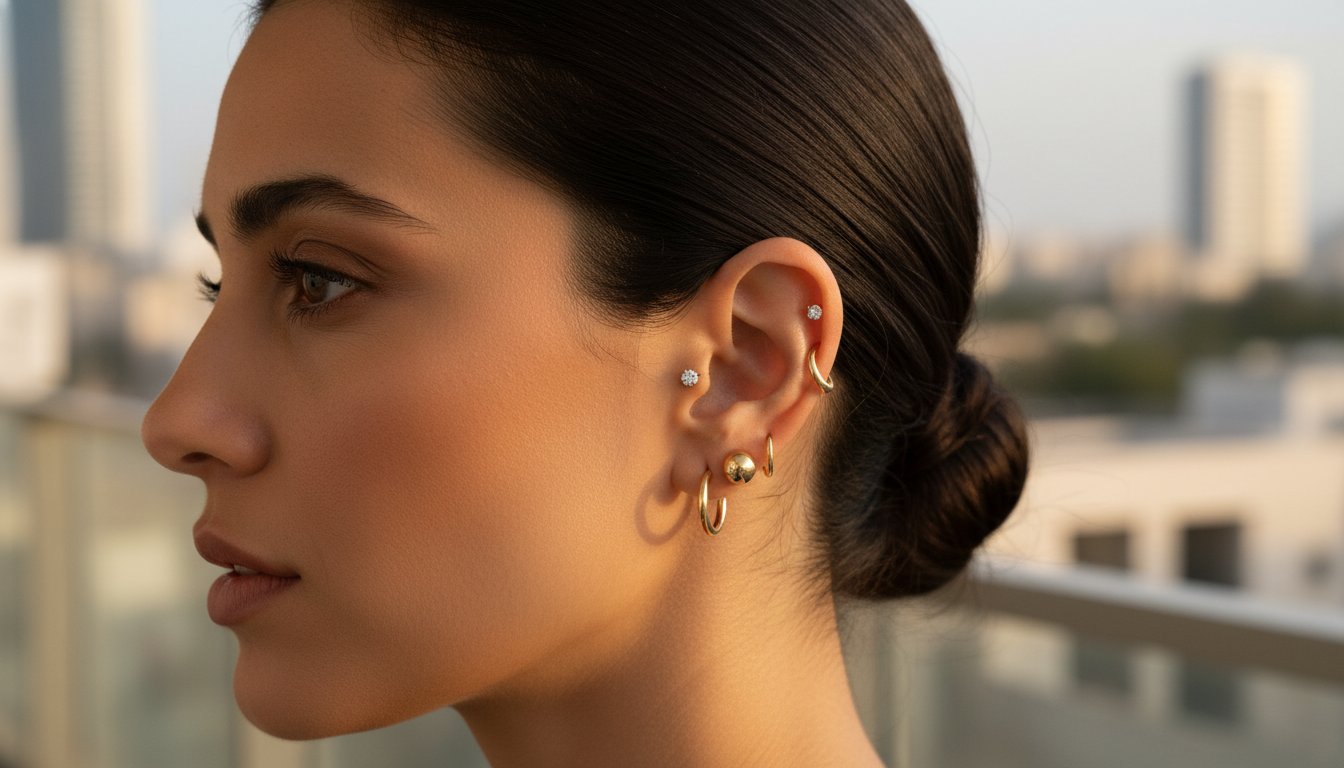
A single millimeter can be the difference between a subtle whisper and a bold declaration. While we often focus on the luster of gold or the fire of a diamond, the true secret to jewelry that feels like “you” lies in the geometry of the piece. Learning how to choose earring size is about more than just reading a chart; it’s about finding the perfect scale to celebrate your unique features. You’ve likely experienced the frustration of unboxing a pair of earrings only to find they feel heavier or larger than they appeared on your screen.
We agree that luxury should feel effortless, not like a guessing game. This guide promises to transform your uncertainty into confidence by decoding the relationship between carat weight, diameter, and your own anatomy. We’ll explore everything from the delicate 3mm stud to the intentional flow of a curated ear stack. By the end, you’ll know exactly how to select dimensions that elevate your everyday style while ensuring every 18K gold piece you choose sits with grace and comfort.
Key Takeaways
- Learn why millimeters are the universal language of fine jewelry and how to accurately measure diameter and length for a flawless fit.
- Master how to choose earring size for studs by identifying your ideal “sweet spot” between minimalist 2mm accents and classic 7mm daily staples.
- Find your perfect hoop diameter, from the intimate fit of an 8mm huggie to the sophisticated presence of a 40mm mid-size hoop.
- Discover the “Cascade Method” for curating an intentional ear stack that balances scale and storytelling across multiple piercings.
- Understand how to align earring scale with your personal proportions, such as hair length and glasses, to ensure your 18K gold pieces truly shine.
The Fundamentals of Earring Measurement and Scale
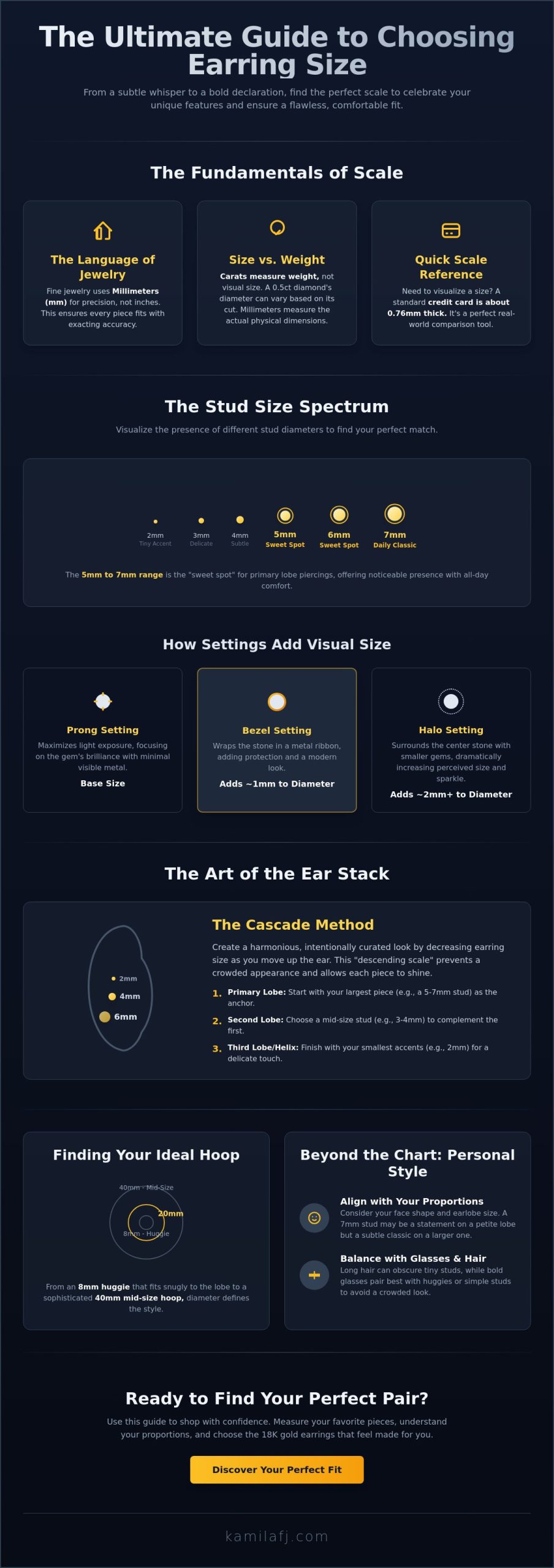
Precision is the silent partner of beauty. When you’re deciding how to choose earring size, you’re essentially mapping the relationship between a piece of art and your own anatomy. To do this effectively, we must move beyond vague descriptions like “small” or “large” and embrace the specific language of the bench jeweler. Every earring is defined by three primary dimensions: diameter, total length, and width. Diameter typically refers to the circular measurement of a stud or a hoop. Total length is the vertical drop from the piercing point to the bottom of the piece, while width accounts for the thickness of the metal or the setting.
While many industries use inches, the world of fine jewelry relies almost exclusively on millimeters. This metric system allows for the incredible accuracy required when working with precious metals. Understanding Body jewelry sizes, specifically the gauge of the post, ensures that the physical scale of the piece feels comfortable and secure in your piercing. Most standard lobe piercings use a 20-gauge or 18-gauge post, and knowing these small details prevents the frustration of a piece that feels too heavy or intrusive.
Materials play a significant role in how we perceive scale. For instance, 18K gold has a higher density than lower karat alloys, which creates a distinct sense of visual weight. A small, solid 18K gold hoop may feel more substantial and look more radiant than a larger, hollow piece made of less refined materials. This “heft” is part of the luxury experience. If you’re struggling to visualize a measurement, look to your wallet. A standard credit card is approximately 0.76mm thick. Holding an earring against the edge of a card can provide an immediate, relatable reference point for scale before you commit to a purchase.
Understanding Millimeters vs. Carat Weight
Confusion often arises when comparing carat weight to millimeter diameter. It’s vital to remember that carats measure mass, while millimeters measure physical size. A 0.5ct diamond may appear larger or smaller depending on its cut. A shallow cut might offer a wider surface area, whereas a deep cut hides its weight below the girdle. Additionally, a minimalist 18K gold bezel setting can add 1 to 2mm to the overall diameter of a stone, making a smaller gem appear far more impactful without increasing its weight or cost.
Tools for Measuring Your Current Favorites at Home
To identify your personal “comfort zone,” measure the pieces you already love wearing. A simple transparent ruler works well, but a digital caliper offers the precision needed for fine jewelry. Once you have the measurements, perform the “mirror test.” Stand three feet back from a mirror. This distance mimics how others see you and reveals if the scale of the earring complements your face or gets lost. Documenting these dimensions makes future online shopping a joyful, certain experience rather than a guessing game.
Choosing the Perfect Stud Size for Every Piercing
Studs are the quiet anchors of a jewelry wardrobe. They offer a sense of permanence and grace that transcends fleeting trends. When you’re figuring out how to choose earring size for your primary lobe piercing, the 5mm to 7mm range is widely considered the “sweet spot.” This size provides enough presence to be noticed during a conversation while remaining comfortable enough for 24-hour wear. However, the physical measurement of the stone is only half the story. The setting style dictates the visual volume of the piece, often changing how it sits against your skin.
A prong setting allows light to dance through a stone, keeping the focus entirely on the gem’s fire and brilliance. In contrast, a bezel setting wraps the stone in a delicate ribbon of 18K gold, which typically adds about 1mm to the overall diameter. If you prefer a more dramatic look, a halo setting can increase the perceived size by 2mm or more. Matching these dimensions to your earlobe’s surface area is essential for a balanced look. A 7mm stud on a petite lobe may look like a bold statement piece, while the same size on a larger lobe might appear as a classic, minimalist choice.
Sizing for Second and Third Lobe Piercings
Creating a harmonious ear stack requires a sense of rhythm and intentionality. We recommend the “Descending Scale” method to ensure your piercings don’t compete for attention. If your first piercing features a 6mm stud, your second should ideally drop to a 3mm or 4mm size. Understanding how to choose earring size for higher placements is key; the third lobe or the flat of the ear often shines best with tiny 2mm accents. These smaller dimensions prevent the ear from looking crowded and allow the natural luster of the gold to catch the light without overwhelming your features.
Minimalist vs. Statement Studs: When to Go Big
Sometimes, the occasion calls for a bold signature that speaks to your personal story. Statement studs, usually 8mm and above, provide a modern alternative to traditional dangles. Because our pieces are crafted from 18K gold, these larger designs retain a refined, artisanal glow rather than the heavy, reflective look often found in costume jewelry. To protect the health of your piercing, ensure the weight is balanced. High-quality 18K gold offers the perfect density for a secure fit that won’t tug or stretch your lobe over time. Explore our collection of gold earrings to find the diameter that reflects your unique perspective.
Finding Your Ideal Hoop Diameter and Drop Length
Hoops possess a kinetic energy that other styles lack. They frame the face with a continuous line of light, catching every movement of the head and reflecting your inner glow. Mastering how to choose earring size for hoops requires a shift in perspective from flat surface area to circular volume. The journey usually begins with the huggie, a petite hoop typically ranging from 8mm to 12mm. These are designed to sit snugly against the lobe, offering a modern, clean silhouette that works beautifully for sleep, work, or play. They are the essential foundation of a curated ear stack.
Moving up the scale, the mid-size hoop (20mm to 40mm) emerges as a versatile companion. These pieces are large enough to be seen through loose hair but subtle enough for a professional environment. For those who embrace a more theatrical presence, statement hoops of 50mm or more provide an architectural impact. Because these are crafted from fine 18K gold rather than heavy, non-precious alloys, they remain surprisingly lightweight. This allows you to wear a bold, expansive silhouette without the physical fatigue or lobe stretching often associated with lower-quality alternatives. When considering drop earrings, measurement starts at the piercing point. A length of 4cm to 6cm is generally the standard for effortless comfort, while 7cm to 9cm will likely reach the jawline or mid-neck, creating a striking focal point.
The Anatomy of a Huggie: Inner vs. Outer Diameter
The secret to a perfect huggie fit lies in the inner diameter rather than the outer measurement. This is the actual space available for your earlobe. To find your size at home, measure the distance from your piercing hole to the lowest edge of your lobe using a simple ruler. We suggest adding 1mm or 2mm to this number to ensure your skin has enough breathing room. This small cushion is vital for sensitive piercings or for those who are still in the healing process. It prevents the metal from pinching or irritating the area, ensuring the jewelry feels like a natural extension of yourself.
Balancing Drop Earrings with Face Shape and Neckline
Drop earrings act as a visual extension of your neck. Choosing a length that hits just above the jawline can create a stunning, elongated effect. Rounder face shapes often benefit from longer, narrower drops that provide vertical balance. Conversely, heart or oval shapes can carry wider, more sculptural hoops with ease. This approach aligns with the KaMila philosophy of effortless elegance, where jewelry isn’t meant to mask your features but to highlight the natural harmony of your identity. By matching the drop length to your neckline, you create a cohesive story that feels both intentional and personal. It’s about finding that delicate balance between the object and the individual.
Curating Your Ear Stack: Sizing for Multiple Piercings
A curated ear is more than a collection of jewelry. It’s a visual rhythm that tells your story through a deliberate sequence of scale and light. Mastering how to choose earring size for a multi-pierced look involves more than just picking pieces you love; it’s about engineering a landscape of gold and light. The most effective way to approach this is through the ‘Cascade Method.’ This technique organizes your pieces from the largest at the bottom lobe to the smallest as you move up the ear’s edge. By following this natural progression, you create a sense of balance that feels intentional rather than cluttered.
When you’re deciding on dimensions for the helix, the standard often falls between 6mm and 8mm hoops or delicate 2mm studs. The helix has less surface area than the lobe, so smaller dimensions ensure the jewelry complements the ear’s curve without overwhelming it. For more specialized placements like the tragus or conch, the anatomy becomes even more specific. A conch piercing often requires a larger hoop, perhaps 10mm to 12mm, to comfortably clear the outer ridge. In contrast, a tragus is best served by a minimalist 2mm or 3mm stud that sits flush against the skin. Mixing textures, such as a hammered gold hoop next to a polished stud, adds depth without requiring extra size.
The Visual Weight Principle in Stacking
Luxury is often found in what we leave out. To avoid a heavy look, balance the warm, solid glow of 18K gold with the sharp brilliance of diamond accents. Space is as vital as the metal itself. We recommend leaving at least 2mm to 4mm of ‘negative space’ between each piece. This allows every item to breathe and be appreciated as an individual work of art. Utilizing different ear piercing placements allows you to build a cohesive story that feels like a single, unified expression of your identity.
Sizing for Cartilage: Comfort vs. Aesthetic
In the firmer tissue of the cartilage, post length is just as critical as the front diameter. A post that’s too long will snag on hair or clothing, while one that’s too short can cause irritation. For smaller sizes, ‘flat back’ studs are the superior choice for daily comfort, especially during sleep. As your piercing heals, you may find you can transition to more snug, decorative pieces. Ready to begin your curation? Explore our collection of gold earrings to find the perfect building blocks for your stack.
Beyond the Chart: How Personal Style Dictates Size
Your physical proportions act as a natural frame for your jewelry. If you wear your hair in a short, architectural bob or a sleek pixie cut, your ears become a focal point. This allows for intricate, smaller designs to shine without being lost. Conversely, those with long, voluminous hair may find that mid-size or statement pieces provide the necessary visual weight to remain visible. Glasses also play a role in this geometry. If your frames are bold and dark, minimalist earrings prevent your face from feeling overcrowded. For those with delicate, wire frames, a more sculptural earring can add a beautiful layer of complexity to your look.
Elevating the Everyday with 18K Gold and Lab Diamonds
The beauty of 18K gold lies in its enduring warmth and density. In minimalist sizes, this metal provides a rich, buttery glow that lower-karat alternatives simply cannot replicate. When you combine this with the brilliance of lab-grown diamonds, the possibilities for scale expand. Lab-grown diamonds allow you to explore larger, more impactful statement pieces while maintaining a commitment to ethical sourcing and modern sustainability. These stones offer the same physical and chemical properties as mined diamonds, giving you the freedom to choose a size that feels substantial and celebratory without compromise.
Custom Sizing and Personal Narratives at KaMila
As modern artisans, we understand that every ear is a unique canvas. Sometimes, a standard measurement doesn’t quite capture the vision you have for your style. We specialize in creating Custom Jewelry and One-of-a-Kind Jewelry that respects the specific anatomy of the individual. Whether you need a slight adjustment to a post length for comfort or a bespoke diameter for a conch hoop, our goal is to ensure your jewelry feels like a second skin. Finalizing your selection is about more than just a number on a chart; it’s about choosing a scale that celebrates your strength, your history, and your identity.
Elevate Your Daily Narrative Through Perfect Scale
Mastering the nuances of how to choose earring size transforms jewelry from a simple accessory into a seamless part of your identity. You now have the technical tools to navigate the precision of millimeters and the intentional flow of the cascade method. This ensures every curated ear stack you build feels balanced and uniquely yours. Whether you’re drawn to the intimate glow of a tiny stud or the architectural presence of a statement hoop, the right dimensions should always honor your natural features and personal comfort.
We believe every piece should be as meaningful as the person wearing it. Our collection features timeless 18K gold designs and sustainable lab-grown diamonds, all handcrafted in Israel with the care of a modern artisan. Choosing the right size is the final step in telling your story with grace. Explore KaMila’s handcrafted 18K gold earrings and find your perfect fit today. Embrace the confidence that comes with jewelry designed to celebrate your strength, your history, and your personal journey.
Frequently Asked Questions
What is the most popular earring size for everyday wear?
A diameter of 5mm to 7mm is the universal favorite for daily wear. This size offers enough presence to catch the light and showcase the luster of 18K gold while remaining comfortable for 24-hour wear. It balances traditional artisan craftsmanship with a modern, minimalist aesthetic. When considering how to choose earring size for your primary piercing, these dimensions provide a reliable baseline that complements almost every face shape and lifestyle.
How do I know if an earring is too big for my face?
An earring might be too large if it distracts from your natural features rather than highlighting them. Use the three-foot mirror test to see if the jewelry overwhelms your jawline or competes with your eyes for attention. If a piece physically pulls your lobe downward or feels heavy after an hour, the scale is likely too large for your anatomy. Balance is achieved when the earring feels like a harmonious extension of your identity.
What size should a second piercing earring be?
Second piercings typically shine best with studs in the 2mm to 4mm range. Following the descending scale principle ensures your ear stack has a clear, rhythmic flow that feels intentional. If your first piercing features a 6mm stone, a 3mm accent in the second hole creates a sophisticated, curated look. This prevents the ear from appearing crowded and allows the unique character of each 18K gold piece to be appreciated individually.
Is there a difference between 14K and 18K gold when it comes to earring weight?
Yes, 18K gold is notably denser and heavier than 14K gold because it contains a higher percentage of pure gold. This density gives 18K pieces a more substantial feel and a richer, warmer luster that reflects high-end craftsmanship. While the physical weight is slightly higher, this often translates to a more secure, luxurious fit on the ear. It’s a subtle detail that makes your daily jewelry feel special rather than just an accessory.
What is a standard post length for stud earrings?
The standard post length for most stud earrings is approximately 11mm. This length is designed to accommodate various lobe thicknesses while leaving enough room for the ear to breathe. If a post is too short, it can pinch the tissue; if it’s too long, the earring may droop forward. For those with unique anatomy, we can provide custom adjustments to ensure your 18K gold studs sit perfectly and comfortably against your skin.
How can I tell if a hoop will be too tight on my earlobe?
To avoid a tight fit, measure the distance from your piercing hole to the bottom of your lobe. Add at least 1mm or 2mm to this measurement to find your ideal inner diameter. This extra space provides the necessary breathing room to prevent irritation or pinching. A hoop that is too snug can disrupt the healing of a piercing, especially when using high-density materials like 18K gold that sit close to the skin.
Does earring size affect how a lab-grown diamond sparkles?
While a diamond’s sparkle is primarily determined by its cut, size influences the visual impact of that light. Larger lab-grown diamonds have a greater surface area, which allows for more dramatic light dispersion and fire. When you’re learning how to choose earring size for a statement piece, remember that a larger stone can showcase the intricate faceting of a high-quality cut more clearly than a very small, minimalist accent might.
What size earrings are best for sensitive ears?
For sensitive ears, the purity of the material is more important than the size, though smaller pieces are often more comfortable. Lightweight studs in 18K gold are an excellent choice because they minimize physical tugging on the piercing. Keeping the diameter under 5mm for daily wear ensures the earring doesn’t trap moisture against the skin. High-purity gold is naturally more biocompatible, which helps maintain the health and grace of your piercings over time.
Related Posts
Jewelry Design in Haifa: What to Expect in 2026
-
Posted by
מילה קלר
If you’re searching “jewelry design consultation in Haifa what to expect,” you may be wondering what to bring, which decisions you’ll need to make,…
Designing a Custom 18k Gold Ring: 2026 Bespoke Guide
-
Posted by
What if the most exquisite jewelry you ever own isn’t reserved for formal galas, but crafted to enrich your daily life? When you start exploring…
Jewelry That Makes Me Feel Protected and Strong: A Guide to Modern Talismans
-
Posted by
Most people view a necklace or a ring as a simple finishing touch, but for the modern woman, it’s often the first layer of emotional armor she puts…
How to Stack Rings: The Art of Curating Your Personal Story in 18K Gold
-
Posted by
What if your jewellery box wasn’t just a collection of objects, but a living timeline of your most cherished milestones? You’ve likely looked at a…
Minimalist Gold Rings: A Guide to Curating Your Timeless 18K Collection
-
Posted by
Your jewelry shouldn’t have an expiration date. Too many of us have felt the frustration of a cherished piece tarnishing or causing skin irritation…

18k Gold Earrings for New Piercings: Safe Styling Guide
-
Posted by
What if the most rewarding part of your piercing journey wasn’t the initial appointment, but the moment you finally swap those generic studs for…

18k Gold Minimalist Bracelets: The Ultimate Guide to Timeless Everyday Luxury
-
Posted by
True minimalism isn’t about having less; it’s about requiring more from the few pieces you choose to wear every day. If you’ve ever felt the…

18k Gold Stud Earrings: The Ultimate Guide to Everyday Luxury
-
Posted by
Why should the jewelry you wear every single day be the piece that irritates your skin or loses its radiance before the season even turns? It’s a…

18k Gold Jewelry Care: Preserving Modern Heirlooms
-
Posted by
Is your most cherished jewelry tucked away in a dark velvet box, waiting for a “special enough” occasion that never quite arrives? Many women…

Shipping Fine Jewelry from Israel to the US: The Complete 2026 Guide
-
Posted by
You’ve finally found it: an 18k gold necklace from a Tel Aviv studio that perfectly captures a chapter of your own story. The design is breathtaking,…
The Ultimate Guide to Choosing a Minimalist 18k Gold Necklace in 2026
-
Posted by
Is your jewelry box a collection of “for now” pieces or a reflection of your forever story? Many women find themselves caught in a cycle of buying…
How to Care for 18K Gold Jewelry: A Complete Guide
-
Posted by
What if your most precious 18k gold ring wasn’t meant for the safety of a velvet box, but for the messy, beautiful reality of your daily life? It’s…