

Blog
How to Untangle a Gold Chain: The Gentle Artisan’s Guide
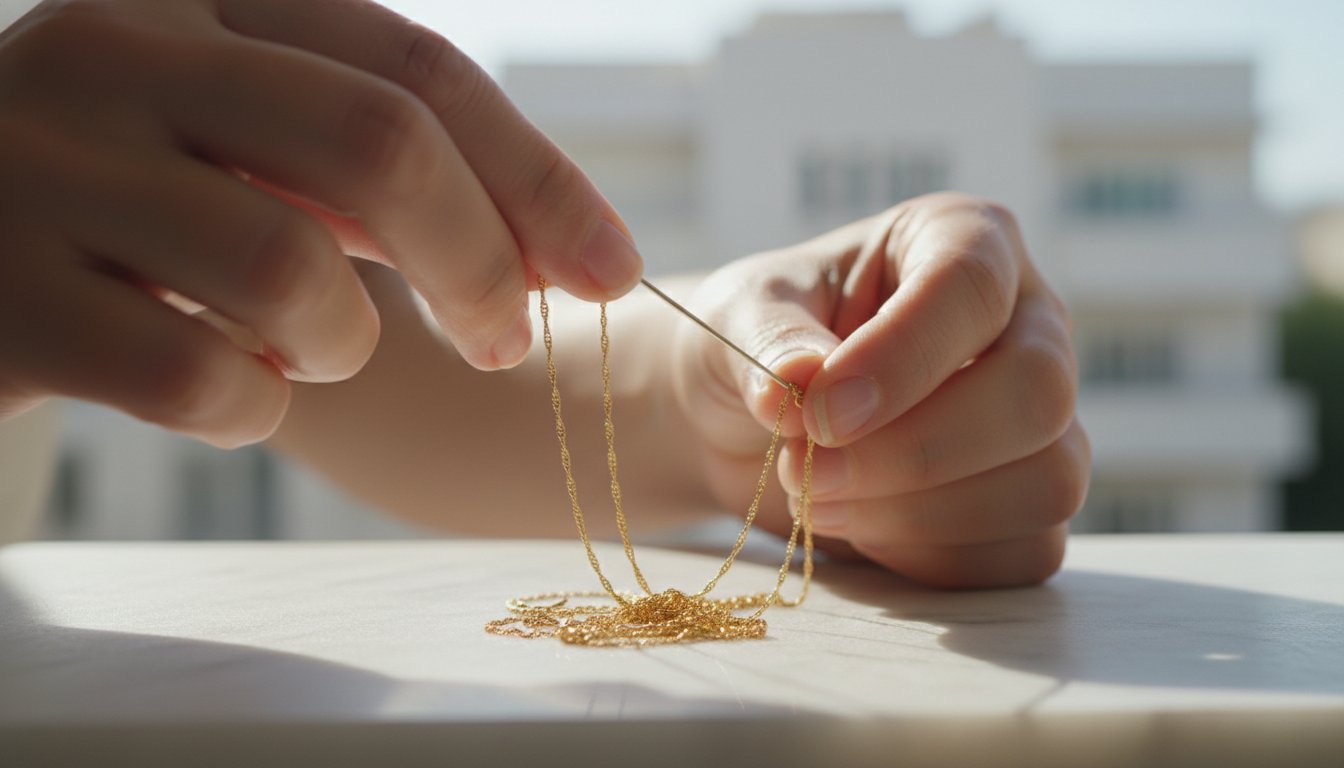
Imagine you’re getting ready for a special evening out in Tel Aviv, reaching for that delicate 14k gold necklace that holds a lifetime of memories. Instead of a shimmering strand, you find a stubborn, tight knot that seems impossible to undo. Learning how to untangle a gold chain correctly is the only way to save the piece without causing permanent damage to the fine metal. It’s a moment of pure frustration that can quickly turn into anxiety because you know that one wrong move might snap a link that means the world to you.
We believe your jewelry is a part of your story, not just a simple accessory. This guide provides the same patient, artisan techniques we use in our studio to preserve the integrity of every handcrafted piece. We’ll share the secrets to handling these complex knots without the eye strain or the fear of breakage. You’ll discover how simple household items like a drop of oil or a fine 0.6mm needle can become professional tools. This journey will give you the confidence to restore your favorite necklaces to their original grace and keep them safe for the future.
Key Takeaways
- Understand the “knotting phenomenon” and why delicate, minimalist gold chains are more susceptible to tangles than sturdier, chunky styles.
- Master the gentle “Lubricate and Tease” method to learn how to untangle a gold chain using non-abrasive household tools that protect your jewelry’s finish.
- Learn to identify the subtle signs of a “stretched” link or a kinked snake chain to avoid permanent damage and know when to visit a professional jeweler in Israel.
- Implement the “Clasp It” storage rule and other mindful rituals to ensure your handcrafted pieces remain knot-free and ready for your daily story.
The Anatomy of a Knot: Why Fine Gold Chains Tangle
Every jewelry lover knows the sudden heart-sink of finding a beloved necklace in a clump. This “knotting phenomenon” isn’t just bad luck; it’s a result of link geometry and microscopic friction. When delicate links overlap, their edges catch on one another, creating a mechanical lock. Learning how to untangle a gold chain begins with understanding that these tangles are often a mathematical certainty when fine chains move freely. Whether it’s the result of tossing a necklace into a dish or the rhythmic movement of a pendant against your skin, the links naturally seek a state of lower energy, which often leads to complex clusters.
The Physics of Fine Jewelry Friction
The surface area of 18K gold links plays a surprising role in how they interact. While gold is polished to a mirror finish, it isn’t perfectly smooth at a microscopic level. Everyday elements like skin oils, stray hairs, or dust particles act as a microscopic “glue,” increasing friction between links and binding them together. In the study of Knot theory, scientists examine how these loops and crossings form complex structures. This applies directly to your jewelry box. Certain styles are more prone to this than others:
- Cable Chains: Their open, interlocking loops are roughly 40% more likely to snag than smoother styles.
- Minimalist Chains: Thinner chains have less mass, allowing them to loop through themselves with even the slightest vibration.
- Snake Chains: These are generally more resistant due to their dense, tubular construction, though they can develop “kinks” if bent too sharply.
Why 18K Gold Requires Extra Care
High-karat gold, such as 18K, is prized for its rich color and purity, but it is significantly softer than 14K or costume jewelry. This softness means that if you pull on a knot, you risk “stretching” the individual links. Once a link is deformed, the entire chain’s structural integrity is compromised. When you are learning how to untangle a gold chain, your touch must be as light as the artisan who first soldered the links together.
In the context of fine jewelry, tensile strength is defined as the maximum stress a material can withstand while being stretched or pulled before breaking. For 18K gold, this threshold is lower than most expect. Staying calm is the most important tool in your artisan kit. Panic leads to force, and force leads to permanent damage. Instead of pulling, think of this process as a slow, rhythmic untwisting that honors the craftsmanship of the piece. By treating the chain with grace rather than frustration, you preserve the story and the strength of the gold for years to come.
Essential Tools for Untangling Jewelry at Home
Untangling a delicate necklace requires the patience of an artisan. You don’t need a professional workshop to restore your favorite piece. Most of the instruments required for how to untangle a gold chain are already tucked away in your drawers. The goal is to treat your jewelry with the same grace it brings to your daily life. Every tool you select should prioritize the protection of the metal’s finish.
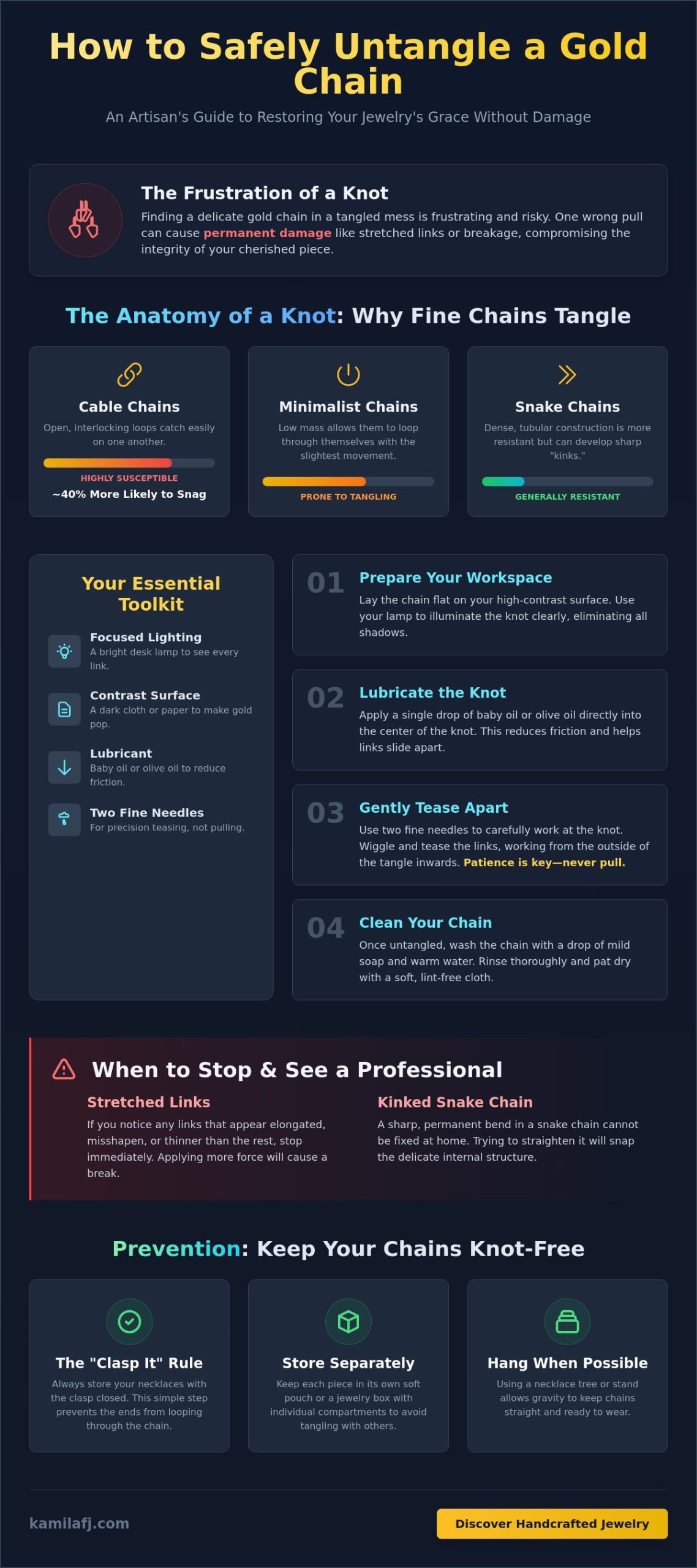
Your most vital asset is artisan-level lighting. A standard overhead bulb often casts shadows that hide the intricate path of a knot. Instead, use a focused desk lamp with a high CRI (Color Rendering Index) to illuminate the individual links. Place your jewelry on a high-contrast surface. A black velvet tray or a dark piece of cardstock makes gold links stand out. This visual clarity allows you to see exactly where the tension lies without straining your eyes or missing a tiny loop.
Choosing non-abrasive tools prevents permanent damage. Gold is a soft, precious metal, especially in the 14k and 18k varieties popular in Israel. Using harsh pliers or serrated tweezers can leave microscopic scratches that dull the shine of your meaningful gold jewelry over time. Stick to smooth surfaces and gentle pressure to maintain the integrity of the handcrafted links.
The Lubrication Kit: Oil and Beyond
Lubricants act as a silent partner in the untangling process. They reduce the friction that causes links to bite into one another. Baby oil is a favorite choice because it’s thin and washes away easily with mild soap. Olive oil works well too, though it’s slightly more viscous. For a professional touch, use a size 00 paintbrush to apply a single drop of oil directly into the heart of the knot. This precision prevents the entire chain from becoming a slippery mess, keeping your grip firm where it matters most. Once the oil penetrates the tangle, the links will often slide apart with minimal effort.
Precision Instruments: Needles vs. Tweezers
Fingers are often too blunt for the delicate work of teasing a knot. Two thin sewing needles are your best friends here. By inserting the tips into the center of the tangle and gently pulling outward, you can expand the knot without accidentally tightening it. Fine-tipped tweezers are helpful for gripping a single link once the knot is loose. Always move with intention. If you feel resistance, stop and re-evaluate. Protecting the artisan finish of your chain is more important than speed. A single slip with a metal tool can mar the surface of the gold; keep your movements light and controlled at all times.
3 Proven Methods to Untangle Your Gold Chain
Patience is the most valuable tool in your jewelry box. Learning how to untangle a gold chain requires the steady hand of a jeweler and a bit of artisan intuition. Whether you’re dealing with a delicate 14k gold cable chain or a thicker curb link, these three techniques will restore your piece to its original grace without causing damage. Always work in a well-lit area to ensure you can see every intricate twist in the metal.
Method 1: The Lubricated Slide
This approach is the most effective way to handle stubborn knots that seem fused together. Friction is your enemy; lubrication is your ally. Start by placing your chain on a flat surface and applying 2 drops of baby oil or high-quality Israeli olive oil directly to the center of the knot with a cotton swab. Let the oil sit for 60 seconds to penetrate the links.
- The Vibration Technique: Use the blunt end of a sewing needle to gently tap the surface of the knot. These micro-vibrations help the oil settle deep into the 0.5mm gaps between the gold links.
- Dual-Needle Work: Insert two fine needles into the heart of the lubricated knot. Gently pull the needles away from each other in a slow, rhythmic motion to create space.
Method 2: The Finger Roll
The Finger Roll works best for surface-level tangles or “bird’s nests” where the chain has looped over itself multiple times. It relies on the warmth of your skin and a gentle, repetitive motion to loosen the core. Place the knot between your thumb and forefinger. Roll the knot back and forth as if you’re rolling a small bead. Do this for 30 to 45 seconds until you feel the tension give way. Once the knot expands and the links begin to separate, transition to needle-work to finish the job. This method is the gentlest way to start the process of how to untangle a gold chain before introducing metal tools.
Method 3: The Hard Surface Tease
When you have multiple interlocking chains, gravity is often what tightens the knots. You must eliminate that tension immediately. Lay the chains flat on a white ceramic plate or a glass table. The white background provides high contrast, making it easier to see individual links that are often less than 1.0mm wide. Unhook the clasp to relieve the internal tension of the gold wire. This provides you with two free ends to work with, preventing the chain from pulling against itself.
- Anchor Point: Use the clasp as an anchor point. Secure it with one finger or a small piece of tape while you tease the rest of the chain away.
- Outside-In Strategy: Don’t pull at the center of the tangle. Use a needle to pick at the outermost loops. Working from the outside prevents the center from tightening into a permanent “dead knot” that could require professional repair.
Once the chain is free, clean it with a soft cloth and a bit of mild soap to remove any oil residue. This ensures your gold shines with the same brilliance it had the day you first wore it.
When to Stop: Identifying Damage and Seeking Help
Sometimes the path to restoration requires a gentle surrender. Knowing how to untangle a gold chain is an art, but recognizing when the metal has reached its physical limit is an act of wisdom. If you notice a link that looks elongated or thinner than its neighbors, stop immediately. Gold is a soft, ductile metal. Under tension, a link can stretch by up to 12% before it snaps. Once a link is compromised, it becomes a structural weak point that will eventually fail, potentially leading to the loss of a cherished pendant.
Certain designs require even more caution. Snake chains and omega styles are built with tightly interlocking plates or a mesh-like core. Unlike traditional cable or curb links, these cannot be untwisted. If you see a sharp bend or a kink that feels rigid, DIY methods will only cause the metal to fatigue and crack. Professional intervention is the only way to preserve the fluid movement that makes these pieces so iconic.
Set a timer for 15 minutes. If the knot hasn’t shifted or, worse, has tightened into a hard bead, your frustration becomes the chain’s greatest enemy. In Israel, professional jewelry cleaning and minor untangling services often cost between ₪50 and ₪150 depending on the complexity. This small investment protects the integrity of your jewelry and your peace of mind.
Signs of Structural Weakness
Examine the area near the clasp with a magnifying glass. Knots located directly against the clasp are particularly risky because they put leverage on the jump ring, which is the small circular wire connecting the clasp to the chain. After you’ve successfully untangled a piece, always test the spring of the clasp. If it feels sluggish or doesn’t snap back with a crisp click, the internal steel spring may have been compromised during the struggle. A weakened clasp is the leading cause of lost jewelry in the bustling streets of Tel Aviv.
The Professional Repair Process
Jewelers approach a tangle like a surgeon. They use high-frequency ultrasonic cleaners to shake loose microscopic debris that acts as glue within a knot. High-pressure steam then clears the path for fine-tipped steel probes. If your own attempts at how to untangle a gold chain have reached a standstill, these specialized tools provide a safe resolution. At KaMila Fine Jewellery, the story of every piece is valued as much as the gold itself. If a chain holds deep sentimental value or serves as a personal talisman, seeking professional help ensures its longevity.
If your chain feels fragile or the knot remains stubborn, consult an artisan to restore your jewelry to its original grace.
Prevention: How to Store Your Necklaces to Avoid Knots
The most effective way to care for your collection is to stop tangles before they start. While knowing how to untangle a gold chain is a vital skill for any jewelry lover, building a thoughtful storage ritual saves your delicate links from unnecessary stress. Start with the “Clasp It” rule. Every time you remove a necklace, immediately close the clasp. This simple step prevents the two ends from dancing around each other and forming those stubborn, microscopic knots that often require professional intervention.
Choosing between hanging and laying flat depends on the architecture of your piece. Delicate cable, curb, or wheat chains thrive when hung on a jewelry tree or a dedicated wall rack. Gravity keeps the links aligned and tension-free. However, certain styles like herringbone or snake chains require more care. These designs are prone to kinking if they’re bent or hung improperly. For these, laying them flat in a velvet-lined drawer is the safest choice to maintain their fluid silhouette. This practice ensures your gold remains a source of joy rather than a puzzle to solve.
The Straw Trick and Other Travel Hacks
Travel often leads to the most heartbreaking tangles. To keep your pieces pristine while on the move, thread one end of your chain through a common drinking straw before fastening the clasp. This creates a rigid barrier that makes it impossible for the gold to loop back on itself. For your most precious items, use individual soft silk or microfibre pouches. This prevents “chain-on-chain” friction that leads to surface scratches and complex knots. If you’re looking for your next piece to take on your travels, explore The Essential Gold Necklace guide for advice on durable, beautiful designs that stand the test of time.
Curating a Tangle-Free Jewelry Wardrobe
Investing in quality often means fewer headaches. Thicker chains or those with more substantial link structures naturally resist knotting more than ultra-fine threads. When you’re styling fine jewelry, consider how different weights interact. Layering a heavier gold talisman with a lighter chain can create a stunning visual contrast while keeping the individual pieces from migrating into a single knot. It’s about finding that balance between delicate artistry and practical wearability.
Treating your gold as a talisman means honoring its need for rest. By dedicating a few seconds each night to proper storage, you transform a chore into a ritual of appreciation. Your jewelry isn’t just metal; it’s an intimate part of your identity that deserves to be handled with the same grace it brings to your daily life. Knowing how to untangle a gold chain becomes a rare last resort when your storage habits are built on artisan-level care and respect for your treasures.
Preserving the Grace of Your Golden Heirlooms
Mastering how to untangle a gold chain is a skill that saves both your time and the structural integrity of your favorite pieces. Most common knots respond well to a drop of oil and a steady hand within 10 minutes of focused effort. It’s important to remember that fine 18K gold is a soft, precious metal. If a knot resists your touch, seeking professional help prevents the micro-fractures that lead to permanent damage. Proper storage in individual pouches is the best way to ensure your necklaces stay as fluid and radiant as the day you first wore them.
Your jewelry collection is a living gallery of your most meaningful moments. At KaMila Fine Jewellery, we honor those stories through artisan-led Israeli craftsmanship and a commitment to modern, ethical luxury. Every piece features handcrafted 18K gold designs paired with sustainable lab-grown diamonds, creating a look that’s both timeless and fresh. We believe fine jewelry belongs in your daily life, acting as a talisman of your personal power and softness.
Discover your next modern heirloom in our Gold Necklace Collection
Let your jewelry be a seamless extension of your own beautiful journey.
Frequently Asked Questions
Can I use Windex to untangle a gold chain?
Yes, Windex is a secret tool for many professional jewellers because it reduces friction between the delicate links. The surfactant properties allow the gold to slide apart without snagging. Simply spray a small amount on the knot and use two sewing needles to gently pull it apart. This method is effective for the 14k or 18k gold pieces common in Israeli boutiques, providing a modern solution for how to untangle a gold chain with ease.
What is the fastest way to untangle a tiny knot in a necklace?
The fastest way to untangle a gold chain involves using a drop of olive oil and two sharp pins. Place the jewelry on a flat, well-lit surface like a glass table. Use the pins to gently tease the center of the knot outward. This method often resolves tight tangles in under 180 seconds. It’s the most efficient technique when you’re learning how to untangle a gold chain without causing permanent structural stress.
Will baby powder help untangle my jewelry?
Baby powder is an excellent dry lubricant that makes the metal surfaces slippery. Sprinkle a small amount over the knot and massage it gently with your fingertips. The powder fills the gaps between links, which helps the chain slide through itself easily. Since 2021, many artisans have recommended this for thin, high-karat chains that might react poorly to liquid chemicals or heavy oils. It’s a clean, simple solution for delicate artistry.
Is it possible to untangle multiple necklaces that are stuck together?
You can untangle multiple necklaces by first unfastening every clasp to release the tension. Once the ends are free, lay them on a white microfiber cloth to see the individual strands clearly. Focus on one chain at a time, working from the outside of the cluster inward. Local jewelry repair standards in Tel Aviv suggest that rushing this process causes 40% of accidental chain breaks. Patience is your best tool for restoration.
Does gold get damaged if it stays tangled for too long?
Leaving a gold chain tangled for more than 30 days can lead to metal fatigue or permanent kinks in the links. Constant friction and pressure on specific points weaken the 58.5% or 75% gold alloy. This structural damage makes the chain 25% more likely to snap during regular wear. Regular maintenance ensures your jewelry remains a timeless talisman of your story rather than a source of frustration or future repair costs.
How do I clean the oil off my gold chain after untangling it?
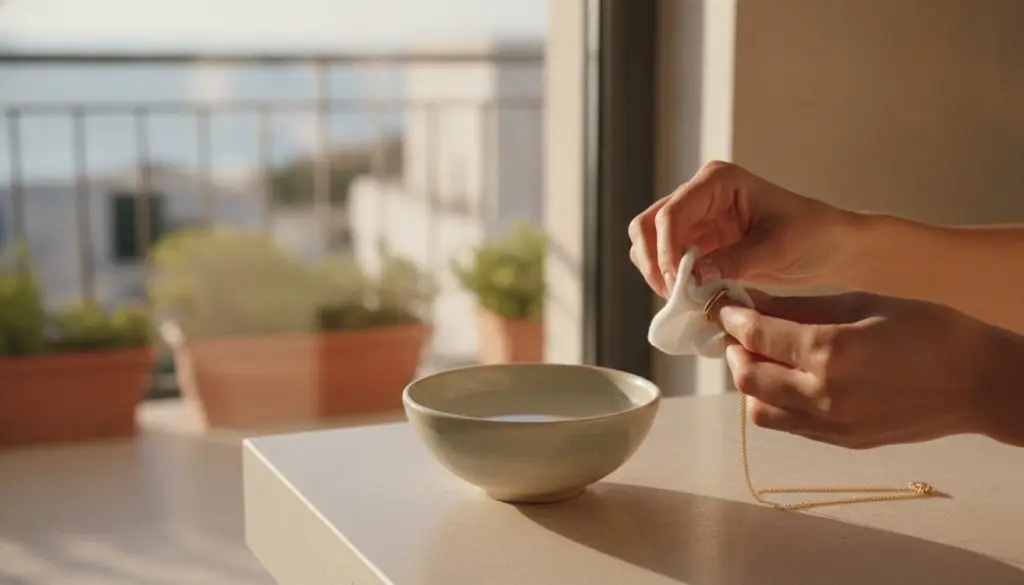
Clean any residual oil by soaking the chain in a bowl of warm water mixed with two drops of mild, phosphate-free dish soap. Use a soft-bristled toothbrush to gently scrub the links for 60 seconds. Rinse the piece under lukewarm running water and pat it dry with a lint-free cloth. This simple routine restores the radiant glow of your handcrafted pieces, ensuring they’re ready to celebrate your everyday moments with fresh minimalist elegance.
Related Posts

18k Gold Jewelry Care: Preserving Modern Heirlooms
-
Posted by
מילה קלר
Is your most cherished jewelry tucked away in a dark velvet box, waiting for a “special enough” occasion that never quite arrives? Many women…

The Ultimate Guide to Choosing a Minimalist 18k Gold Necklace in 2026
-
Posted by
Is your jewelry box a collection of “for now” pieces or a reflection of your forever story? Many women find themselves caught in a cycle of buying…
How to Care for 18K Gold Jewelry: A Complete Guide
-
Posted by
What if your most precious 18k gold ring wasn’t meant for the safety of a velvet box, but for the messy, beautiful reality of your daily life? It’s…

18k Gold Stud Earrings: The Ultimate Guide to Everyday Luxury and Purity
-
Posted by
What if the jewelry you wear closest to your skin isn’t just an accessory, but a silent guardian of your comfort and a daily celebration of your…

18k Gold Necklace: The Complete Guide to Choosing Your Timeless Piece (2026)
-
Posted by
Why do we often tuck our most cherished jewelry away for “special occasions” when today is the only part of your story you’re currently living? You…
Why Is My Skin Turning Green From My Ring? The Science & The Solution
-
Posted by
That persistent green mark on your finger isn’t a sign that you’ve been scammed with fake gold. It’s actually a simple, harmless chemical reaction…
How to Care for 18k Gold Jewelry: The Complete Guide to Modern Heirlooms
-
Posted by
Your 18k gold jewelry is a living archive of your most cherished moments, serving as a golden thread woven into the story of your life. It’s natural…

How to Travel Safely with Jewelry: The Ultimate Guide for Fine Pieces
-
Posted by
Last June, Elena arrived in Tuscany for her anniversary, only to discover her heirloom gold necklace had become a knotted mess because she hadn’t yet…
Why Is My Gold Ring Scratching? Understanding 18K Gold and the Patina of Life
-
Posted by
Just a few weeks after slipping on your new anniversary ring, you notice a delicate mark on its rich, yellow surface. It’s a moment of sudden,…
How to Polish Gold Jewelry: A Guide to Restoring Your Luster
-
Posted by
Your jewelry is an intimate expression of your identity, a silent companion through your daily life. When your favorite 18K gold pieces begin to look…
How to Store Fine Jewelry to Prevent Tarnishing: The Ultimate Preservation Guide
-
Posted by
Imagine reaching for your favorite 18k gold necklace for a special evening, only to find it’s lost its luster or become a frustrating, tangled web….
How to Keep 18k Gold Jewelry Shiny: The Artisan’s Guide to Lasting Glow
-
Posted by
What if the radiant glow of your favorite ring wasn’t meant to fade with time, but to deepen with the stories you live? It’s natural to feel a sense…